Has AI Made People Stop Visiting the Web? How Websites and Blogs Are Changing
Internet use is still growing, but AI summaries and search platforms are reducing outbound clicks. Here is what the latest data says about websites, blogs, and content that still earns a visit.
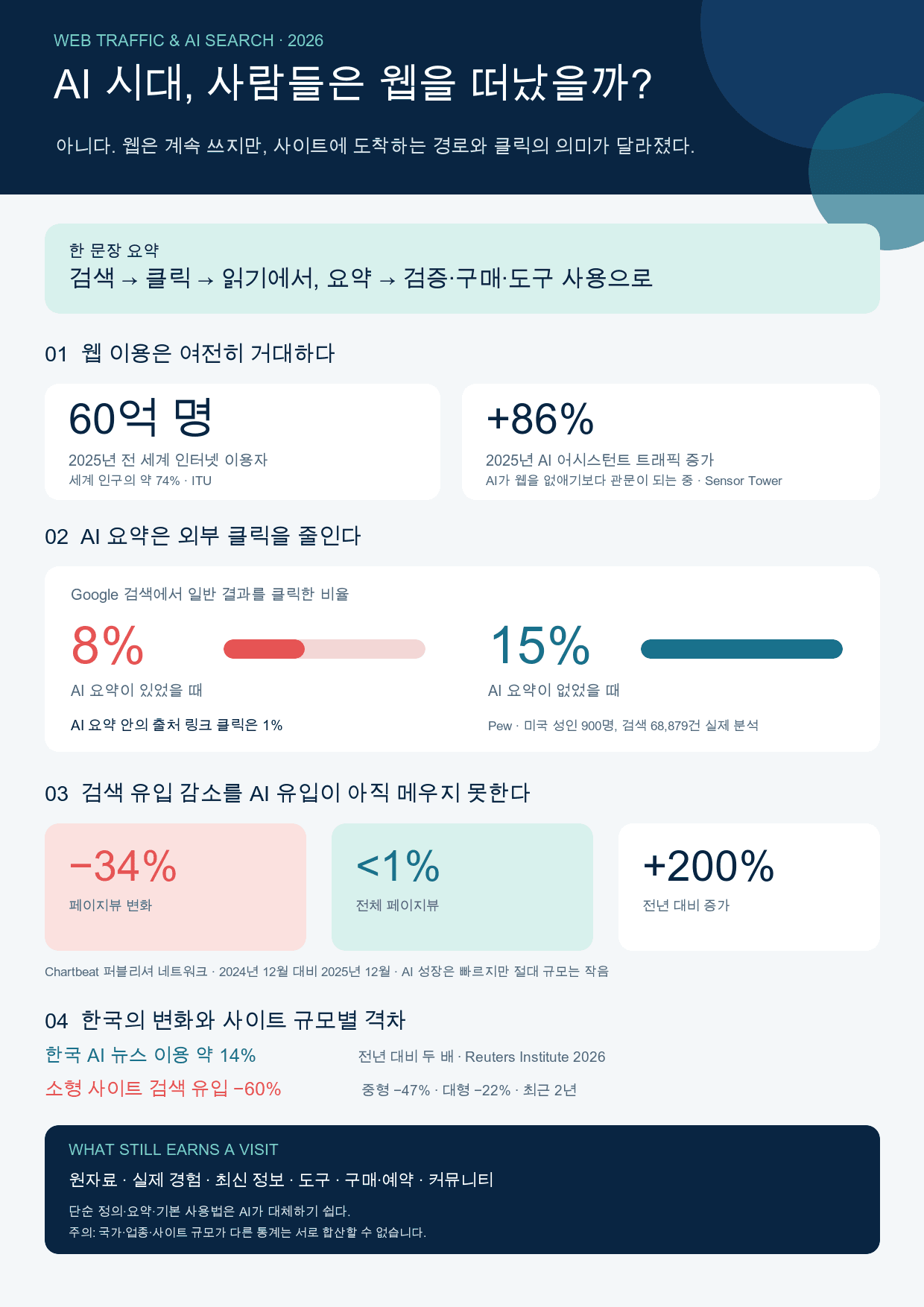
People have not left the web. The path to a website has changed.
It is easy to wonder whether people still read blogs and websites now that ChatGPT and AI search can answer questions immediately. Google, Naver, YouTube, and social platforms also show summaries and videos before sending people to an external page.
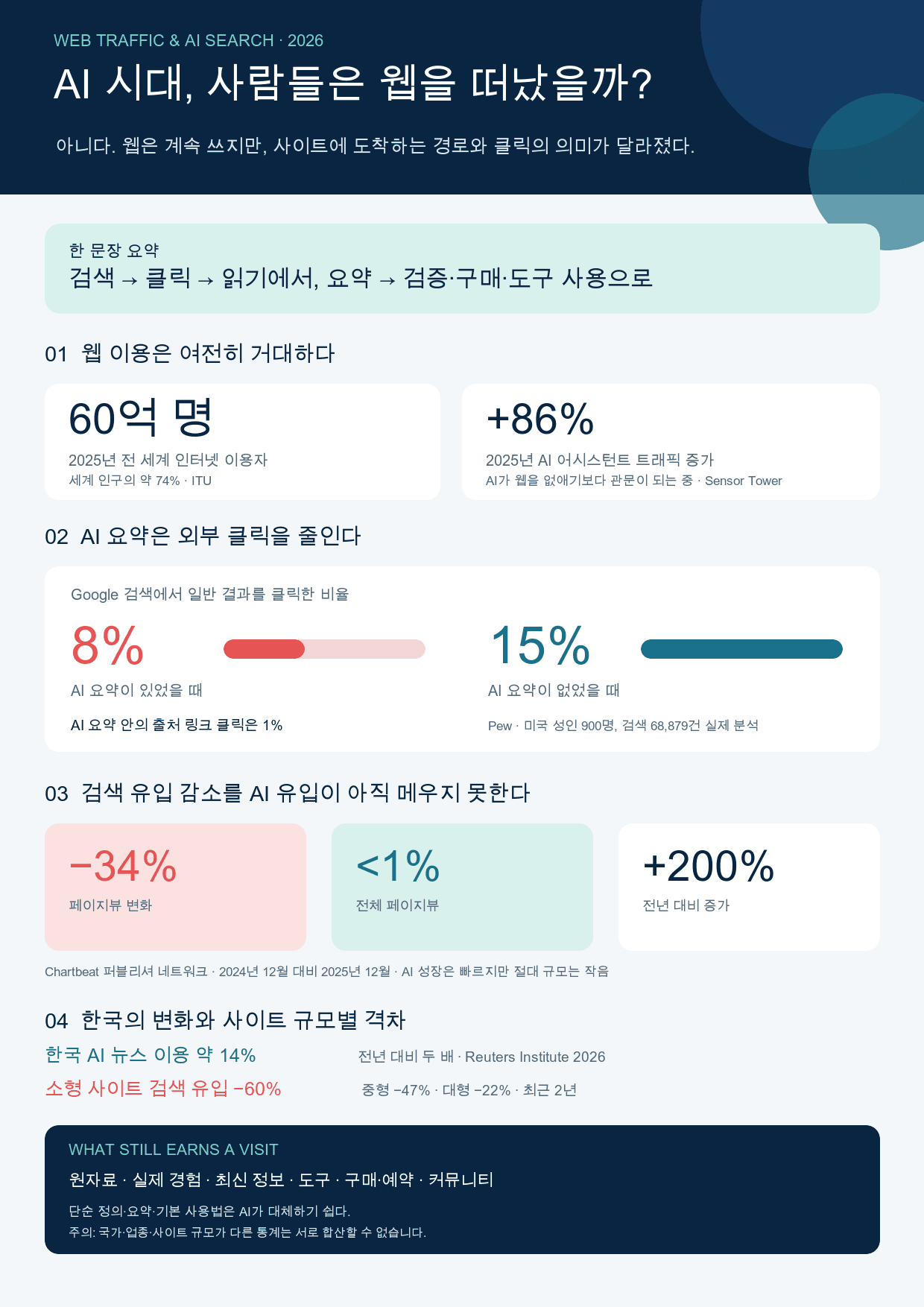
Yet internet use itself has not disappeared. In 2025, about 6 billion people were estimated to use the internet worldwide. The important change is the route to a website. Instead of clicking a search result first, people increasingly read a summary on an AI tool, portal, or social platform and visit the original source only when they need proof, a product, or a tool.
AI summaries reduce ordinary search clicks
Pew Research Center analyzed the real browsing records of 900 U.S. adults and 68,879 Google searches. When an AI summary appeared, users clicked a traditional search result in 8% of visits. When no AI summary appeared, the rate was 15%.
Links inside the AI summary were clicked in only 1% of visits. Being cited by an AI answer and receiving a visit are therefore different outcomes.
These figures describe U.S. Google searches observed in March 2025. They should not be treated as a universal rate for every country, search engine, or type of website.
AI referrals are growing, but they do not replace lost search traffic yet
Across the Chartbeat publisher network, pageviews from Google Search fell about 34% between December 2024 and December 2025. ChatGPT referrals grew by more than 200% year over year, but AI platforms still represented less than 1% of total pageviews.
This does not mean AI referrals are unimportant. They are growing quickly. It means their current volume is not yet large enough to replace the traffic lost from traditional search.
South Korea is moving quickly toward AI and video
According to the Reuters Institute Digital News Report 2026, about 14% of people in South Korea used AI chatbots for news, twice the previous year’s level. Portals such as Naver remain important gateways, but portal-based news use has been declining over time while YouTube, short-form video, and other online video formats have grown.
For Korean blogs and information sites, this means Google SEO alone is not enough. Portals, YouTube, social media, newsletters, and direct visits all matter.
Which content is most vulnerable?
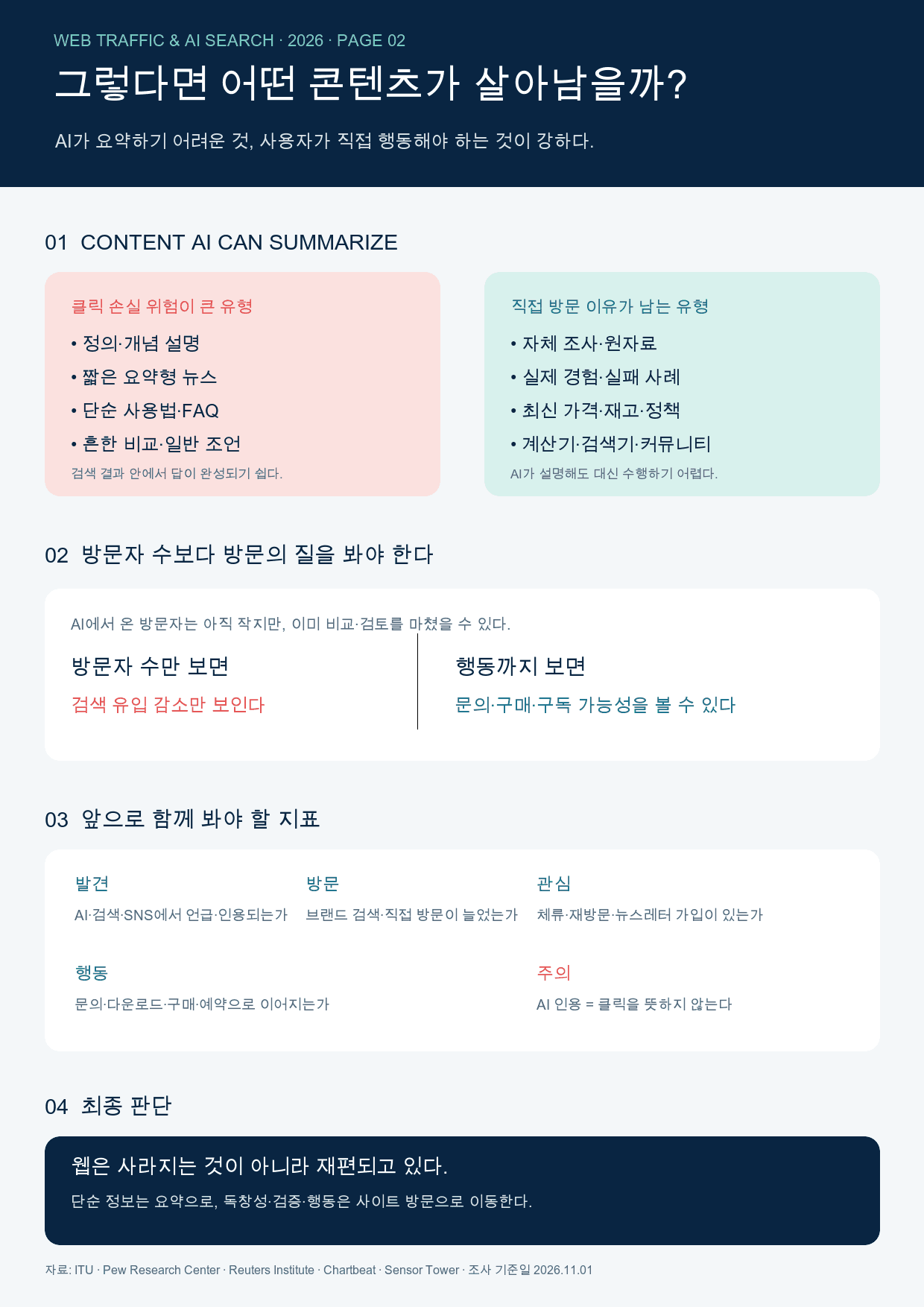
Content that AI can answer in one short paragraph faces the greatest click risk: definitions, short news summaries, basic how-to guides, common comparison tables, and generic advice.
Other content still gives people a reason to visit directly:
- Original research, datasets, and primary sources
- First-hand experience and failure cases
- Current prices, inventory, regulations, and policies
- Calculators, search tools, filters, and simulations
- Pages with a purchase, booking, download, or inquiry action
- Communities with comments and continuing discussion
AI can summarize these things, but it cannot always perform the user’s calculation, verify a current condition, or complete the final action. The role of a website is shifting from simply explaining something to helping people verify, compare, and act.
Smaller sites are more exposed
An analysis citing Chartbeat data found that traditional search referrals declined about 60% for small publishers, 47% for medium publishers, and 22% for large publishers over the past two years. Large publishers are better insulated by brand searches, apps, subscriptions, and newsletters.
Blog owners should therefore measure more than pageviews. They should also track whether they are mentioned by AI and search, whether branded searches grow, and whether visits lead to return visits, newsletter signups, downloads, inquiries, or purchases.
Conclusion
People are not abandoning the web. The web is being reorganized. We are moving from a web where people search, click, and read to a web where people discover information through AI and platforms, then visit an original source, brand, or tool when they have a reason to act.
The future of blogging is not simply ranking first for every query. It is creating original evidence, first-hand experience, trustworthy sources, and useful functions that AI can describe but cannot fully replace.
Sources
Get new posts by email ✉️
We'll notify you when new posts are published