2026 DRAM Complete Analysis — Laptop, Desktop, Server & HBM Price Surge Explained
LPDDR5X up 100%, DDR5 kits up 440%, server DRAM up 60–70% QoQ. A full breakdown of the 2026 memory crisis by segment — causes, current prices, and what's coming next.
In 2026, memory prices are surging to historic levels across PCs, servers, and smartphones alike. The root cause: semiconductor fabs are being rapidly converted to produce HBM (High Bandwidth Memory) for AI servers, squeezing supply of standard DRAM across the board.
As of 2026, different DRAM segments are moving in entirely different directions. Laptop LPDDR5X is surging on supply-side dynamics; desktop DDR5 kits have soared 400%+ on AI demand shock; server DRAM is posting 60–70% QoQ gains. Here's a full breakdown across five sections: Laptop / Desktop / Server·HBM / LPDDR4 EOL / Outlook.
📊 DRAM Price Trends — Past 12 Months
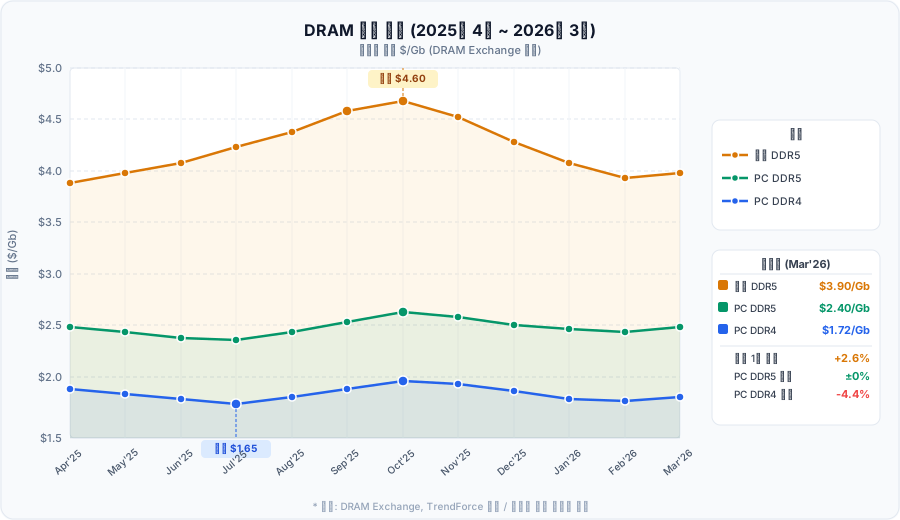
Contract price basis, $/Gb (sourced from DRAM Exchange & TrendForce; includes estimates)
📋 Current Prices by Product
| Product | Apr 2025 | 2025 Peak | Mar 2026 | 1-Year Change |
|---|---|---|---|---|
| Laptop LPDDR5X 16GB | ~$25 | ~$40 (Q4) | ~$50+ | +100%+ |
| Laptop LPDDR5X 32GB | ~$42 | ~$70+ (Q4) | ~$84+ | ~+100% |
| Desktop DDR5-6000 32GB kit | ~$80 | — | ~$432 | +440% |
| Desktop DDR4 (16Gb) | $1.80/Gb | $1.88 (Oct) | $1.72/Gb | -4.4% |
| Server DDR5 (32Gb) | $3.80/Gb | $4.60 (Oct) | $3.90/Gb+ | +2.6%~ |
Note: Contract prices ($/Gb) and retail module prices ($/module) use different measurement bases. The table mixes both — retail prices show larger swings than contract prices.
💻 Section 1 — Laptop DRAM (LPDDR5X): The Hottest Market
What Is LPDDR5X?
LPDDR (Low Power Double Data Rate) is the memory standard used in mobile devices like laptops and smartphones. Unlike standard DDR, LPDDR5X is often soldered directly to the motherboard — consumers can't upgrade it after purchase, and manufacturers lock in the spec at the factory.
Since 2025, the vast majority of AI PC laptops have adopted LPDDR5X, and memory capacity demand is rapidly shifting from 16GB to 32GB as on-device AI workloads require more headroom.
Price Surge in Detail
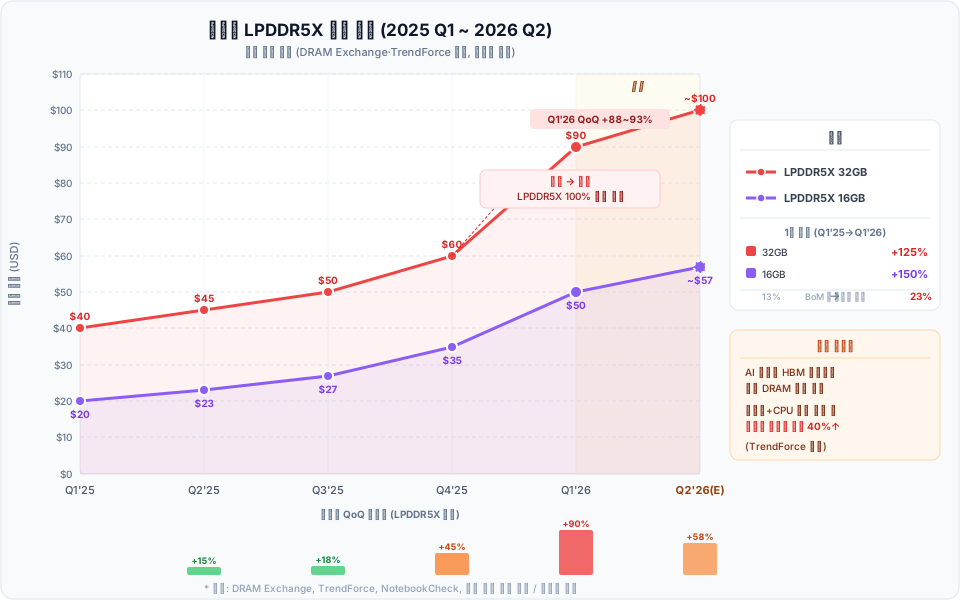
- LPDDR5X 16GB module: ~$25 in early 2025 → over $50 in Q1 2026 (100%+ increase)
- LPDDR5X 32GB module: Nearly doubled over the same period
- Q4 2025 vs Q1 2026: LPDDR5X contract prices up 88–93% QoQ (TrendForce)
Samsung × Apple — The 100–133% Hike Case
The most talked-about event of 2025 was Samsung raising its LPDDR5X supply price to Apple by approximately 100%. Samsung had initially considered a 60% hike, but as the supply shortage worsened, it put forward a 100% increase — and Apple accepted, prioritizing securing supply ahead of competitors.
The 12GB LPDDR5X module for iPhone 17 surged from $30 to $70 — a 133% jump — while high-capacity modules for MacBook Pro and MacBook Air effectively doubled in cost.
What drove this structural price hike:
- LPDDR5X manufacturing is more complex than DDR5, with lower yields
- Only Samsung, SK Hynix, and Micron can produce high-capacity (32GB/64GB) LPDDR5X modules
- Demand for 32GB+ AI PC configurations exploded faster than supply could respond
Memory's Growing Share of Laptop BoM
Memory's share of total laptop Bill of Materials has risen sharply with the AI PC transition:
| Laptop Type | Memory Config | Memory % of BoM |
|---|---|---|
| Standard Laptop (2024) | 8–16GB DDR4 | ~13% |
| Standard Laptop (2025) | 16GB LPDDR5X | ~17% |
| AI PC (2025–2026) | 32GB LPDDR5X | up to 23% |
TrendForce warns that if LPDDR5X and CPU prices rise simultaneously, flagship laptop retail prices could increase by as much as 40%.
Real-World Retail Price Increases
| Brand | Timing | Increase | Notes |
|---|---|---|---|
| Dell | Dec 2025 | 15–20% | $550 premium for 16GB→32GB LPDDR5X upgrade |
| Lenovo | Jan 2026 | 15–20% | Similar scale to Dell |
| Acer / ASUS | Q1 2026 | 10–15% | Sequential increase following Dell |
| LG Gram 16 (2026) | Jan 2026 | ~19% | ₩2.64M → ₩3.14M (+₩500K) |
| Samsung Galaxy Book | Q1 2026 | ~20% | Crossed ₩3M threshold |
| Apple MacBook Pro M4 | 2025–2026 | — | Additional $100–200 on high-capacity options |
The "₩3M laptop era" has become reality. TrendForce reports global laptop shipments fell a minimum of 10% YoY in Q1 2026, with a further 10–20% decline expected in Q2.
🖥️ Section 2 — Desktop DRAM (DDR4 & DDR5): Two Very Different Stories
DDR5 — Up 440% on AI Demand Shock
Desktop DDR5 shares production lines with AI server memory — and the AI demand wave has hit it hard.
- DDR5-6000 32GB kit: ~$80 in mid-2025 → ~$432 in early 2026 (440%+ surge)
- DDR5 32GB single module: $149 → $239 (Samsung, +60%)
- DDR5 contract unit price: ~$7 → ~$19.50 (+178%)
Team Group's GM warned that "the RAM price crisis is just beginning," with the real peak expected in mid-2026.
AMD Ryzen 9000 and Intel Core Ultra 200 both require DDR5. With RAM costs alone dramatically inflating total build costs, the DIY PC market is under real pressure. MSI has announced it will raise gaming PC prices by up to 30%.
DDR4 — Declining Under Chinese Supply Pressure
Desktop DDR4 contract prices moved $1.80 → $1.65 (July low) → $1.72 (March) — a mild but persistent downtrend.
① China's CXMT Flooding the Market CXMT (ChangXin Memory Technologies) has rapidly scaled DDR4 production, pushing lower-cost supply into the market. It's aggressively capturing share in the budget PC segment.
② Accelerating DDR5 Transition With Intel Arrow Lake and AMD Zen 5 shipping DDR5-only, DDR5 adoption in new PC builds is estimated to have crossed 55% by late 2025. DDR4 is increasingly a legacy segment.
🟡 Section 3 — Server DRAM & HBM: AI Demand Creates Two Markets
Server DDR5 — 21% Annual Rally, Then 60–70% QoQ Shock
Annual view (April 2025 – March 2026) Prices surged from $3.80 to $4.60 — a 21% jump — by October. A single NVIDIA GB200 NVL72 server rack carries hundreds of GB of standard memory, and hyperscaler AI investments from Microsoft, Google, Meta, and AWS drove outsized demand.
Q1 2026 quarterly shock Samsung and SK Hynix raised server DRAM contract prices 60–70% QoQ in Q1 2026. A further 58–63% increase is forecast for Q2 2026 (TrendForce). Both companies have abandoned long-term agreements (LTAs) in favor of quarterly contracts — a clear signal that suppliers now hold complete pricing power.
HBM — A Separate Market Where Suppliers Set the Price
| HBM Generation | Key Applications | Estimated Price |
|---|---|---|
| HBM2e | A100, legacy AI servers | ~$10/Gb |
| HBM3 | H100 | ~$18–22/Gb |
| HBM3e | H200, MI300X | ~$25–30/Gb |
| HBM4 (2025+) | B200 and next-gen | Undisclosed (under negotiation) |
Samsung and SK Hynix both raised HBM3E supply prices by ~20% in response to surging AI ASIC demand. HBM generates 3–5x the margin of standard DRAM, accelerating fab conversion — and that conversion is the root cause of the standard DRAM supply crunch.
SK Hynix dominates with over 50% HBM3e share. Samsung is catching up through yield improvements, and Micron has begun HBM3e supply. AI server build costs have risen approximately 25% overall.
Memory Maker Profits — Super-Cycle Mode
Samsung, SK Hynix, and Micron are all posting 40–50% operating margins, riding a full memory super-cycle. The supplier-dominated market is expected to continue for the foreseeable future.
📉 Section 4 — The Twilight of LPDDR4: Effectively the Final Chapter
Bottom Line: Still in Production, But Discontinuation Is a Matter of Time
Micron — In June 2025, Micron issued official end-of-life notices for mainstream DDR4 and LPDDR4 products. Final shipments were completed in early 2026.
Samsung & SK Hynix — Both had originally planned to discontinue DDR4 by end of 2025, but a global supply shortage caused prices to spike, prompting them to extend production. SK Hynix specifically increased DDR4 output at its Wuxi, China factory to meet rising orders.
ADATA's chairman put it plainly:
"All three global memory manufacturers have already shut down and dismantled their DDR4 lines. Expanding DDR4 production capacity is practically impossible."
This is the key insight: Samsung and SK Hynix are running existing equipment, not investing in new lines. They'll keep old fabs running as long as margins justify it. Meanwhile, as U.S. and Korean manufacturers reduce LPDDR4X supply, a supply panic is spreading through emerging markets that still rely on LPDDR4X for budget smartphones.
| Timeframe | Expected Situation |
|---|---|
| 2026 | Samsung & SK Hynix maintain existing lines; prices remain elevated |
| 2027 | Standard DDR4 / LPDDR4 modules become difficult to source |
| 2028+ | Survives only as niche product for industrial, telecom, and defense contracts |
🏭 Supplier Strategies
| Samsung | SK Hynix | Micron | |
|---|---|---|---|
| HBM | Ramping after NVIDIA cert, developing HBM4 | Dominant leader, HBM4 at the frontier | Late entrant, expanding HBM3e share |
| LPDDR5X | Supplies Apple & others, price leader | Chasing Samsung's position | Increasing LPDDR5X production |
| Server DDR5 | Strong share, shifted to quarterly contracts | Maximizing margins | Expanding share |
| PC DDR4 | Cutting commodity output, shifting to premium | Similar direction | EOL completed early 2026 |
📈 Section 5 — H2 2026 and Beyond: Outlook
Near Term (Q2–Q3 2026)
| Product | Direction | Key Variables |
|---|---|---|
| Laptop LPDDR5X | ↗ Further increases | Supply shortage persists, AI PC demand growing |
| Desktop DDR5 | ↗ Approaching peak | Price peak likely mid-2026 |
| Desktop DDR4 | ↘ Continued weakness | CXMT growth, accelerating DDR5 transition |
| Server DDR5 | ↗ Q2 up another 58–63% | AI datacenter spend |
| HBM3e / HBM4 | → Premium maintained | Supply shortage structure persists |
Medium Term (H2 2026 – 2027)
- If HBM4 mass production ramps, some fab capacity may return to standard DRAM
- However, if AI demand growth outpaces the return of capacity, price relief will be limited
- WCCFTech projects DDR5/DDR4 supply shortage could persist through Q4 2027
- TrendForce expects total BoM costs to rise an additional 5–7% in 2026 vs 2025
💡 What This Means for You
If you're buying a laptop:
- A 32GB LPDDR5X AI PC is likely to get more expensive in the near term. H1 2026 may be a relatively better buying window
- Watch for spec downgrades — some OEMs are keeping prices flat while quietly reducing memory (32GB → 16GB)
- Consider used/refurbished — DDR4-based used laptops and PCs offer strong relative value right now
If you're building a desktop PC:
- Many analysts expect DDR5 prices to peak around mid-2026. If you can wait, H2 2026 may offer better value
- DDR4-based systems are actually getting cheaper — a silver lining for legacy platform users
For investors: What matters most is not just "DRAM prices rising" — it's LPDDR5X and HBM product mix. Both Samsung and SK Hynix are posting 40–50% operating margins. As long as the AI investment cycle remains intact, this super-cycle shows no signs of ending. Track each company's HBM percentage and AI datacenter capex trajectory, not the headline DRAM index.
This memory price surge is not a simple supply-demand imbalance — it's part of a structural transformation as AI rewrites the entire semiconductor ecosystem. Consumers will have to absorb elevated prices for the foreseeable future. The key inflection points to watch: memory maker capacity expansion decisions and the timeline for HBM4 mass production ramp.
Price data in this post references DRAM Exchange, TrendForce, WCCFTech, and publicly available industry sources. Some figures are estimates. Actual contract prices vary by customer, volume, and timing.
Get new posts by email ✉️
We'll notify you when new posts are published