DRAM Price Trends 2025–2026: Laptop, Desktop & Server Full Analysis
A complete breakdown of DDR4, DDR5, LPDDR5X, Server DRAM, and HBM price trends from April 2025 to March 2026. Covers Samsung's 100% LPDDR5X hike to Apple, notebook BoM changes, and AI server demand.
In the semiconductor industry, DRAM is far more than just a component. It's a critical memory type found in virtually every digital device — smartphones, laptops, desktop PCs, datacenter servers, and AI accelerators alike. And DRAM pricing directly determines the earnings of South Korean giants like Samsung Electronics and SK Hynix.
Over the past year (April 2025 – March 2026), the DRAM market moved in completely different directions depending on the product category. Laptop LPDDR5X surged on supply-side dynamics, desktop DDR4 declined under Chinese pressure, and server DRAM rode the AI demand wave to new highs. Here's a full breakdown by segment.
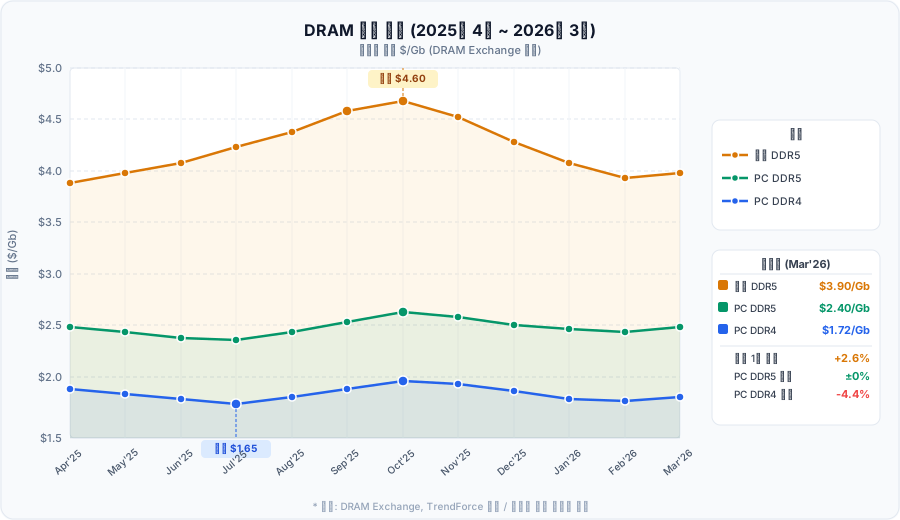
📊 DRAM Price Trends — Past 12 Months
Contract price basis, $/Gb (sourced from DRAM Exchange & TrendForce; includes estimates)
📋 Current Prices by Product (March 2026)
| Product | Apr 2025 | 2025 Peak | Mar 2026 | 1-Year Change |
|---|---|---|---|---|
| Laptop LPDDR5X 16GB | ~$22 | ~$28 (Oct) | ~$26 | +18% |
| Laptop LPDDR5X 32GB | ~$42 | ~$55 (Oct) | ~$50 | +19% |
| Desktop DDR4 (16Gb) | $1.80/Gb | $1.88 (Oct) | $1.72/Gb | -4.4% |
| Desktop DDR5 (16Gb) | $2.40/Gb | $2.55 (Oct) | $2.40/Gb | ±0% |
| Server DDR5 (32Gb) | $3.80/Gb | $4.60 (Oct) | $3.90/Gb | +2.6% |
💻 Section 1 — Laptop DRAM (LPDDR5X): The Hottest Market
What Is LPDDR5X?
LPDDR (Low Power Double Data Rate) is the memory standard used in mobile devices like laptops and smartphones. Unlike standard DDR, LPDDR5X is often soldered directly to the motherboard, meaning consumers can't upgrade it after purchase — manufacturers lock in the spec at the factory.
Since 2025, the vast majority of AI PC laptops have adopted LPDDR5X, and memory capacity demand is rapidly shifting from 16GB to 32GB as on-device AI workloads require more headroom.
The Price Surge: Samsung's 100% Hike to Apple
The most talked-about event of the year was Samsung raising its LPDDR5X supply price to Apple by approximately 100%. The high-capacity LPDDR5X modules in MacBook Pro and MacBook Air effectively doubled in cost, and this fed directly into higher consumer prices for the latest MacBook configurations.
What drove the hike:
- LPDDR5X manufacturing is more complex than DDR5, with lower yields
- Only Samsung, SK Hynix, and Micron can produce high-capacity (32GB/64GB) LPDDR5X modules
- Demand for 32GB+ AI PC configurations exploded faster than supply could respond
Memory's Growing Share of Laptop BoM
BoM (Bill of Materials) memory share has risen sharply with the AI PC transition:
| Laptop Type | Memory Config | Memory % of BoM |
|---|---|---|
| Standard Laptop (2022) | 8–16GB DDR4 | ~13% |
| Standard Laptop (2025) | 16GB LPDDR5X | ~17% |
| AI PC (2025–2026) | 32GB LPDDR5X | up to 23% |
Memory now accounts for nearly a quarter of total component cost — a stark shift from the era when the CPU was overwhelmingly the dominant cost item.
Real-World Retail Price Increases
LPDDR5X cost increases are already flowing through to consumers:
| Brand | Model | Price Increase |
|---|---|---|
| LG Electronics | Gram 17 (2026) | ~$60–75 increase vs. prior-year equivalent |
| Dell | XPS 13 Plus (2026) | $100–150 increase on 32GB config |
| Lenovo | ThinkPad X1 Carbon (2026) | ~5–8% increase on 32GB option |
| Apple | MacBook Pro M4 | Additional $100–200 on high-capacity options |
TrendForce Warning: Up to 40% Price Increase
TrendForce's 2026 outlook warned that if LPDDR5X and CPU prices (Intel Arrow Lake, AMD Strix) rise simultaneously, flagship laptop retail prices could increase by as much as 40%.
For 32GB+ configurations in particular, memory is projected to account for over 60% of the total price increase. For consumers, the "AI PC premium" is not a marketing invention — it's a direct reflection of component cost inflation.
🖥️ Section 2 — Desktop PC DRAM (DDR4 & DDR5): Diverging Paths
DDR4 — Declining Under Chinese Supply Pressure
Desktop DDR4 contract prices moved $1.80 → $1.65 (July low) → $1.72 (March) over the past year — a mild but persistent downtrend.
① China's CXMT Flooding the Market CXMT (ChangXin Memory Technologies), a Chinese state-backed firm, has rapidly scaled DDR4 production, pushing lower-cost supply into the market. Yield rates don't yet match Samsung or SK Hynix, but CXMT is aggressively capturing share in the budget PC segment.
② Sluggish PC Replacement Demand Global PC shipments recovered more slowly than expected, leaving demand without a strong floor.
DDR5 — Growing Market Share, Price Flat
PC DDR5 peaked at $2.55 in October 2025 before retracing to $2.40 by March 2026, finishing the year virtually unchanged.
With platforms like Intel Arrow Lake and AMD Zen 5 shipping DDR5-only, DDR5 adoption in new PC builds is estimated to have crossed 55% by late 2025. The generational shift is well underway, but supply has kept pace with demand, limiting upside.
🟡 Section 3 — Server DRAM & HBM: AI Demand Creates Two Markets
Server DDR5 — 21% Rally in H1, Correction in H2
Server DRAM (DDR5 RDIMM basis) was the most dramatic mover of the three standard categories.
H1 2025 (April – October): Strong Rally Prices surged from $3.80 to $4.60 — a 21% jump by October. A single NVIDIA GB200 NVL72 server rack carries hundreds of GB of standard memory, and hyperscaler AI infrastructure investments from Microsoft, Google, Meta, and AWS drove outsized demand.
H2 2025 (November 2025 – March 2026): Correction Prices pulled back approximately 15% from the peak, settling near $3.90 by March. Cloud providers temporarily entered an inventory digestion phase, dampening near-term demand. That said, the $3.80–4.00 range appears to be acting as a structural price floor.
HBM — A Separate Market Where Suppliers Set the Price
HBM (High Bandwidth Memory) operates as an entirely separate market from standard DRAM with different contract structures.
| HBM Generation | Key Applications | Estimated Price |
|---|---|---|
| HBM2e | A100, legacy AI servers | ~$10/Gb |
| HBM3 | H100 | ~$18–22/Gb |
| HBM3e | H200, MI300X | ~$25–30/Gb |
| HBM4 (2025+) | B200 and next-gen | Undisclosed (under negotiation) |
SK Hynix dominates the HBM market with over 50% share in HBM3e. Samsung is catching up through yield improvements, and Micron has begun HBM3e supply. Demand substantially exceeds supply, so suppliers effectively dictate pricing.
🏭 Supplier Strategies
| Samsung | SK Hynix | Micron | |
|---|---|---|---|
| HBM | Ramping after NVIDIA certification | Dominant leader, developing HBM4 | Late entrant, expanding share |
| LPDDR5X | Supplies Apple and others, price leader | Chasing Samsung's position | Increasing LPDDR5X production |
| Server DDR5 | Strong market share | Maintaining high-margin position | Expanding share |
| PC DDR4 | Cutting commodity output, shifting to premium | Similar direction | Similar direction |
📉 Section 4 — The Twilight of LPDDR4: Effectively the Final Chapter
Bottom Line: Still in Production, But Discontinuation Is a Matter of Time
As of April 2026, LPDDR4 is still being produced. But across the industry, the consensus is clear: this is the end stage.
Status by Manufacturer
Micron — In June 2025, Micron officially issued end-of-life notices for mainstream DDR4 and LPDDR4 products covering consumer PCs, datacenter, and mobile. Final shipments were completed in early 2026.
Samsung & SK Hynix — Both had originally planned to discontinue DDR4 by end of 2025, but a global supply shortage caused prices to spike, prompting them to reverse course and extend production into 2026. SK Hynix specifically increased DDR4 output at its Wuxi, China factory in response to rising customer orders and improved pricing.
"Capacity Expansion Is Practically Impossible"
The chairman of Taiwanese module maker ADATA put it plainly:
"All three global memory manufacturers have already shut down and dismantled their DDR4 lines. Expanding DDR4 production capacity is practically impossible."
This is the key insight. When Samsung and SK Hynix say they're "extending production," they mean running existing equipment — not investing in new lines. They'll keep the old fabs running as long as the margins justify it.
Supply Panic in Emerging Markets
As U.S. and Korean manufacturers reduce or halt LPDDR4X supply, a supply shortage panic is spreading through emerging markets that still rely on LPDDR4X for budget and mid-range smartphones.
LPDDR4 Timeline Outlook
| Timeframe | Expected Situation |
|---|---|
| 2026 | Samsung & SK Hynix maintain existing lines; prices elevated |
| 2027 | Standard DDR4 / LPDDR4 modules become difficult to source |
| 2028+ | Survives only as niche product for industrial, telecom, and defense long-term contracts |
In short: Samsung and SK Hynix are only keeping DDR4 running as long as margins are positive. There is no new capacity investment. Full discontinuation of LPDDR4 is a matter of when, not if.
📈 Section 5 — H2 2026 Price Outlook
| Product | Direction | Key Variables |
|---|---|---|
| Laptop LPDDR5X | ↗ Sustained high or further increases | Growing AI PC demand, supply constraints persist |
| Desktop DDR4 | ↘ Continued weakness | CXMT volume growth, accelerating DDR5 transition |
| Desktop DDR5 | ↗ Gradual uptick | AI PC recovery, Intel Panther Lake launch |
| Server DDR5 | ↗ Sustained strength | Ongoing AI datacenter investment |
| HBM3e / HBM4 | → Premium pricing maintained | Supply shortage structure persists |
💡 What Does This Mean for You?
If you're buying a laptop, a 32GB LPDDR5X AI PC is likely to get more expensive in the near term. If you're considering a purchase, H1 2026 may be a relatively better window. Desktop DDR4-based systems, on the other hand, are actually getting cheaper.
For investors, what matters most now is not just "DRAM prices rising" — it's LPDDR5X and HBM product mix. As the AI PC transition accelerates, LPDDR5X demand grows structurally, and those who secured early supply dominance are positioned to benefit most.
Price data in this post references DRAM Exchange, TrendForce, and publicly available industry sources. Some figures are estimates. Actual contract prices vary by customer, volume, and timing.
Get new posts by email ✉️
We'll notify you when new posts are published