50 Years of South Korea's Gasoline Prices: Is ₩2,000 per Liter Really That Expensive?
A look at how South Korea's consumer gasoline prices have changed from 1975 to 2026. We analyze three major price surges and where current prices stand in historical context.
Every time I stop at a gas station lately and see prices creeping past ₩2,000 per liter, I let out a sigh. "Was it always like this?" I thought, so I went and dug up 50 years of data.
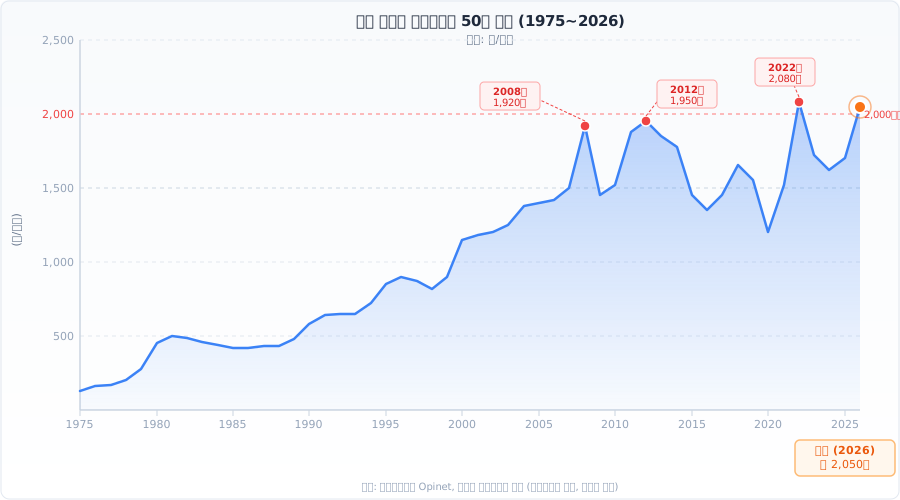
50-Year Trend in South Korean Gasoline Prices
One thing becomes clear from the chart: Crossing the ₩2,000 mark is not happening for the first time.
Three Major Price Surges
1st Surge: 1979–1980 Oil Shock (₩300s → ₩450s)
Gasoline prices that had stayed in the ₩100–200 range through the mid-1970s more than tripled in an instant due to the Iranian Revolution (1979) and the Iraq-Iran War (1980). It was a shocking price spike by the standards of the time, and the government launched sweeping oil stockpile programs and energy conservation campaigns.
Note: ₩450 in the early 1980s is equivalent to roughly ₩2,500–3,000 in today's prices. In real terms, this was the highest gasoline price in Korean history.
2nd Surge: 2007–2008 Global Oil Price Spike (₩1,500 → ₩1,920)
When Dubai crude hit $147 per barrel in July 2008, domestic gasoline prices in Korea crossed ₩1,920 per liter. After the U.S. financial crisis erupted in September 2008, oil prices plummeted, and pump prices came down quickly as well.
3rd Surge: 2011–2012 Middle East Instability (₩1,500 → ₩1,950)
As the Arab Spring destabilized the Middle East and the Libyan civil war broke out, oil prices surged again. By 2012, prices had climbed to ₩1,950 per liter, setting what was then a record high.
4th Surge: 2022 Russia-Ukraine War (₩1,500 → ₩2,080)
Russia's invasion of Ukraine in February 2022 triggered a spike in global oil prices, and for the first time, the ₩2,000 threshold was breached. Prices hit a then-record ₩2,080 per liter, and the government slashed fuel taxes in an attempt to contain the rise.
Where Do 2026 Prices Stand Historically?
| Year | Peak Price | Main Cause |
|---|---|---|
| 1980 | ~₩450 | Second Oil Shock |
| 2008 | ~₩1,920 | Global crude at $147/barrel |
| 2012 | ~₩1,950 | Middle East tensions, Arab Spring |
| 2022 | ~₩2,080 | Russia-Ukraine War |
| 2026 (Now) | ~₩2,050 | Middle East conflict, strong dollar |
In nominal terms, today's gasoline prices are near a historically high range, approaching 2022 levels. Compared to 6–7 years ago in 2018–2019 (₩1,550–1,650), prices are roughly 25–30% higher.
Why Has It Gotten This Expensive?
① International Oil Prices: Continued instability in the Middle East has elevated uncertainty around crude oil supply.
② Exchange Rate: The USD/KRW rate has remained elevated, increasing the cost of imported crude oil. Since South Korea imports 100% of its crude oil, exchange rates have a major impact.
③ Fuel Taxes: Fuel taxes that were temporarily cut in 2022 have been gradually restored, increasing the tax burden.
④ Distribution Margins: Refinery and gas station margins have also edged up slightly with overall inflation.
What About Inflation-Adjusted Prices?
Looking only at nominal prices makes the situation seem like "an all-time high," but the picture changes when you look at real prices adjusted for the Consumer Price Index (CPI).
₩450 in 1980 translates to roughly ₩2,800–3,200 in today's money. In real terms, the First Oil Shock era was far more expensive than today.
The peak prices of 2008–2012 are also similar to or slightly higher than today in real terms.
Conclusion: While nominal prices are record-high, when adjusted for inflation, 2026's fuel cost burden is not the worst in history. That said, the perceived burden relative to income levels can vary significantly.
What's Ahead for Prices?
| Scenario | Expected Price Range |
|---|---|
| Middle East tensions ease, oil prices fall | ₩1,600–1,800 |
| Status quo continues | ₩1,900–2,100 |
| Supply shock worsens | ₩2,200+ |
International oil prices and the exchange rate are the biggest variables. In particular, if the USD/KRW rate stabilizes, domestic prices could come down to some degree.
Closing Thoughts
Looking at 50 years of data, South Korean gasoline prices have repeatedly spiked sharply with each oil shock or geopolitical crisis, then stabilized again after a period of time. Today's ₩2,000+ prices feel unfamiliar and burdensome, but history seems to say "this too shall pass."
That said, history doesn't soothe the pain of a thin wallet — so it might be worth seriously considering public transport or carpooling.
The price data in this post references Korea National Oil Corporation's Opinet, Statistics Korea's energy statistics, and other sources. Some figures for certain years are estimates.
Get new posts by email ✉️
We'll notify you when new posts are published