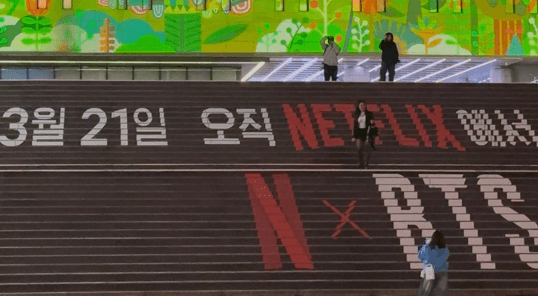
Why Netflix Is Broadcasting BTS from Gwanghwamun to the Entire World
What's happening on March 21st at Gwanghwamun in Seoul. The real story behind the BTS concert that Netflix is broadcasting live to the world.
This might sound like just another story, but the evening of March 21st at 8 PM is going to be something unusual. BTS will be performing at Gwanghwamun in Seoul, and 200 million people worldwide will be watching simultaneously via Netflix.
When you think about it, it's a wild proposition. This wasn't just a concert — it was something entirely different.
Why Did Netflix Do This?
At first glance, it seems simple. A famous band, a famous platform, a perfect match. But when Netflix makes this kind of decision, there's always a deeper calculation at play.
When they released the BLACKPINK documentary last year, new subscribers reportedly surged by 2.3 million that week. In advertising terms, that's around $30 million worth. For something that wasn't even an ad but just content, those numbers are staggering.
For Netflix executives, this was pure math. BTS is a group that gets searched over 50 million times monthly worldwide, and they record Beyonce-level monthly listeners on Spotify. Their fandom alone numbers around 200 million. Looking at these numbers, the thought "what if we brought all these people to our platform?" was inevitable.
To put it more bluntly, Netflix is in a crisis right now. Disney+ has the invincible IP of Marvel and Star Wars, Amazon has started acquiring film studios, and Apple is throwing money around like there's no tomorrow. YouTube is free. In the midst of all this, what can Netflix do?
The answer was "live." Since sports were already dominated by Amazon and ESPN, Netflix decided to create "the moment" in a different domain — music. Something irreplicable, magic that exists only at that exact time on that exact day.
Why Gwanghwamun?
Here's where it gets interesting.
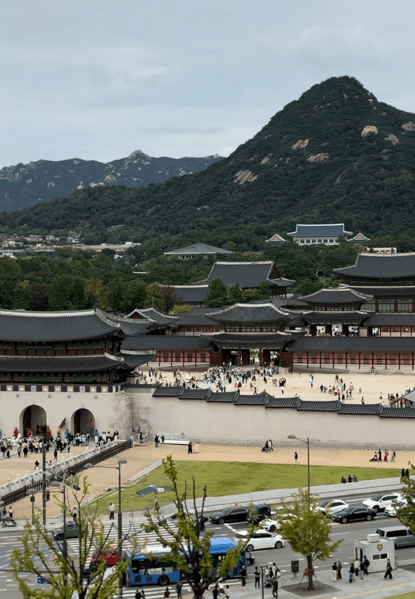
The choice of Gwanghwamun as the venue. There's the Incheon Music Festival, there's the Seoul Olympic Stadium — so why Gwanghwamun? At first, it seemed like it was simply about scale or symbolism. But on reflection, it's something else entirely.
Gwanghwamun is not just a plaza. It's the starting point of 600 years of the Joseon Dynasty, a sacred ground of the democratization movement. It's where candles flickered, and it's the place where Korea's national identity is most concentrated.
Broadcasting BTS from that location to the entire world carries a different message. It reads like a declaration: "Music made in Korea is now a national asset." Like Samsung or Hyundai as export products, K-pop now belongs in that tier.
The government knows this too. The Ministry of Culture, Sports, and Tourism has officially included BTS in its "soft power policy." It means they intend to use them as a diplomatic card — a tool for gradually shifting the Western-dominated cultural landscape.
Seen through that lens, Gwanghwamun doesn't feel random at all. You can sense the intention embedded in the choice of location.
BTS Is Not Just an Idol Group
To be more specific, BTS is different from other groups.
BLACKPINK and NewJeans are wonderful too, but BTS was always a bit unusual. They write their own songs. Over 90% of their albums are self-composed. Most idol groups manage 20 to 30 percent at best. And every album has a theme — suicide prevention, youth mental health, social inequality.
Their fans were unusual too. They were less like fans and more like activists. Called ARMY, they moved on social media not as fans but as advocates — fighting discrimination, spreading messages, donating.
Some music critics have written that BTS has the potential to become a generation-defining artist on the level of the Beatles or Michael Jackson. It may sound like an overstatement now, but in 10 years, it might not.
Either way, from Netflix's perspective, they didn't just pick musicians — they chose a group with something far bigger than music. That's the important part.
Why Live Broadcasting Matters
The idea that Netflix's play right now is live content felt fresh.
Sports broadcasting is already eaten up by ESPN and Amazon. YouTube has live-streamed plenty of music festivals too. But capturing "that moment" is different. An irreplicable experience that exists only at that exact time on that exact day.
Through this, Netflix is trying to prove: "We can do what theaters do." Going further, it's signaling that they could handle live broadcasts of mega-events like the Olympics or the World Cup.
In fact, a Netflix executive reportedly said this performance serves as a test case for their live broadcasting technology. If it succeeds, it means they can aim for even bigger events.
Why the Evening of March 21st at 8 PM Is Special
When you think about it, this experience will be remembered for several reasons.
First, there's the sense that this will become history. If people talk about the "March 21, 2026 Gwanghwamun concert" a hundred years from now, it will have become legend — the peak moment of Korean popular culture.
And beyond just watching a concert, there's the feeling of the entire world watching the same thing at the same time from their TVs. That kind of experience is rare these days. Social media scatters our attention. But that night, 200 million people will be looking at one screen.
If Gwanghwamun's energy can be delivered straight to your living room in 4K, HDR, and Dolby Atmos? That becomes proof that TV can fully replace the theater.
More honestly, you'll need to have an answer ready when someone at work or school asks "Did you watch it?" the next day. If you're the only one who missed what 200 million people saw, that's going to feel a bit awkward.
In Closing
This event is a concert, but it's also a declaration.
For Netflix, it declares: "We're entering the live era." For BTS, it proves: "We've transcended being idols." For Korea, it's an acknowledgment: "Our culture is a national asset."
And for you? It will simply be the experience of witnessing history.
The evening of March 21st at 8 PM. It might be a good idea to keep that time open.
Why Gwanghwamun? — Geopolitical Symbolism
Here's where the interesting part comes in. Why specifically Gwanghwamun?
Not an indoor arena in Suwon, Gyeonggi-do, but Seoul's most historic plaza?
Answer: This is a declaration of cultural supremacy.
Gwanghwamun is:
- The starting point of 600 years of Joseon Dynasty history
- A sacred site of the democratization movement (epicenter of candlelight rallies)
- The center of Korean culture and symbol of national identity
The significance of Netflix and BTS choosing this location:
"Music and culture made in Korea are now national assets. These are points of pride on the same level as Samsung semiconductors or Hyundai automobiles as exports."
In fact, the Korean government has officially included BTS's global influence in its 'soft power policy.' The Ministry of Foreign Affairs and the Ministry of Culture, Sports, and Tourism jointly support BTS as a top priority in their "K-culture development strategy."
Why BTS Is Special: Not Just an Idol Group, but a Phenomenon
There's one more thing you should know.
BTS is completely different from other K-pop groups.
Of course, BLACKPINK and NewJeans are excellent too. But:
- Self-composed ratio of over 90% (most idol groups manage 20-30%)
- Philosophical album concepts (Big Hit Entertainment's 'BTS Universe' setting unfolds like a real narrative)
- Social messages (every album addresses suicide prevention, youth mental health, social inequality)
- Fundamental fandom activism (ARMY isn't just a fan club — it's a 'movement' that spreads BTS's message to the world)
Put simply, BTS is not in a 'singer' state but a 'movement' state.
An American music critic analyzed that BTS has the potential to become a generation-defining artist like the Beatles or Michael Jackson.
Netflix's Long-Term Strategy: Surviving the Content Wars
To understand the real significance of this live broadcast, you need to look at Netflix's crisis:
Netflix's 2026 Problem:
| Competitor | Strength |
|---|---|
| Disney+ | Marvel, Star Wars, Pixar (IP exclusivity) |
| Amazon Prime | Film studio subsidiaries (securing original content) |
| Apple TV+ | Apple's unlimited capital (aggressive investment) |
| YouTube | Free + ad model (price competitiveness) |
Netflix "needed something different."
That something was "real-time live events."
Sports were already dominated by Amazon and ESPN. YouTube had already live-streamed multiple music festivals.
But "BTS's Gwanghwamun concert" offers:
- Uniqueness (irreplicable magic of 'that day, that moment')
- Global reach (200 million people worldwide watching at the same time = cultural synchronization)
- Historic significance (potential to appear in history books decades later)
Netflix CEO's announcement: "This performance is a test case proving our platform's live broadcasting technology. If successful, it signals that we could handle live broadcasts of the Olympics and the World Cup going forward."
Why You Should Watch on the Evening of March 21st at 8 PM
- A historic moment — If people talk about the "March 21, 2026 Gwanghwamun concert" 100 years from now, it will be legend
- The pinnacle of K-pop — There is no bigger stage than this. This might be the last of its kind
- A triumph of technology — If 4K live broadcast can convey Gwanghwamun's energy, it marks the beginning of the era when TV replaces theaters
- Cultural conviction — The experience of feeling that "music made in Korea moves the entire planet"
- FOMO (an experience you can't miss) — To avoid the embarrassment of having no answer when friends ask "Did you watch it?" the next day
Conclusion: This Is Not a Concert — It's a Declaration
What will happen at Gwanghwamun in Seoul is:
- Korea: "Our culture is now national power"
- Netflix: "We're bringing the theater into homes"
- BTS: "Our message transcends language"
- K-pop fandom: "We are not just fans — we are agents of a cultural movement"
...all declared simultaneously in one moment.
March 21st, 8 PM. Turn on Netflix.
And witness the moment that becomes history.
Netflix will provide multi-angle live broadcasts from special cameras, with 4K/HDR/Dolby Atmos support. Official BTS fan club members can pre-purchase designated plaza seating tickets.
Get new posts by email ✉️
We'll notify you when new posts are published