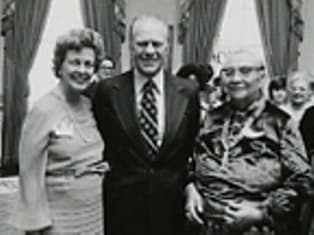
"Let No More of My People's Children Die" — Annie Dodge Wauneka, Mother of the Navajo Nation
In 1963, a Navajo woman became the first Native American to receive the Presidential Medal of Freedom. This is the story of Annie Dodge Wauneka, who spent a lifetime driving dusty roads and knocking on doors to save her people from tuberculosis.
"Let No More of My People's Children Die" — Annie Dodge Wauneka, Mother of the Navajo Nation
A Childhood Shaped by Death
Annie Dodge was born on April 11, 1910, on the Navajo Reservation in Arizona. Her father, Henry Chee Dodge, was one of the last great traditional leaders of the Navajo people — the first elected chairman of the Navajo Tribal Council. Her mother, Kʼeehanabah, was a traditional Navajo woman who lived according to the old ways.
When Annie was just eight years old, the 1918 Spanish Flu pandemic swept across the world — and it devastated the Navajo Reservation with particular cruelty. There were virtually no hospitals, no doctors, and no clean running water across the vast reservation that stretched across Arizona, New Mexico, and Utah. Attending a government boarding school at the time, young Annie watched helplessly as her classmates fell ill one by one. Some never got up again.
She later recalled that experience as the moment that defined her life's purpose: "I saw children dying. And I knew then that someone had to stop it."
The White Plague
By the 1940s and 1950s, a different killer was ravaging the Navajo people: tuberculosis. The TB rate on the Navajo Reservation was ten times the national average. Malnutrition, overcrowded housing, lack of sanitation, and an almost complete absence of medical infrastructure created a perfect storm of suffering. Hundreds of Navajo children died every year from the disease.
But the medical crisis was compounded by a cultural one. In traditional Navajo belief, illness was often attributed to spiritual causes — a disruption of harmony, contact with the dead, or the influence of malevolent forces. Many Navajo families feared Western medicine. They refused to send sick family members to distant government hospitals where they would be separated from their loved ones, surrounded by strangers who didn't speak their language, and subjected to treatments they didn't understand.
Elected to Serve
In 1951, Annie Dodge Wauneka — she had married George Wauneka in 1929 — was elected to the Navajo Tribal Council. She was one of the very few women to serve in that body, and she immediately volunteered to chair the Health Committee, a position no one else wanted.
Annie understood something that most government health officials did not: to save her people, she would have to build a bridge between two worlds.
The Bridge Builder
Annie's approach was revolutionary in its simplicity and its respect for Navajo culture. Rather than dismissing traditional medicine men as obstacles, she went to them first.
She invited Navajo healers to look through microscopes at tuberculosis bacteria. She showed them the tiny organisms that were killing their people. Then she said something extraordinary:
"Your prayers are needed. But to kill this small enemy, we must also use the white man's medicine."
She worked with medicine men to create a Navajo-language vocabulary for medical concepts — developing terms that made sense within the Navajo worldview. She didn't ask her people to abandon their traditions. She asked them to add new tools to their healing practices.
Then she hit the road. For years — for decades — Annie Wauneka drove tens of thousands of miles across the vast, unpaved roads of the Navajo Reservation, visiting hogans (traditional Navajo dwellings) one by one. She explained TB symptoms in Navajo. She demonstrated handwashing and proper ventilation. She taught nutrition. She personally drove patients to hospitals and sat with them to ease their fear.
She launched a Navajo-language radio program, broadcasting health information weekly to remote communities that had no other source of medical knowledge. She created illustrated health education materials in Navajo. She was tireless, relentless, and deeply, fundamentally kind.
Speaking Truth to Power
Annie's work wasn't confined to the reservation. She traveled to Washington, D.C., dozens of times to advocate for increased federal funding for Native American health care. She testified before Congress with the quiet authority of someone who had held dying children in her arms:
"Our Navajo people are American citizens. Our children are American children. Why must our children die so easily?"
Her advocacy produced results. New medical facilities were built on the reservation. Health education programs were expanded. Slowly, then dramatically, the TB rate among the Navajo began to fall.
The Presidential Medal of Freedom — December 6, 1963
On December 6, 1963 — just two weeks after the assassination of President John F. Kennedy — President Lyndon B. Johnson held a ceremony at the White House to present the Presidential Medal of Freedom, the highest civilian honor in the United States.
Among the distinguished recipients that day was a name that made history: Annie Dodge Wauneka — the first Native American ever to receive the Presidential Medal of Freedom.
The citation praised her as "a pioneer in improving the health of her people through nutrition, education, and health care."
She stood in the White House wearing a traditional Navajo velvet blouse and silver jewelry — a living symbol of the two worlds she had spent her life connecting.
Mother of Her People
Annie Wauneka continued her work for decades after receiving the medal. She expanded her focus beyond tuberculosis to address alcoholism, infant mortality, education, and the full spectrum of health and welfare challenges facing the Navajo Nation.
She served on the Navajo Tribal Council until 1978 and remained active in public health advocacy until her final years. She passed away on November 10, 1997, at the age of 87.
The Navajo people called her "Mother of the Navajo Nation."
The Quietest Kind of Courage
What makes Annie Wauneka's story so powerful is the nature of her heroism. She didn't rush into a burning building. She didn't leap onto subway tracks. She didn't make one dramatic, split-second decision that saved a life.
Instead, she drove dusty roads. She knocked on doors. She explained, in her people's own language, how to fight an invisible enemy. She held hands. She wiped tears. She carried children to hospitals. She argued with politicians. She built bridges between worlds that had no reason to trust each other.
She did this every day, for more than forty years.
And in doing so, she saved thousands of lives — quietly, persistently, one person at a time.
Sometimes the most powerful courage doesn't roar. Sometimes it drives a dirt road at dawn, knocks on a stranger's door, and says in a gentle voice: "I'm here to help."
The quietest courage often saves the most lives.
Get new posts by email ✉️
We'll notify you when new posts are published