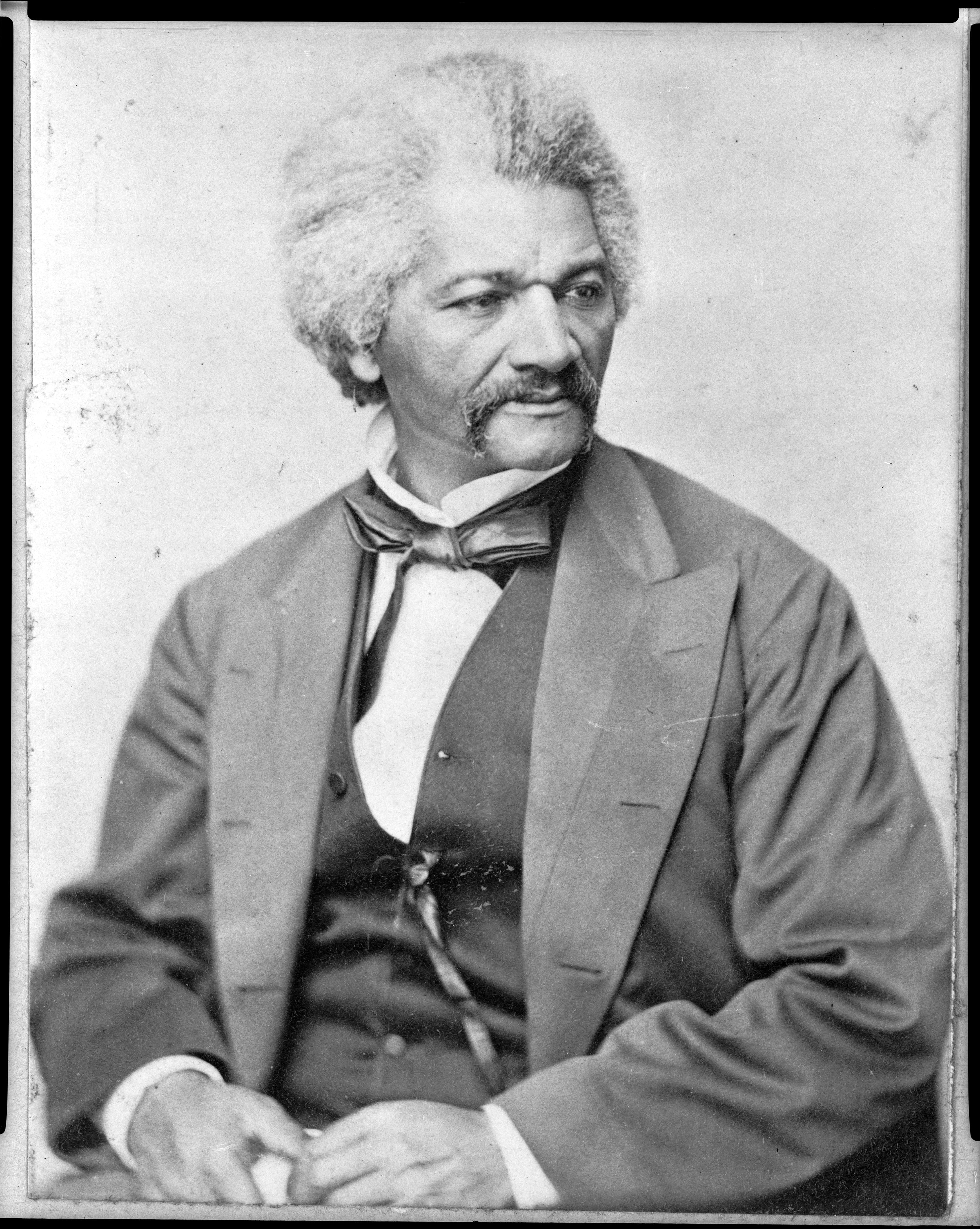
The Boy Who Stole Letters, Then Became a President's Conscience — The Story of Frederick Douglass
Born into slavery, Frederick Douglass taught himself to read, broke free from bondage, and rose to become Abraham Lincoln's advisor and the moral conscience of American democracy. What he fought for wasn't just his own freedom — it was the fulfillment of America's founding promise.
The Boy Who Stole Letters, Then Became a President's Conscience — Frederick Douglass
One Letter Changed Everything
In 1818, a child was born on a Maryland plantation. He barely remembered his mother's face and had nothing but a slave name — Frederick Bailey. No one could have imagined that this boy would become one of the most powerful orators in American history and a trusted advisor to President Abraham Lincoln.
Frederick Douglass (1818–1895). His life story is perhaps the most moving testament to how America's promise — "all men are created equal" — transformed from words on paper into reality, one agonizing step at a time.
"Don't Teach That Boy to Read"
In 1826, eight-year-old Frederick was sent to the household of Hugh and Sophia Auld in Baltimore. Sophia, with genuine kindness, began teaching the small slave boy his ABCs. A, B, C… the boy's eyes lit up.
When Hugh discovered this, he was furious.
"If you teach that boy to read, he'll never be fit to be a slave again."
These words struck the boy like lightning. But the very reason his master feared literacy became proof of hope for Frederick. 'If reading leads to freedom — my own master just said so.'
From that day forward, Frederick began stealing letters.
Street Children Became His Teachers
Formal education was forbidden, but the boy refused to give up. On the streets of Baltimore, he traded bread crusts with white children in exchange for reading lessons. At the shipyard, he traced the letters carved into lumber. He secretly gathered discarded newspapers from his master's house. At night, by candlelight — and sometimes by moonlight alone — he decoded the world one letter at a time.
Around age twelve, a single book fell into his hands and changed his life forever — The Columbian Orator, a collection of speeches on liberty and human rights. In its pages, Frederick encountered for the first time logical arguments against slavery. He read a dialogue in which a slave persuades his master to grant freedom through reason alone, and a revelation struck him:
"I can fight with words."
Escape — A Train Ride to Freedom
On September 3, 1838, twenty-year-old Frederick made his daring escape. Borrowing identification papers from a free Black sailor and dressing in a sailor's uniform, he boarded a northbound train. Twenty-four hours of heart-pounding terror. Baltimore to Philadelphia to New York — when the conductor glanced at his papers and waved him through, Frederick finally exhaled.
In New York, he chose a new name. He shed "Frederick Bailey," the slave's name, and took "Douglass" — inspired by a character in Sir Walter Scott's poetry. Frederick Douglass — reborn as a free man.
One Speech That Shook America
Settling in New Bedford, Massachusetts, Douglass worked at the shipyards and began his life as a free man. Then in 1841, at an anti-slavery convention on Nantucket Island, he stood before a crowd for the first time.
When his voice rang out, the audience froze.
His testimony of whippings endured, families torn apart, and the daily dehumanization of bondage — told from his own experience — was more powerful than any theoretical treatise. William Lloyd Garrison, the era's leading abolitionist, immediately recruited this unknown fugitive as a touring anti-slavery speaker.
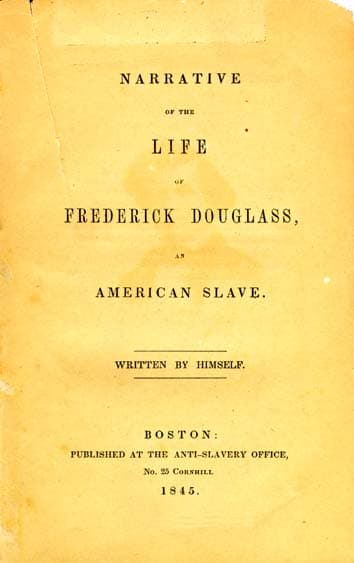
But Douglass's eloquence created an unexpected problem: people doubted his story. "That man couldn't possibly have been a slave. He's too refined." To answer these doubts, Douglass made an extraordinary decision — he published his autobiography, revealing his real name, his masters' real names, and the exact location of his plantation.
Published in 1845, Narrative of the Life of Frederick Douglass became an instant bestseller, sending shockwaves across America and Europe. But the book also placed Douglass in extreme danger — with his master's name now public, he could be captured and returned to slavery.
A Voice That Crossed the Atlantic
Fleeing the threat of capture, Douglass traveled to the British Isles, where he lectured across Ireland and England to rapturous audiences. British supporters raised $711 — the price of a single slave — to purchase his legal freedom from his former master, Thomas Auld. On December 5, 1846, Frederick Douglass became a legally free man.
Returning to America, he founded The North Star newspaper in Rochester, New York in 1847. Its motto declared:
"Right is of no sex – Truth is of no color – God is the Father of us all, and we are all brethren."
The Man Who Became Lincoln's Conscience
When the Civil War erupted in 1861, Douglass defined the war's meaning more clearly than anyone: "This must be a war not to preserve the Union, but to end slavery." He passionately advocated for Black men to be allowed to serve in the military.
"Once let the Black man get upon his person the brass letters, U.S., a musket on his shoulder and bullets in his pocket, and there is no power on earth that can deny that he has earned the right to citizenship."
His own two sons, Charles and Lewis, enlisted in the 54th Massachusetts Infantry Regiment — one of the first Black regiments in U.S. history. Douglass himself traveled the country recruiting Black volunteers.
In August 1863, Frederick Douglass met President Abraham Lincoln at the White House. A man who had been born into slavery, sitting in the presidential office, discussing the future of the nation — this remains one of the most symbolic moments in the history of American democracy.
Douglass spoke frankly to Lincoln: Black soldiers must receive equal pay. Captured Black soldiers must be protected from being sold back into slavery. Lincoln listened, and he treated Douglass as a genuine advisor.
Lincoln later described Douglass this way:
"Douglass is one of the most meritorious men in America."
The Amendments — When Paper Promises Became Law
After the war ended, Douglass's fight was far from over. In truth, it had only just begun.
The Emancipation Proclamation had been a wartime military measure — nothing more. It needed to become permanent law. Douglass threw his full weight behind the passage of the 13th Amendment (abolishing slavery), the 14th Amendment (guaranteeing citizenship), and the 15th Amendment (prohibiting the denial of voting rights based on race).
When the 15th Amendment — "The right of citizens to vote shall not be denied on account of race, color, or previous condition of servitude" — was ratified in 1870, Douglass declared:
"Slavery is not abolished until the Black man has the ballot."
A slave boy born on a Maryland plantation fifty-two years earlier had played a pivotal role in securing the right to vote for four million Black Americans.
The Most Photographed American of the 19th Century
Here is a little-known fact: Frederick Douglass was the most photographed American of the nineteenth century. More than Lincoln. More than General Grant.
This was no accident. Douglass understood the power of images. At a time when Black people were almost exclusively depicted as degrading caricatures in newspapers and popular media, Douglass deliberately sat for portrait after portrait, creating visual evidence of Black dignity and humanity.
He never smiled in photographs. He believed a lighthearted expression might reinforce stereotypes about Black people. In every image, his expression is serious, resolute — as if saying, "Look at me. Really look."
"All Men Are Created Equal" — The Unfinished Promise
On February 20, 1895, the 77-year-old Douglass attended a women's suffrage rally, then returned home and died of a heart attack. Until the very last day of his life, he was fighting for the equal rights of all human beings — not just the freedom of Black men, but the enfranchisement of women. In his vision, there were no blind spots in the struggle against inequality.
What Frederick Douglass fought for was never just his own freedom. He fought for the fulfillment of the Declaration of Independence — for the words "all men are created equal" to mean not just white men, but truly all people.
"To deny a man his rights while demanding his obedience is a contradiction that cannot exist in a nation built on liberty."
A boy who secretly learned the alphabet became a president's conscience, helped secure voting rights for four million people, and redefined what American democracy means. That is the life of Frederick Douglass. And his story still asks us, today:
"Are we truly keeping that promise?"
"Power concedes nothing without a demand. It never did and it never will." — Frederick Douglass
Get new posts by email ✉️
We'll notify you when new posts are published