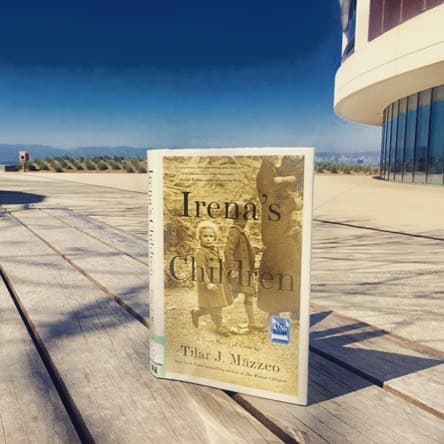
"The Kansas Girls Who Rescued a Forgotten Hero" — How Four High School Students Brought Irena Sendler's Story Back to the World
In 1999, four high school students from a tiny Kansas town discovered the forgotten story of Irena Sendler, who saved 2,500 children during the Holocaust, and brought her story to the world through a school project turned global movement. Their connection with the 89-year-old hero in Warsaw became one of the most remarkable intergenerational stories of courage, curiosity, and love.
"The Kansas Girls Who Rescued a Forgotten Hero" — The Life in a Jar Project
A One-Line Article in a Tiny Town
In the fall of 1999, in Uniontown, Kansas — a town of fewer than 80 people — history teacher Norman Conard gave his students at Uniontown High School an assignment that would end up changing lives across the globe.
"Find an unsung hero from history and create a project about them."
Three young women — Elizabeth Cambers, Megan Stewart, and Sabrina Coons — began digging through library archives. They stumbled upon a single line in a 1994 U.S. News & World Report article: "Irena Sendler saved 2,500 children from the Warsaw Ghetto."
Twenty-five hundred children. And yet none of them had ever heard her name.
Who Was Irena Sendler?
Irena Sendler (1910–2008) was a Polish social worker in Warsaw during World War II. When the Nazis established the Warsaw Ghetto in 1940, confining nearly 400,000 Jewish residents behind walls, Sendler used her credentials as a health inspector to enter the ghetto under the pretext of checking for typhus.
What she was really doing was smuggling children out.
She hid babies in ambulance floors, inside suitcases, under garbage on carts, and even inside coffins. Older children were led through sewer tunnels or guided through secret passages in buildings that straddled the ghetto wall. Each rescued child was placed with a Polish family, in a convent, or in an orphanage under a false identity.
But Sendler did something extraordinary beyond the rescues themselves: she meticulously recorded every child's real name alongside their new identity on slips of tissue paper, sealed them in glass jars, and buried them beneath an apple tree in her neighbor's yard. Her hope was that after the war, the children could be reunited with their families.
In 1943, the Gestapo arrested her. She was tortured — both her legs and feet were broken — but she never revealed a single child's name. Sentenced to death, she was rescued at the last moment by the Polish underground resistance, who bribed a guard. She spent the rest of the war in hiding, listed officially as "executed."
After the war, under Poland's communist regime, her story was suppressed. For nearly sixty years, the woman who saved 2,500 children lived in near-total obscurity.
The Students' Discovery
Back in Kansas, the students were astonished. How could someone who saved more people than Oskar Schindler be virtually unknown? They threw themselves into research, writing letters to Holocaust organizations, contacting the Polish consulate, and searching every database they could access.
Then came the discovery that changed everything: Irena Sendler was still alive.
In 2001, she was 89 years old, living alone in a modest nursing home in Warsaw. The Kansas teenagers wrote her a letter. Sendler, who had lived decades believing no one remembered or cared, was overwhelmed. She wrote back.
"Life in a Jar"
The students channeled their research into a short dramatic performance titled "Life in a Jar," named for the glass jars that held the children's identities. First performed in the Uniontown High School auditorium for a small local audience, the play quickly attracted attention. Invitations came from churches, civic organizations, schools, and eventually national venues.
The story spread through local Kansas media, then national outlets, and eventually international press. What had started as a class assignment became a movement.
Crossing the Ocean
Through fundraising efforts, the students traveled to Warsaw to meet Sendler in person. The encounter was deeply emotional. Sendler, frail and in a wheelchair, wept as she embraced the teenagers.
She told them: "I am not a hero. The word 'hero' irritates me greatly. The opposite is true — I continue to have qualms of conscience that I did so little. You, my dear girls from Kansas, are the real heroes."
The students visited her multiple times over the following years, forming a bond that transcended age, geography, language, and culture. They became, in Sendler's words, her "beloved granddaughters from America."
A Ripple Felt Around the World
The impact of the Life in a Jar project has been extraordinary:
- The play has been performed over 500 times worldwide across the United States, Canada, Europe, and beyond.
- Irena Sendler received Poland's highest civilian honor, the Order of the White Eagle, in 2003.
- She was nominated for the Nobel Peace Prize in 2007.
- In 2009, the Hallmark Hall of Fame produced a television film, "The Courageous Heart of Irena Sendler," starring Anna Paquin.
- Norman Conard went on to help establish the Lowell Milken Center for Unsung Heroes in Fort Scott, Kansas, which now runs a national educational program encouraging students to discover and share the stories of forgotten heroes.
- Several of the original Kansas students pursued careers in education and social work, directly inspired by their experience.
The Deeper Meaning
This story carries a profound and layered significance. On one level, it is about Irena Sendler's breathtaking courage — a woman who risked everything, endured torture, and never broke. On another level, it is about the power of young people who refuse to let a story remain buried.
A one-line article. A small-town classroom. A teacher who believed in the assignment. Four teenagers who asked, "Why don't we know her name?" That chain of curiosity and compassion pulled a forgotten hero back into the light of history during the final years of her life.
Irena Sendler passed away on May 12, 2008, at the age of 98. But thanks to four Kansas students, her last years were filled with the recognition, love, and gratitude that had eluded her for six decades.
Elizabeth Cambers later reflected: "We were just doing a school project. But that project changed our lives, and it helped the world remember a great woman before it was too late."
Sometimes all it takes is one line, one question, and the refusal to look away.
This story is based on documented accounts from the Lowell Milken Center for Unsung Heroes, multiple news sources including the New York Times and CBS News, and the book "Life in a Jar: The Irena Sendler Project" by Jack Mayer (2011).
Get new posts by email ✉️
We'll notify you when new posts are published