"That Person Is Going Down!" — The Ordinary Government Clerk Who Dove into the Frozen Potomac: The Story of Lenny Skutnik
On January 13, 1982, when Air Florida Flight 90 crashed into the icy Potomac River in Washington, D.C., a 28-year-old government office worker named Lenny Skutnik stripped off his coat and plunged into the freezing water to save a drowning survivor. His act of courage not only rescued a life but created a lasting American tradition: the presidential practice of honoring ordinary heroes during the State of the Union address.
A City Frozen in Chaos
On the afternoon of January 13, 1982, Washington, D.C. was paralyzed by one of the worst winter storms in years. Snow and ice blanketed the capital, turning roads into skating rinks and grounding most of the region to a halt. At 4:01 p.m., Air Florida Flight 90, a Boeing 737 carrying 74 passengers and 5 crew members, attempted to take off from Washington National Airport. The plane had been inadequately de-iced. It struggled to gain altitude, clipped the 14th Street Bridge — crushing several cars and killing four motorists — and plunged nose-first into the frozen Potomac River.
Within seconds, the fuselage began sinking beneath sheets of jagged ice. Of the 79 people on board, only a handful managed to claw their way to the surface. They clung to pieces of wreckage in water barely above freezing, their bodies shutting down minute by minute.
Hundreds of commuters stood on the bridge and along the riverbank, watching in horror. A U.S. Park Police helicopter, Eagle One, piloted by Donald Usher with paramedic Gene Windsor, raced to the scene and began lowering a lifeline and flotation ring to the survivors. But the cold had already done terrible damage. Fingers wouldn't close. Arms wouldn't hold. The survivors kept slipping away.
The Man Who Jumped
Among the crowd on the shore was Martin Leonard "Lenny" Skutnik III, a 28-year-old office assistant at the Congressional Budget Office. He had been on his way home from work when traffic ground to a halt near the crash site. Like everyone else, he got out of his car and walked to the riverbank to see what had happened.
Skutnik watched as the helicopter crew made pass after pass. He saw a young woman named Priscilla Tirado, who had already lost her husband and infant son in the crash, grab the flotation ring lowered by the helicopter. But hypothermia had robbed her hands of all strength. She slipped off the ring and began sinking into the black water.
Screams erupted from the crowd. People yelled for someone to do something. But the water was lethal — medical experts later estimated that an average person could survive no more than 15 to 20 minutes in those conditions before cardiac arrest.
Skutnik didn't calculate the odds. He pulled off his coat and boots, pushed through the crowd, and dove into the Potomac River.
"I Just Did What Felt Right"
The cold hit him like a wall of knives. Every nerve in his body screamed at him to turn back. But Skutnik swam on, pushing through floating chunks of ice until he reached Tirado. He grabbed her arm, pulled her head above water, and began towing her back to shore. Other bystanders and rescue workers hauled the two of them out of the river.
Priscilla Tirado survived. She was one of only five passengers pulled alive from the wreckage that day. Seventy-four people on the plane and four people on the bridge died.
When reporters descended on Skutnik in the days that followed, he seemed almost baffled by the attention.
"I wasn't a hero. I just did what felt right. Someone was drowning, and nobody was doing anything about it."
But that was precisely the point. Hundreds of people stood on that riverbank. Only one went in.
The Unnamed Hero of the Same Disaster
The crash of Flight 90 produced another extraordinary act of sacrifice. Among the survivors clinging to the wreckage was a balding, middle-aged man who repeatedly passed the helicopter's lifeline to other survivors. Five times the helicopter lowered the ring to him; five times he handed it to someone else. When Eagle One returned for him a sixth time, he was gone — swallowed by the frozen river.
He was later identified as Arland D. Williams Jr., a 46-year-old bank examiner from Atlanta. The 14th Street Bridge was renamed the Arland D. Williams Jr. Memorial Bridge in his honor. His story has been told in its own right and is already included in the list above. But it is worth remembering that on that single terrible afternoon, two ordinary men — one who lived and one who died — showed the world what selflessness looks like.
A Tradition Is Born
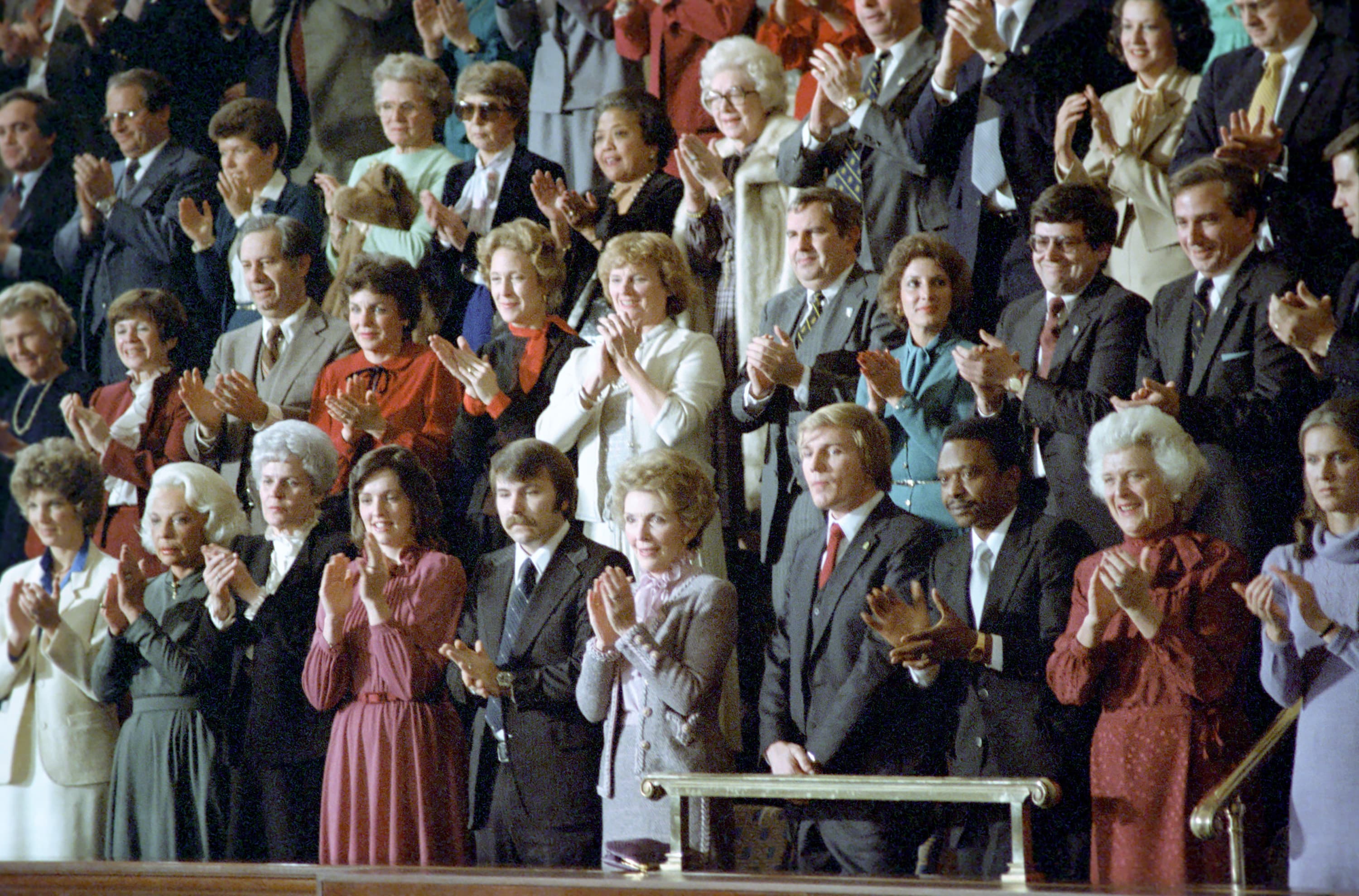
Thirteen days after the crash, on January 26, 1982, President Ronald Reagan stood before a joint session of Congress to deliver his State of the Union address. Midway through the speech, he paused and looked up at the gallery.
"Just two weeks ago, in the worst of tragedies on the Potomac, we saw again the spirit of American heroism at its finest — the heroism of dedicated rescue workers and of an individual citizen, Lenny Skutnik, who, when he saw a woman losing her grip on the helicopter line, dived into the water and dragged her to safety."
The chamber erupted in a standing ovation. A shy young man in the balcony stood awkwardly, nodded, and sat back down.
It was the first time in American history that a president had singled out an ordinary citizen seated in the gallery during a State of the Union address. The gesture proved so powerful that every president since — Democrat and Republican alike — has continued the practice. In Washington political parlance, the invited guests are informally called "Skutniks." Lenny Skutnik's name became a permanent part of the American political lexicon, a synonym for the everyday hero whose story reminds the nation of its best self.
Back to Ordinary Life
Skutnik received the Coast Guard's Gold Lifesaving Medal and the Carnegie Hero Fund's Carnegie Medal. But he never sought celebrity. He returned to his desk at the Congressional Budget Office and continued working there for decades, eventually retiring quietly.
In interviews over the years, he consistently deflected praise.
"I'm no hero. Anyone in my position would have done the same thing."
Yet psychologists and disaster researchers who have studied bystander behavior know that this is precisely what most people do not do. The bystander effect — the well-documented tendency for individuals in a crowd to assume someone else will act — is one of the most powerful forces in human psychology. What Skutnik did was not merely brave; it was statistically extraordinary.
The Ripple Effects
The Air Florida Flight 90 disaster led to sweeping changes in American aviation safety. The National Transportation Safety Board's investigation resulted in new FAA regulations on de-icing procedures, crew resource management training, and winter operations at airports nationwide. Washington National Airport overhauled its rescue response protocols. The reforms enacted in the wake of this tragedy have been credited with preventing countless future accidents.
But beyond policy and regulation, the crash left a deeper legacy — the image of a lone man throwing off his coat and leaping into impossible cold because a stranger was dying and he could not stand by and watch.
Why This Story Still Matters
In an age when we often feel powerless against vast and impersonal forces — terrorism, pandemics, political division — Lenny Skutnik's story delivers a deceptively simple message: one person can make a difference, and that person can be anyone.
He was not a soldier. He was not a firefighter. He was not trained in rescue operations. He was a man who processed paperwork for a living. And yet, when the moment came, he chose to act. That choice — instantaneous, unrehearsed, and terrifying — saved a human life and inspired a nation.
Every January, when the President of the United States stands before Congress and points to a citizen in the gallery, that gesture traces back to a freezing afternoon on the Potomac and a quiet young man who simply could not look away.
Heroes are not born. They are made in a single moment of decision.
Priscilla Tirado, the woman Skutnik rescued, suffered devastating losses that day — her husband, José, and their two-month-old son, Jason, both perished in the crash. She struggled with survivor's guilt and PTSD for years. But she lived. She rebuilt. And she has spoken publicly about the stranger who gave her that chance. "He didn't know me," she said. "He just jumped in."
Get new posts by email ✉️
We'll notify you when new posts are published