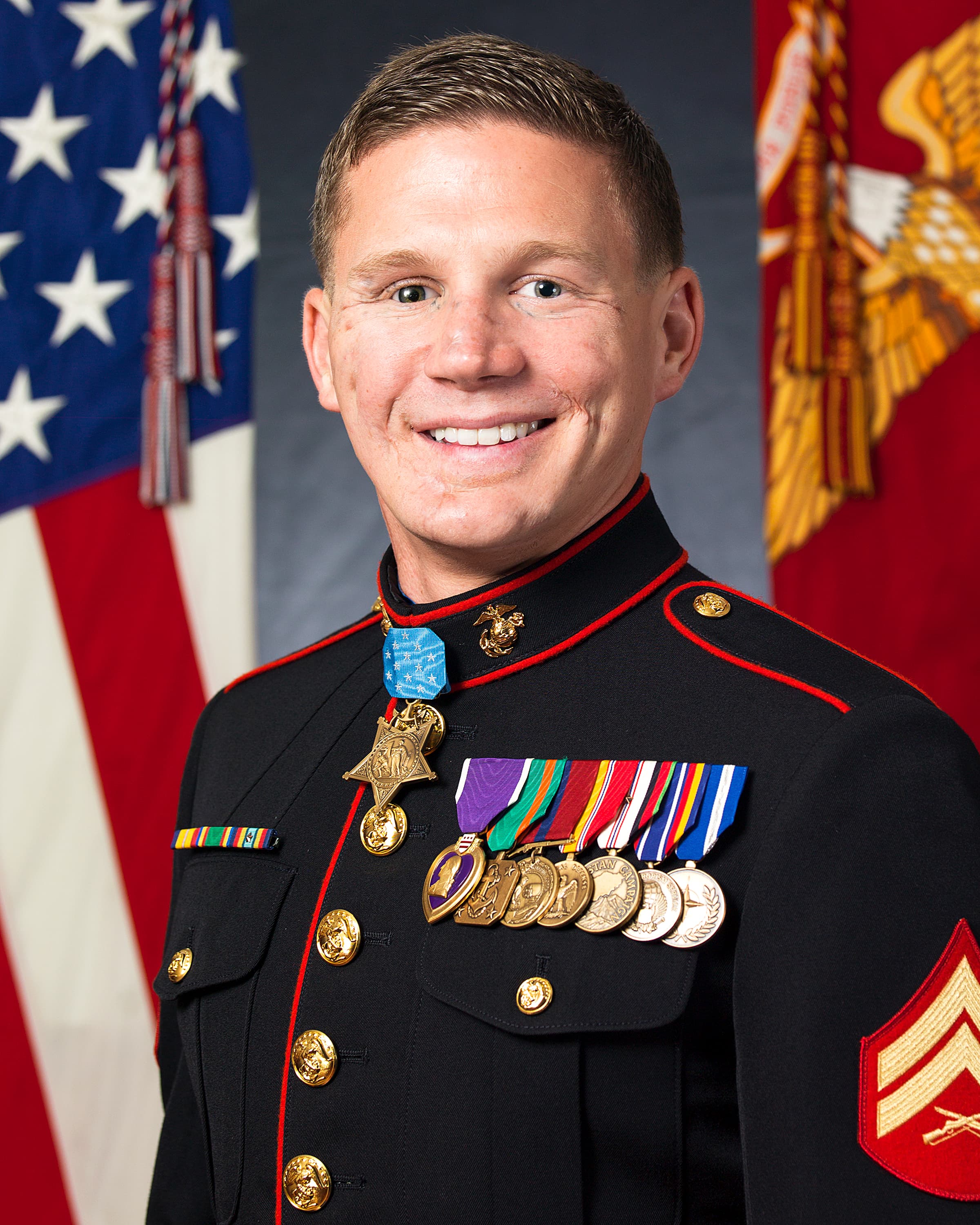
"I'll Take the Blast" — The Marine Who Jumped on a Grenade to Save His Brother, Kyle Carpenter's Story
In 2010, twenty-one-year-old Marine Lance Corporal Kyle Carpenter threw himself on an enemy grenade to shield his fellow Marine in Afghanistan. Miraculously surviving, he became the youngest living Medal of Honor recipient and rebuilt his life as a beacon of hope for wounded warriors everywhere.
"I'll Take the Blast" — The Story of Kyle Carpenter
A Small-Town Kid with a Bigger Calling
William Kyle Carpenter was born on October 17, 1989, in Jackson, Mississippi, and grew up in the quiet town of Gilbert, South Carolina. After graduating from high school, he briefly attended college but felt pulled toward something larger than himself. In 2009, at the age of nineteen, Kyle enlisted in the United States Marine Corps. He was assigned to 2nd Battalion, 9th Marines, 2nd Marine Division — and in the fall of 2010, he deployed to Marjah, Helmand Province, Afghanistan, one of the most fiercely contested areas in the entire war.
November 21, 2010: Three Seconds on a Rooftop
That afternoon, Lance Corporal Carpenter and fellow Marine Lance Corporal Nick Eufrazio were manning a rooftop observation post in Marjah. The day had been relatively quiet — until it wasn't.
An enemy hand grenade sailed over the low parapet wall and landed between the two young Marines. In combat, a fragmentation grenade detonates in roughly three to five seconds. There is almost no time to think, only to react.
Kyle Carpenter reacted. But not in the direction instinct would dictate. Instead of diving away, he lunged toward the grenade, throwing his body over the explosive device to shield Eufrazio from the blast.
The grenade detonated directly beneath him.
"Patient Expired"
The explosion was devastating. Carpenter lost his right eye. Most of his jaw was destroyed. His right arm was shattered. His skull was fractured and portions of it were blown away. His lungs collapsed. Shrapnel riddled his face and body. When the medical team reached him, his injuries were so catastrophic that he was initially classified as "P.E." — Patient Expired. Dead.
But Kyle Carpenter's heart had other plans. During the medevac flight, faint vital signs were detected. He was rushed to Camp Bastion, then to Landstuhl Regional Medical Center in Germany, and finally to Walter Reed National Military Medical Center in Bethesda, Maryland.
Over the next two and a half years, Kyle endured more than forty surgeries. Surgeons reconstructed his jaw using bone grafts. They rebuilt portions of his skull with titanium plates. They fitted him with a prosthetic eye. Doctors were unsure whether he would ever walk again, let alone live a normal life.
Nick Eufrazio also suffered severe injuries, including traumatic brain injury and shrapnel wounds. But he survived. Kyle's body had absorbed the deadliest force of the blast.
The Youngest Living Medal of Honor Recipient
On June 19, 2014, President Barack Obama presented Corporal Kyle Carpenter with the Medal of Honor — the United States military's highest decoration for valor — in a ceremony at the White House East Room. At twenty-four years old, Carpenter became the youngest living recipient of the Medal of Honor for actions in Afghanistan.
During the ceremony, President Obama said:
"Kyle, you remind us that heroism is not just about what happens on the battlefield. It's about the character you bring to every single day afterward."
Carpenter stood before the nation, his face bearing the unmistakable marks of the grenade blast, and smiled — a broad, genuine, irrepressible smile. It was, many observers noted, the most powerful image of the entire ceremony.
Rebuilding: From Ward to Graduation
After his medical retirement from the Marines, Carpenter enrolled at the University of South Carolina. Balancing physical therapy with coursework, he earned a bachelor's degree in International Studies in 2017. At the commencement ceremony, thousands of graduates and their families rose to their feet in a sustained standing ovation as he crossed the stage.
But Carpenter didn't want to simply move on with his life. He wanted to bring others along.
He began speaking publicly — at universities, corporate events, veterans' organizations, and high schools across the country. His message was disarmingly simple:
"Every scar on my body is proof that I'm still here. Scars are not the end of the story. They're the beginning."
He became an advocate for wounded veterans, working with organizations that provide resources for service members dealing with PTSD, traumatic brain injuries, and the difficult transition to civilian life. He used his social media presence — where he became known for his self-deprecating humor and relentless optimism — to shatter stereotypes about what a "wounded warrior" looks like.
The Choice That Defines a Life
What makes Kyle Carpenter's story resonate so deeply is not the explosion itself, nor even his miraculous survival. It is the choice he made in that fraction of a second on a rooftop in Marjah.
When the grenade landed, Kyle Carpenter could have dived for cover. No one would have blamed him. The instinct of self-preservation is the most fundamental force in human biology. But in that instant, a twenty-one-year-old Marine chose someone else's life over his own.
Military psychologists and historians have long debated what drives a person to make such a sacrifice. Training, unit cohesion, adrenaline — all play a role. But those who know Carpenter say the answer is simpler than any academic theory. He loved his brother Marine. And love, in its most radical form, does not calculate the cost.
What followed — the forty surgeries, the years of rehabilitation, the decision to pursue education, the commitment to helping others — represents a second kind of heroism. It is the quieter, longer, harder kind: the heroism of choosing to fully live the life that was almost taken away.
A Living Reminder
Kyle Carpenter is thirty-five years old as of 2025. He continues to speak, to advocate, and to live with the visible and invisible scars of November 21, 2010. Nick Eufrazio, the Marine he saved, has also recovered and is living his own life — a life made possible by a friend's split-second decision.
At nearly every speaking engagement, Carpenter ends with a variation of the same words:
"The person standing in front of you was once classified as dead. But I'm here. And if I can stand here and smile, you can get through whatever you're facing."
His smile — crooked, scarred, brilliant — is the punctuation mark on one of the most extraordinary stories of sacrifice and resilience in modern American military history. It is a smile that says: I chose you over me, and I would do it again.
Corporal William Kyle Carpenter, USMC (Ret.), received the Medal of Honor on June 19, 2014. He remains active in veteran advocacy and motivational speaking.
Get new posts by email ✉️
We'll notify you when new posts are published