"Won't You Come and Join Me?" — Fred Rogers, François Clemmons, and the Small Pool That Challenged a Nation
In 1969, at the height of racial segregation in America's swimming pools, a quiet TV host invited his Black co-star to share a small wading pool on camera. That simple act of kindness became one of the most powerful moments in television history.
A Small Pool That Changed America's Heart
America, 1969
The summer of 1969 was a time of fire. Dr. Martin Luther King Jr. had been assassinated just a year earlier. Public swimming pools across America remained segregated — not always by law anymore, but by practice, by violence, by threat. In cities across the South and beyond, municipal pools were being drained, closed, or privatized rather than allow Black and white children to swim together. The image of a Florida hotel owner pouring acid into a pool where Black people were swimming had seared itself into the nation's conscience.
Into this churning moment stepped a man in a cardigan sweater, speaking in the softest voice on television.
Fred Rogers: The Quiet Revolutionary
Fred McFeely Rogers (1928–2003) was an ordained Presbyterian minister who never led a congregation from a pulpit. Instead, his parish was a television studio in Pittsburgh, Pennsylvania, where from 1968 to 2001 he hosted "Mister Rogers' Neighborhood" on PBS — one of the longest-running and most beloved children's programs in American history.
Rogers didn't shout. He didn't use flashy effects. He looked into the camera and spoke directly to children as though each one were the only person in the world: "I like you just the way you are." He talked about feelings — fear, anger, sadness, joy — at a time when most children's TV was about selling cereal. He believed, with absolute conviction, that every human being had inherent dignity and worth.
But his most radical act wasn't a speech. It was an invitation.
François Clemmons: From Poverty to the Neighborhood
François Scarborough Clemmons was born in 1945 in Birmingham, Alabama, and raised in Youngstown, Ohio, amid poverty and domestic violence. His extraordinary tenor voice earned him a scholarship to Carnegie Mellon University, where he trained as an opera singer.
In 1968, Fred Rogers heard Clemmons sing and sought him out with an unusual proposal: Would he play a police officer on the show?
Clemmons hesitated. In 1960s America, police officers were figures of terror in Black communities — the men with dogs and fire hoses at civil rights marches. A Black man wearing a badge on a children's show? It felt impossible.
Rogers responded quietly: "That's exactly why you need to do it. Children need to see that a Black man can be a police officer, and that a police officer can be kind."
Clemmons accepted. Officer Clemmons became one of the first recurring Black characters on an American children's television series. He would play the role for 25 years.
The Scene — May 9, 1969
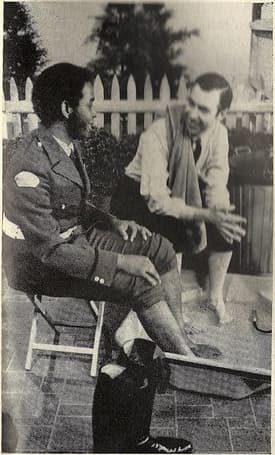
In a Season 1 episode, Rogers sits on his porch on a hot day, soaking his bare feet in a small plastic wading pool. Officer Clemmons walks by on patrol.
Rogers looks up and says: "It's such a good feeling to have your feet in cool water on a hot day. Would you like to join me?"
Clemmons removes his shoes and socks. He sits down beside Rogers. Two men — one white, one Black — dip their feet into the same small pool of water.
The camera lingers on their feet, side by side, in the same water.
No speech. No slogan. No anger. Just an invitation: Come sit with me.
In an America where Black people were being chased out of public pools with chemicals and clubs, Fred Rogers shared his water on national television. And to the millions of children watching at home, it looked like the most natural thing in the world.
The Towel — 1993
Twenty-four years later, in Clemmons' final episode, the scene was recreated. Once again, the two men sat side by side at the little pool. But this time, when they finished, Rogers knelt down and dried Clemmons' feet with a towel — a deliberate echo of Jesus washing the feet of his disciples.
After the cameras stopped rolling, Clemmons wept.
He later recalled: "I never had a father who loved me. When Fred dried my feet, it was the first time I felt like a beloved son."
A Complicated, Honest Friendship
The relationship between the two men was not without tension. In the early 1970s, when Rogers learned that Clemmons was frequenting gay bars, he advised him to be more discreet, fearing it could jeopardize the show. Clemmons was hurt, and briefly entered a marriage of convenience. Over time, however, Rogers' understanding deepened. He never stopped embracing Clemmons — literally and figuratively — telling him after every taping, "I love you just the way you are."
When Rogers died of stomach cancer in February 2003, Clemmons spoke at memorial gatherings, calling Rogers "the most genuine human being I have ever known — and the first adult who told me I was special and truly meant it."
In 2021, at age 76, Clemmons published his memoir, "Officer Clemmons: A Memoir," detailing how Rogers' love had rescued him from a childhood of abuse, from the crushing weight of racism, and from a lifetime of self-doubt.
The Legacy of a Small Pool
Fred Rogers never marched in a protest. He never gave a fiery speech at a rally. He never introduced a bill or organized a boycott.
He simply said, "Won't you come and join me?"
But that invitation — extended across the color line on national television at one of the most racially charged moments in American history — planted a seed in the hearts of millions of children. For Black children, it said: You belong here. For white children, it said: Sharing water with someone who looks different is the most ordinary, wonderful thing.
Not through fury but through kindness. Not through argument but through presence. Not through a grand gesture but through a small plastic pool.
More than two decades after his death, Rogers' message still resonates, still challenges, still comforts:
"I like you just the way you are."
And that love, it turns out, was as simple as sharing a pool — and as revolutionary as anything America has ever seen.
Get new posts by email ✉️
We'll notify you when new posts are published