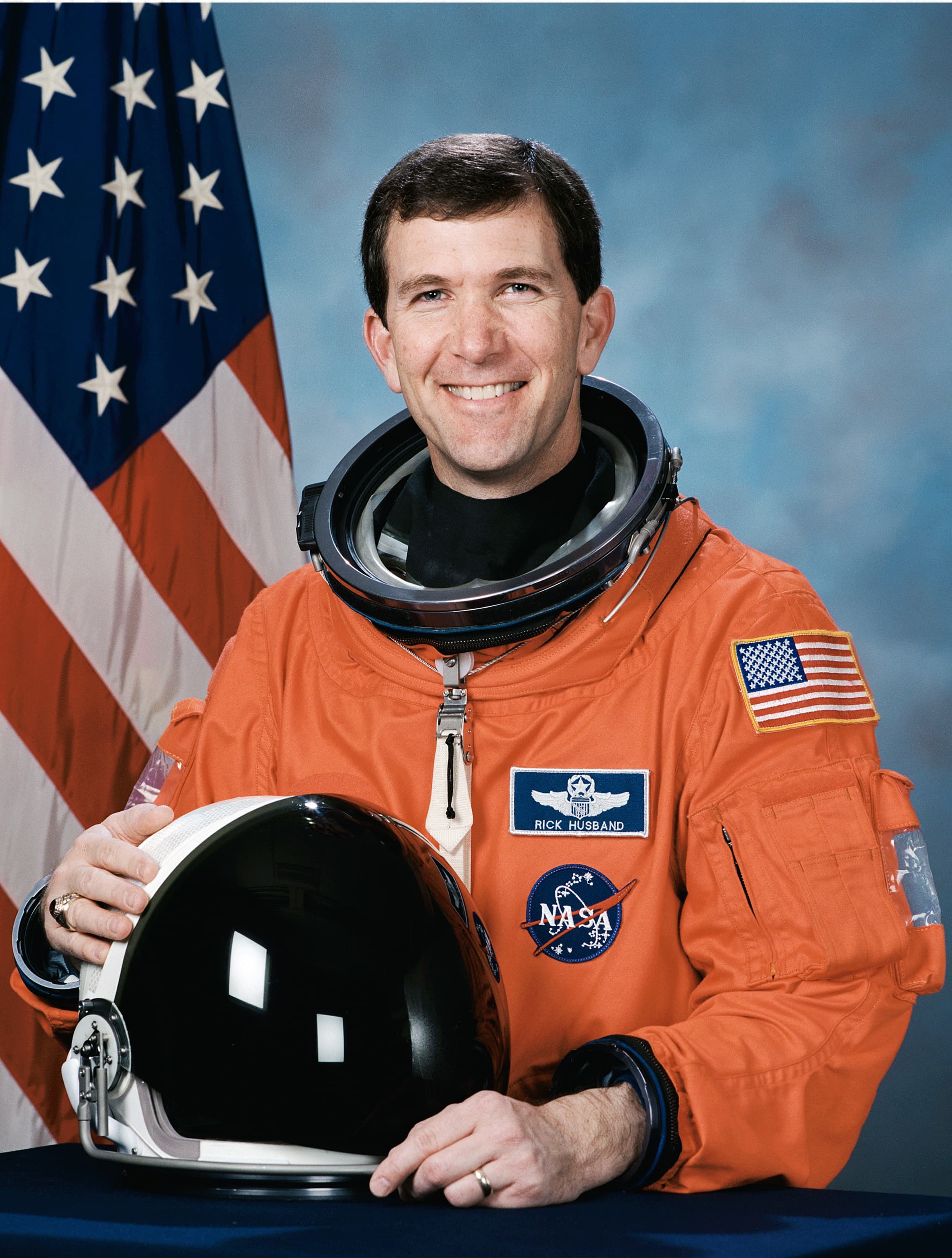
"If I Don't Come Back, Open This Letter" — The Last Love of Columbia Commander Rick Husband
When Space Shuttle Columbia disintegrated on February 1, 2003, killing all seven astronauts, Commander Rick Husband had already left behind a sealed letter for his wife — a final testament of love, faith, and an unwavering message to never give up on your dreams.
"If I Don't Come Back, Open This Letter"
A Boy From Amarillo Who Wouldn't Quit
Rick Douglas Husband was born on July 12, 1957, in Amarillo, Texas — a flat, wind-swept city better known for cattle ranches than rocket launches. At four years old, he watched John Glenn orbit the Earth on television and told his parents he would go to space someday. It was the kind of thing every child says. But Rick never stopped meaning it.
He earned a mechanical engineering degree from Texas Tech University, became an Air Force test pilot, and eventually set his sights on NASA's astronaut corps. He applied four times. Three times, he was rejected. Each time, his wife Evelyn watched him absorb the disappointment with a quiet faith that unnerved even her.
"He never complained," Evelyn later recalled. "He'd say, 'God's timing isn't my timing. But He didn't say stop.'"
On his fourth attempt, in 1994, Rick Husband was selected. He was 37 years old.
Mission STS-107: Sixteen Days in Orbit
On January 16, 2003, Space Shuttle Columbia launched from Kennedy Space Center on mission STS-107. Rick Husband was the mission commander, leading a crew of seven: William McCool, Michael Anderson, Kalpana Chawla, David Brown, Laurel Clark, and Ilan Ramon — Israel's first astronaut and the son of a Holocaust survivor.
The mission was a dedicated science flight. For sixteen days, the crew conducted more than eighty experiments in everything from cancer research to atmospheric science. From orbit, Rick sent cheerful video messages home to his two children, Laura and Matthew, waving at the camera with the blue curve of Earth glowing behind him.
What no one told the crew was that eighty-two seconds after launch, a briefcase-sized piece of insulating foam had broken off the external fuel tank and struck the left wing's reinforced carbon-carbon thermal protection panel. Engineers on the ground flagged the issue and requested satellite imagery to assess the damage. NASA management declined, reasoning that foam strikes had occurred on previous flights without catastrophic consequences.
It was a decision that would haunt the agency forever.
February 1, 2003: The Sky Over Texas
Columbia began its reentry on the morning of February 1. At 8:59 a.m. Central Time, mission control lost contact. Seconds later, viewers across Texas and Louisiana looked up to see multiple streaks of light crossing the morning sky. Columbia had broken apart at an altitude of approximately 200,000 feet, traveling at eighteen times the speed of sound.
All seven crew members perished. Debris rained over an area stretching from east Texas to western Louisiana — a corridor more than 250 miles long. It was the second shuttle disaster in NASA's history, coming seventeen years after Challenger.
The Letter
In the days that followed, as the nation mourned and flags flew at half-staff, Evelyn Husband found herself drowning in grief. Then she remembered.
Before every dangerous mission, Rick had a private ritual. He would write a letter to Evelyn, seal it, and leave it behind with instructions: "If I don't come back, open this." If he returned safely, the letter would be discarded, never read. He had done the same before his first spaceflight in 1999 — and came home, so that letter was thrown away unopened.
This time, he did not come home.
Evelyn opened the envelope with trembling hands. Inside, she found pages filled with Rick's steady handwriting — words of love for her and the children, expressions of gratitude for the life they had built together, and a clear, unwavering message:
"Don't be sad. I was doing what I loved. Tell the kids — their dad never gave up on his dream. And they should never give up on theirs."
The letter became an anchor for the Husband family. In interviews, Evelyn described it as the moment she decided not to be destroyed by grief but to honor Rick's legacy by living with the same persistence he had always modeled.
High Calling
In 2004, Evelyn published High Calling: The Courageous Life and Faith of Space Shuttle Columbia Commander Rick Husband, a memoir that traced Rick's journey from a small-town boy with an impossible dream to the commander's seat of a space shuttle. The book resonated with readers far beyond the space community. It was a story about tenacity, about love that prepares for the worst while hoping for the best, and about the kind of faith that writes a goodbye letter but still climbs aboard.
Evelyn became a sought-after speaker, sharing Rick's story at schools, churches, and corporate events. She always ended with the same reflection:
"Rick became a star. But before he left, he made sure to leave us his light."
What Survived the Fire
The recovery effort was one of the largest in American history. More than 25,000 civilians — ranchers, high school students, retirees — joined NASA personnel and federal agents in combing the fields, forests, and lakebeds of east Texas. In the small town of Nacogdoches, residents organized themselves into search teams without being asked.
Amid the wreckage, remarkable things were found. A significant portion of the mission's scientific data survived intact. A canister containing the nematode worm C. elegans — part of a biological experiment — was recovered with living organisms inside. Life had survived the inferno.
Ilan Ramon's personal diary was also found among the debris, its pages charred but partially legible. It was painstakingly restored and is now preserved at the Israel Museum in Jerusalem. Even in destruction, the human record endured.
A Name That Endures
Amarillo renamed its airport the Rick Husband Amarillo International Airport in 2003. On Mars, NASA named a range of hills in Gusev Crater the Columbia Hills, and the Spirit rover explored them starting in 2004, honoring each of the seven crew members with individual peaks.
But Rick Husband's most enduring legacy may be the simplest one: a sealed envelope, a few handwritten pages, and a father's final plea to his children to never stop dreaming.
Laura Husband grew up and, in interviews years later, spoke about how her father's letter shaped her life. "He didn't just tell us to dream," she said. "He showed us — by trying four times, by never quitting, by climbing into that shuttle even knowing the risks. The letter was his way of making sure his voice would stay with us even if he couldn't."
The Meaning of a Last Letter
We live in an age of instant messages that disappear in seconds. Rick Husband sat down before the most dangerous journey of his life and put pen to paper — not because he expected to die, but because love demands preparation for every possibility. He wrote the letter hoping it would never be read. He sealed it hoping he would come home and throw it away, as he had done before.
He didn't come home. And so the letter became something sacred — proof that even at the boundary between Earth and the void, a man's last thought was not of glory or legacy, but of the people waiting for him at the kitchen table.
Rick Husband was rejected three times before he reached space. He wrote a goodbye letter he prayed would never be opened. He turned death itself into one final act of love.
And somewhere in Amarillo, in a frame or a drawer or simply in memory, those handwritten pages still glow — a light left behind by a man who became a star.
This story is based on Evelyn Husband's memoir "High Calling" (2004), NASA's Columbia Accident Investigation Board Report (2003), and multiple published interviews with the Husband family.
Get new posts by email ✉️
We'll notify you when new posts are published