"Today Is the Day" — Rick Rescorla, the Man Who Saved 2,687 Lives on 9/11
On September 11, 2001, Morgan Stanley's security chief Rick Rescorla evacuated 2,687 employees from the World Trade Center's South Tower before it collapsed — then went back inside to save more. He had predicted the attack years earlier and spent a decade preparing his people for the day that finally came.
"Today Is the Day" — Rick Rescorla, the Man Who Saved 2,687 Lives on 9/11
A Soldier's Beginning
Cyril Richard "Rick" Rescorla was born in 1939 in Hayle, a small town in Cornwall, England. From the start, he seemed destined for a life defined by service. He joined the British Army as a young man, serving in Cyprus and Northern Rhodesia (now Zambia). But it was America that called to him most deeply. In 1963, Rescorla immigrated to the United States and enlisted in the U.S. Army, eventually joining the 7th Cavalry Regiment — the same unit once commanded by George Armstrong Custer.
In November 1965, Lieutenant Rescorla found himself in the Ia Drang Valley of Vietnam, in one of the first major engagements between U.S. forces and the North Vietnamese Army. The battle was savage. Men were dying all around him. And in the middle of that hell, Rescorla did something extraordinary — he began to sing.
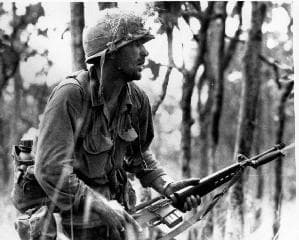
Belting out Cornish folk songs and patriotic anthems, he moved through the chaos with a bayonet fixed to his rifle, rallying terrified soldiers and keeping morale alive in the face of overwhelming enemy fire. A war photographer captured his image — jaw set, eyes determined, young and fierce — and that photograph would later grace the cover of "We Were Soldiers Once… and Young" by Lt. Gen. Hal Moore and Joe Galloway. The book was adapted into the 2002 film We Were Soldiers, starring Mel Gibson.
Rescorla emerged from Vietnam as one of the most decorated soldiers of his generation. But his greatest act of heroism was still 36 years away.
The Prophet Nobody Listened To
After the war, Rescorla earned a law degree and a master's in creative writing before entering the world of corporate security. In 1985, he was appointed Director of Security for Morgan Stanley Dean Witter, which occupied 22 floors (44 through 74) of the World Trade Center's South Tower — making it the largest tenant in the entire complex, with roughly 3,700 employees.
Rescorla immediately recognized the vulnerability of the towers. Working with his old Army buddy and military strategist Dan Hill, he conducted a thorough assessment and concluded that the underground parking garage was an obvious target for a truck bomb. They submitted a detailed report to the Port Authority of New York and New Jersey, urging immediate security upgrades.
The Port Authority ignored the warning.
On February 26, 1993, a truck bomb detonated in the underground garage of the World Trade Center, killing six people and injuring over a thousand. Rescorla's prediction had come true with chilling accuracy. During the attack, he personally guided Morgan Stanley employees to safety. Every single one survived.
But Rescorla didn't celebrate. He was already thinking about what came next. He told Dan Hill: "They'll come back. Next time they'll use planes."
He urged Morgan Stanley's leadership to relocate the company to New Jersey, away from what he considered a prime target. The company declined — they had a lease running until 2006. But they gave Rescorla something almost as valuable: full authority over evacuation procedures.
The Drills Nobody Wanted
What followed was one of the most remarkable — and least appreciated — acts of preparedness in American corporate history. Rescorla instituted mandatory full-building evacuation drills every three months. All 3,700 employees, from entry-level analysts to senior managing directors, were required to participate.
The drills were deeply unpopular. Traders complained about lost revenue. Executives grumbled about wasted time. Some employees openly mocked the exercises. Rescorla didn't care. He had learned in Vietnam that survival in chaos depends not on instinct but on muscle memory. When the real crisis came, he didn't want people thinking — he wanted them moving.
He assigned floor wardens on every level. He established right-side stairwell traffic flow. He identified bottleneck points and optimized descent times. He enforced strict rules: no elevators, no returning for personal belongings, no stopping until you reached the designated assembly point. Year after year, drill after drill, the procedures were etched into the collective consciousness of Morgan Stanley.
September 11, 2001 — "Today Is the Day"
At 8:46 a.m., American Airlines Flight 11 struck the North Tower. The impact shook the South Tower violently. Almost immediately, the Port Authority's public address system delivered a familiar instruction: "Please remain at your desks. The building is secure."
Rick Rescorla disregarded the order entirely.
He grabbed his bullhorn, his walkie-talkie, and his cell phone. He called Dan Hill: "Danny, it's Rick. The bastards hit the North Tower. I'm getting my people out." Then he activated the evacuation plan that 3,700 people had rehearsed dozens of times.
The years of drilling paid off instantly. There was no panic. Employees rose from their desks, left their belongings behind, and filed into the stairwells in orderly lines — exactly as they had practiced. They knew which stairwell to use. They knew to stay to the right. They knew not to stop.
At 9:03 a.m., United Airlines Flight 175 slammed into the South Tower between floors 78 and 84 — right through the heart of Morgan Stanley's offices. The building shuddered. Smoke poured into the stairwells. Fear gripped the descending workers.
And then, from somewhere in the stairwell, came the sound of singing.
It was Rescorla. Just as he had done in the Ia Drang Valley 36 years earlier, he was singing to keep people calm. "Men of Harlech," the old Welsh battle hymn. "God Bless America." Between songs, his voice boomed through the bullhorn: "You're doing great. Almost there. Keep moving. Today is a beautiful day to be alive."
Survivors would later describe the almost supernatural effect of his voice. One employee recalled: "The moment I heard him singing, the fear just melted. I knew we were going to be okay."
The Last Phone Call
As the evacuation neared completion, Rescorla took a moment to call his wife, Susan Rescorla. His voice was calm.
"Stop crying. I have to get these people out safely. If something should happen to me, I want you to know I've never been happier. You made my life."
Susan begged him to get out. He replied:
"I've got my people to take care of."
He hung up and turned back toward the stairs — not down, but up. There were still people on the upper floors. His security team followed him.
Rescorla was last seen on the 10th floor of the South Tower, heading upward. At 9:59 a.m., the building collapsed.
The Numbers That Tell the Story
Of the approximately 3,700 Morgan Stanley employees in the South Tower that morning, 2,687 made it out alive. The company lost only 13 people — among them Rick Rescorla and several members of his security team who had stayed behind with him to search for stragglers.
To put this in perspective: Morgan Stanley was the single largest tenant of the World Trade Center, yet it suffered one of the lowest casualty rates of any company in the complex. On a day when 2,977 people perished, one man's years of preparation saved an entire corporate population.
Those 2,687 lives were not saved by luck. They were not saved by a split-second act of bravery. They were saved by a decade of relentless, unglamorous preparation — by a man who saw what others refused to see and did what others found inconvenient.
Legacy
Rick Rescorla's remains were never recovered. He was posthumously awarded the Presidential Citizens Medal, and he has been honored in numerous documentaries, books, and memorials. The U.S. military academy at Fort Benning (now Fort Moore) has commemorated his leadership, and his story is taught in security and crisis management programs worldwide.
Susan Rescorla dedicated the years following her husband's death to advocating for disaster preparedness education. She authored a memoir and spoke at countless events, carrying forward the message Rick had lived and died by.
In 2021, on the 20th anniversary of September 11, survivors of the South Tower evacuation gathered
Get new posts by email ✉️
We'll notify you when new posts are published