The Six-Year-Old Girl Who Walked Alone — Ruby Bridges and the Step That Changed American Democracy
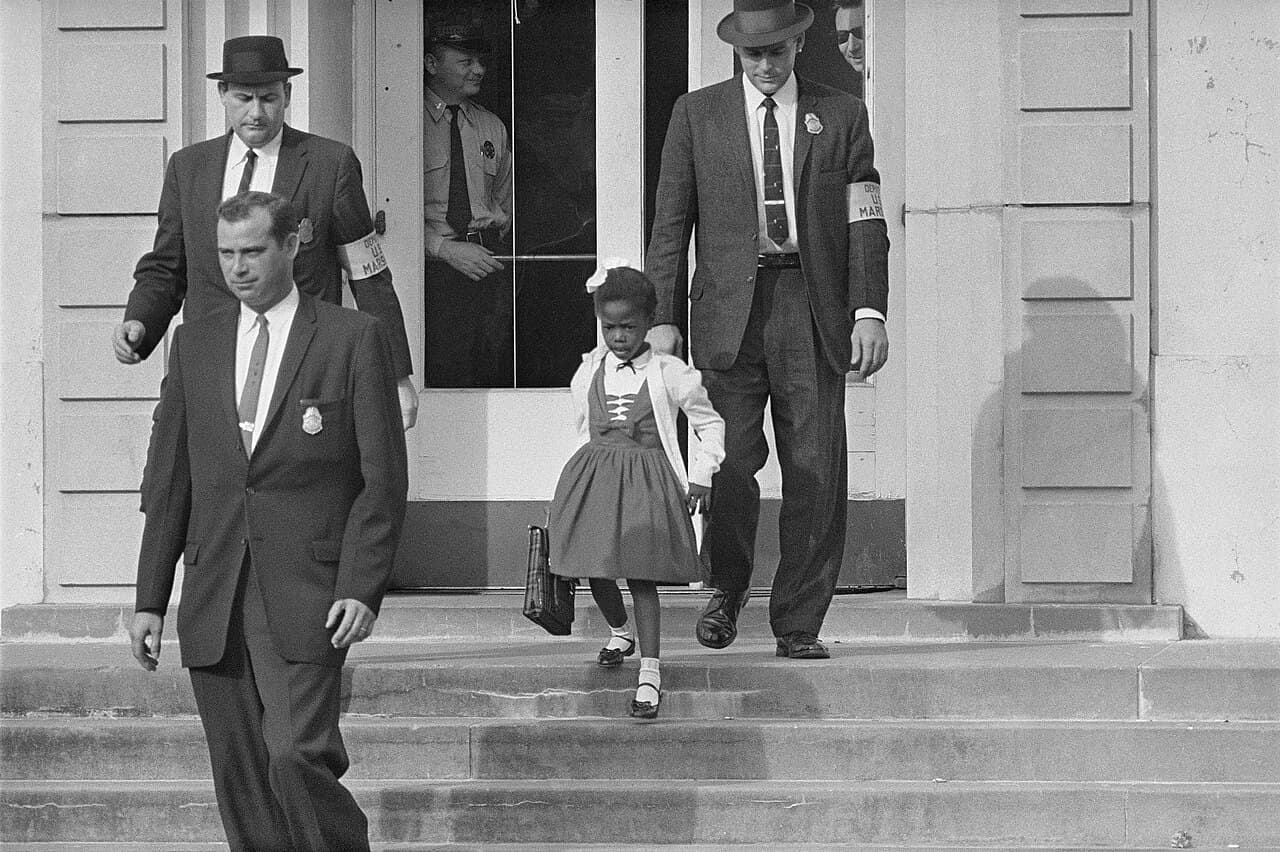
In 1960, six-year-old Ruby Bridges was escorted by four federal marshals into an all-white school in New Orleans. She spent an entire year as the only student in her classroom. That single act of courage forever changed the history of American public education.
The Six-Year-Old Girl Who Walked Alone — Ruby Bridges
The Girl Who Passed the Test
In 1954, the United States Supreme Court handed down a landmark decision. Brown v. Board of Education — "Separating Black and white children in public schools is unconstitutional." But even after the ruling, schools across the American South refused to budge. The law had changed, but reality had not.
Six years later, in 1960, a federal court finally ordered the desegregation of public schools in New Orleans, Louisiana. A test was administered to select Black children who would attend white schools, and six-year-old Ruby Nell Bridges passed it.
Ruby's father, Abon, was against it. "It's too dangerous. We shouldn't send her there." But her mother, Lucille, saw it differently.
"If my child has a chance to get a better education, we have to take it. If we don't go, the children who come after her won't be able to go either."
And so began the bravest school commute in American history.
November 14, 1960 — That Morning

On the morning of November 14, 1960, six-year-old Ruby Bridges left her house wearing a white ribbon in her hair, a crisp white blouse, and a checkered skirt. She was flanked by four U.S. Marshals.
Their destination: William Frantz Elementary School — an all-white school in New Orleans.
Hundreds of white protesters had gathered outside the school. They screamed obscenities and threats, waving signs that read "Go back where you came from." Someone threw tomatoes at the child. One woman held a small coffin containing a Black doll — a message: "This is what will happen to you."
The six-year-old girl walked between the marshals' legs. Years later, Ruby recalled:
"I thought it was Mardi Gras. There were so many people."
The child didn't understand why the crowd was shouting, or that the hatred was directed at her.
The Empty Classroom
The moment Ruby entered the school, it was deserted. White parents had pulled every single child out. Teachers refused to teach a Black student — all except one.
Barbara Henry — a young teacher from Boston.
Barbara Henry welcomed Ruby into an empty classroom. Twenty-five empty desks surrounded them. One student. One teacher.
"The moment I met Ruby, I knew she was a special child. And I knew I had to give her the best education I possibly could."
For an entire year, Barbara Henry taught Ruby alone. Arithmetic, storybooks, drawing pictures together. The world had rejected this child, but inside that classroom, there was a safe universe built for two.
Every Day Was a Battle
Ruby's walk to school wasn't a one-time event. Every single day, she was escorted by federal marshals. Every day, she walked past an angry mob.
The threats escalated. Ruby's father was fired from his job. The family's grocery store refused to serve them. Her grandparents were evicted from their sharecropping land in Louisiana.
But even in the darkness, there was light. A white neighbor prepared food for Ruby's family every day. Letters of encouragement arrived from across the country. One grandmother wrote: "Angels are walking beside you on that path."
What gave young Ruby the most strength was prayer. Every morning when she arrived at school, she would stop in front of the crowd and pray quietly.
"Please, God, try to forgive these people. Because even if they say those bad things, they don't know what they're doing."
Federal Marshal Charles Burks later testified:
"I never saw fear in Ruby. She was like a little soldier."
Norman Rockwell's Painting — Awakening America's Conscience
In 1964, America's beloved illustrator Norman Rockwell captured this moment in a painting: "The Problem We All Live With."
A small Black girl in white walks between four towering marshals. On the wall behind her, the word "NIGGER" is scrawled alongside the splatter of a thrown tomato. But the girl walks forward, eyes straight ahead. Without fear. With dignity.
The painting was published as a centerfold in Look magazine, and it sent shockwaves across America. The weight that a six-year-old child had been forced to carry became impossible for anyone to ignore.
The Beginning of Change
After Ruby's first year, something shifted. When the next school year began, a few white children returned. The classroom was no longer empty.
That change spread beyond New Orleans, rippling across the entire nation. The path Ruby Bridges walked became a catalyst for the Civil Rights Act of 1964 and the desegregation of American public education.
Barbara Henry and Ruby lost touch for 35 years. When they reunited in the early 2000s, they embraced and wept. Barbara said:
"Ruby, do you know how brave you were? You changed this country when you were six years old."
Ruby's Prayer Continues
Ruby Bridges is still alive today. She founded the Ruby Bridges Foundation, dedicated to promoting racial harmony and educational equality. She visits schools across the country, telling her story to children.
In 2011, President Barack Obama hung Norman Rockwell's painting in the West Wing of the White House. He then invited Ruby Bridges to see it. The little girl who had once been escorted to school by federal marshals now stood beside America's first Black president, looking at a painting of her own courage — one of the most beautiful moments in the story of American democracy.
Ruby always tells children the same thing:
"Racism is a disease. And babies are not born with it. It's taught. And anything that can be taught can be untaught."
A six-year-old girl's small footsteps tore down the walls of American public education. A child who sat alone in an empty classroom created a world where all children could sit side by side. What Ruby Bridges proved is a simple but profound truth:
Courage has no age requirement. And someone always has to take the first step.
"I didn't go to that school to make history. I just wanted to go to school." — Ruby Bridges
Get new posts by email ✉️
We'll notify you when new posts are published