"Don't Move, I've Got You" — The Story of Wesley Autrey, the Subway Hero Who Jumped onto the Tracks
On January 2, 2007, a New York construction worker leaped onto subway tracks to shield a stranger suffering a seizure, with a train passing just inches above their bodies. Wesley Autrey's split-second act of courage made him one of America's most celebrated everyday heroes.
The Day an Ordinary Father Became New York's Greatest Hero
January 2, 2007 — 137th Street Station, Manhattan
The new year was barely two days old when Wesley Autrey, a 50-year-old construction worker and Navy veteran, stood on a Manhattan subway platform with his two young daughters — four-year-old Syshe and six-year-old Shuqui. It was a Tuesday morning routine: drop the girls off with their mother, then head to a job site. Nothing about the day suggested it would become one of the most celebrated moments of human courage in modern American history.
Then a young man collapsed.
Cameron Hollopeter, a 20-year-old film student, suffered a violent seizure near the platform edge. He staggered, stumbled, and fell off the platform directly onto the subway tracks. Bystanders screamed. Some froze. Some stepped backward.
And at the far end of the tunnel, two headlights were approaching fast.
A Half-Second Decision
Wesley didn't deliberate. He didn't weigh the odds. He didn't calculate clearances.
He shouted to his daughters — "Stay right there! Don't move!" — and jumped.
He grabbed Hollopeter, who was still convulsing, and dragged him into the shallow drainage trough between the two rails. The trough was barely 20 inches deep. Wesley pressed his body flat on top of the young man, pinning him down with every ounce of his weight.
"Don't move, I've got you," he whispered.
The train roared into the station. The motorman saw the frantic waving of passengers and hit the emergency brake, but momentum carried the train forward. Five cars passed over the two men before the train came to a full stop.
The clearance between the undercarriage of the train and Wesley's back was roughly two inches. The grease from the train's underside left a dark smear across the top of his knit cap.
Two inches. That was the margin between life and death.
"We're Okay Down Here!"
Chaos erupted on the platform. Passengers screamed. Wesley's daughters burst into tears. A woman grabbed the girls and held them tight. Transit workers radioed for an emergency power shutdown.
Then, from beneath the train, a voice rang out:
"We're okay down here! Tell my daughters their father is all right!"
The platform erupted — screams turned to cheers, tears of horror became tears of relief. When rescue crews finally moved the train and extracted both men, Wesley was completely uninjured. Hollopeter, aside from the aftereffects of his seizure, was unharmed.
Wesley climbed back onto the platform, hugged his daughters, and reportedly said: "I don't feel like I did something spectacular. I just saw someone who needed help."
A City — and a Nation — Responds
The story detonated across every media outlet in the country. Within hours, Wesley Autrey was dubbed the "Subway Hero," and his face was on every front page and every evening newscast.
The recognition came swiftly and from every direction:
- New York City Mayor Michael Bloomberg awarded him the Bronze Medallion, the city's highest civilian honor.
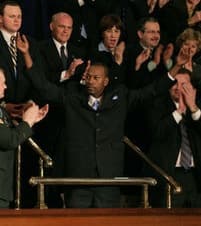
- President George W. Bush invited Wesley to the 2007 State of the Union Address. When the president acknowledged him from the podium, the entire United States Congress rose in a sustained standing ovation.
- Donald Trump handed him a $10,000 check. The New York Film Academy offered a full scholarship to his daughters. Disney World flew the family to Orlando. Gifts, job offers, and speaking invitations poured in from across the nation.
- The City of New York later renamed the day in his honor.
But through it all, Wesley remained strikingly modest. When reporters pressed him on what made him different from the roughly 75 other people on that platform — all of whom saw the same emergency and none of whom jumped — his answer was simple:
"I just did what anyone would do. Somebody had to help that guy. I was just the closest one."
What the Numbers Don't Tell You
The physics of that morning are staggering. A New York subway train weighs approximately 40 tons per car. Five cars — 200 tons of steel — rolled over Wesley and Cameron at a speed that, even while braking, was still considerable. The drainage trough gave them perhaps 20 inches of vertical space. Wesley, a stocky man, had to flatten himself and another adult male into that sliver of clearance.
But the numbers don't capture the real weight of the moment: a father who had every reason in the world not to jump — two little girls standing right there on the platform, watching — chose to jump anyway.
He later told interviewers that his thought process was instantaneous: "I just felt I had enough body room down there to fit. I saw the guy, I saw the train, and I just went."
There was no guarantee. There was no safety net. There was only a father's instinct that he could not watch a young man die when his body might be enough to save him.
The Deeper Lesson
Wesley Autrey was not a firefighter, not a police officer, not a trained paramedic. He was a construction worker — a man who built things with his hands and rode the subway to work every day. He had no equipment, no protocol, no backup plan. What he had was a moral reflex so deeply embedded that it overtook every rational calculation of self-preservation.
In the years since, Wesley has spoken at schools, churches, and community events. His message is always the same: heroism is not a superpower. It's a choice. And it's available to everyone.
"You don't have to be special to do something good. You just have to be willing."
Approximately 75 people stood on that platform. They all saw Cameron Hollopeter fall. They all saw the train coming. They all had the same few seconds to act. Only one person jumped.
Not because he was fearless. Not because he had calculated the clearance. But because, in that fraction of a second, the voice inside him that said "someone needs help" was louder than the voice that said "you might die."
That is the definition of courage.
Epilogue
Wesley Autrey continued working in New York construction after the incident and raised his daughters in the city. Cameron Hollopeter made a full recovery and resumed his studies. The two men stayed in touch, bound forever by a moment that lasted only seconds but meant everything.
Wesley's knit cap — the one with the grease stain from the train's undercarriage — became one of the most iconic artifacts of everyday heroism in modern America. It sits as a quiet reminder: sometimes the distance between an ordinary morning and an extraordinary act of love is exactly two inches.
And sometimes, all it takes is one person willing to jump.
Get new posts by email ✉️
We'll notify you when new posts are published