The Father Who Jumped Onto the Subway Tracks — Wesley Autrey, New York's "Subway Hero"
In January 2007, construction worker Wesley Autrey leaped onto the New York City subway tracks to save a stranger who had fallen after suffering a seizure. With a train bearing down and his two young daughters watching from the platform, Autrey pinned the man between the rails as five cars passed over them both — and both survived.
The Father Who Jumped Onto the Subway Tracks — Wesley Autrey, the "Subway Hero"
An Ordinary Tuesday Afternoon
On January 2, 2007, Wesley Autrey, a 50-year-old construction worker and Navy veteran, was standing on the platform of the 137th Street–City College subway station in Harlem, Manhattan. He was holding the hands of his two daughters — Syshe, age four, and Shuqui, age six — waiting for the downtown 1 train. It was an unremarkable winter afternoon. Nothing about the moment suggested it was about to become one of the most extraordinary acts of heroism in modern American history.
Autrey was born in 1956 in Pensacola, Florida. After serving in the United States Navy, he moved to New York City and worked in construction. He wasn't a firefighter, a police officer, or a paramedic. He was simply a working father trying to get his girls where they needed to go.
A Stranger Falls
At approximately 12:45 p.m., a young man standing nearby on the platform began to convulse. Cameron Hollopeter, a 20-year-old film student, was suffering a seizure. He stumbled, lost his balance, and tumbled off the platform edge onto the subway tracks below.
Autrey and two women initially tried to help Hollopeter back up, but before they could pull him to safety, Hollopeter stumbled further between the rails. Then Autrey saw it — the headlights of an approaching 1 train, barreling toward the station.
There were more than 75 people on that platform. Most screamed. Some recoiled in horror. Some covered their eyes.
Wesley Autrey did something else entirely.
Two Seconds to Decide
He turned to his daughters and shouted, "Don't move!" Then he jumped.
Autrey leaped off the platform and landed on the tracks beside the disoriented Hollopeter. In the seconds he had left, he made a rapid calculation: there wasn't enough time to lift the young man back onto the platform. Instead, Autrey pushed Hollopeter down into the shallow drainage trench that runs between the two rails — a gap barely deeper than a foot. He then threw his own body on top of Hollopeter, pressing the young man's head down and holding him flat with all his weight.
The train operator saw them and hit the emergency brakes, but momentum carried the train forward. Five full cars passed over the two men before the train came to a complete stop.
On the platform above, witnesses were screaming. Autrey's two little girls had just watched their father disappear beneath a subway train. The horror was unbearable.
A Voice from the Darkness
Then, from beneath the train, a voice rang out:
"We're okay down here! But I've got two daughters up there — let them know their father is okay!"
It was Wesley Autrey, alive and conscious, still lying on top of Cameron Hollopeter between the rails. The clearance between the bottom of the train and Autrey's body had been mere inches. Grease from the train's undercarriage had smeared across his knit cap — that's how close it had been. A fraction of an inch less, and neither man would have survived.
Emergency responders arrived and carefully extracted both men from beneath the train. Miraculously, neither suffered serious injuries. Hollopeter was treated for his seizure-related condition. Autrey walked away with nothing more than scrapes and a grease-stained hat.
A City — and a Nation — Responds
The story of the subway hero spread like wildfire. Within hours, every major news outlet in the country — The New York Times, CNN, ABC, NBC, CBS, Fox News — was broadcasting the story. The name Wesley Autrey was on everyone's lips.
New York City Mayor Michael Bloomberg awarded Autrey the Bronze Medallion, the city's highest award for exceptional citizenship and outstanding achievement. Bloomberg called it "one of the most selfless acts of bravery in the city's history."
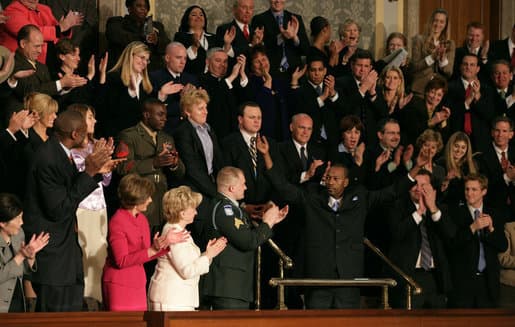
President George W. Bush invited Autrey to the 2007 State of the Union Address as a special guest. When Bush acknowledged him from the podium, the entire United States Congress rose to its feet in a sustained, thunderous standing ovation. Autrey, visibly moved, simply waved and smiled.
The outpouring of gratitude was immense. Donald Trump sent a $10,000 check. Disney World offered a free family vacation. The New York Film Academy provided a full scholarship for Autrey's children. Gifts, letters, and offers poured in from across the country and around the world. Gap Inc., the clothing company, gave him a year's worth of free clothing. The Ellen DeGeneres Show and David Letterman's Late Show both hosted him.
"I'm Not a Hero"
Through it all, Autrey remained remarkably humble. In interview after interview, he repeated the same simple message:
"I'm not a hero. I just saw someone who needed help. I did what I felt was right. I think anyone would have done the same thing."
But here is the profound truth that makes his humility all the more powerful: there were more than 75 people on that platform. Dozens witnessed Hollopeter fall. They all saw the train approaching. Only one person jumped.
It's easy to say we would act in the moment. It's easy to believe that courage would find us when it mattered most. But the reality of human behavior in crisis situations tells a different story. Psychologists call it the bystander effect — the tendency for individuals to be less likely to help when others are present. Wesley Autrey defied every statistical prediction about human inaction. He didn't freeze. He didn't rationalize. He didn't wait for someone else. He jumped.
And he did it with his two young daughters watching.
The Weight of That Choice
This is perhaps the most extraordinary dimension of the story. Autrey wasn't a single man with nothing to lose. He was a father. His two little girls were standing on that platform. If he had miscalculated by even an inch — if the drainage trench had been a fraction shallower, if his body had been positioned slightly differently — those two girls would have lost their father.
He knew this. In later interviews, he acknowledged the risk. But he also said something that reveals the depth of his character:
"I didn't want my daughters to see someone die. I wanted them to see their father do the right thing."
In that single sentence lies a philosophy of parenting, of manhood, of humanity. He wasn't just saving Cameron Hollopeter's life. He was teaching his daughters — in the most visceral, unforgettable way possible — what it means to be a good human being.
Legacy of an Everyday Hero
Wesley Autrey didn't retire to fame and fortune. He went back to work. He continued living in his Harlem apartment, continued working in construction, continued raising his daughters. He spoke at schools and community events, always emphasizing that heroism isn't about superpowers — it's about a willingness to act.
The story of the Subway Hero has been studied in psychology courses, ethics classes, and leadership seminars around the world. It has been cited in academic papers about altruism, bystander intervention, and moral courage. It serves as a powerful counter-narrative to the cynical view that modern urban life has stripped away human compassion.
Cameron Hollopeter recovered fully and went on to continue his education. The two men met again, and Hollopeter expressed his profound gratitude to the stranger who had risked everything for him.
Why This Story Still Matters
In an era when headlines are dominated by division, tragedy, and cynicism, the story of Wesley Autrey is a reminder of something fundamental: ordinary people are capable of extraordinary goodness.
He had no training for what he did. He had no obligation. He had every reason in the world — two small, beautiful reasons standing on that platform — to stay where he was. And yet he jumped.
Every day, millions of people ride the New York City subway. They pass through the 137th Street station, perhaps glancing at the platform where it happened. Most don't think about it. But beneath the rhythm of the trains and the hum of the city, the echo of that voice remains:
"We're okay down here. But tell my daughters their father is okay."
That voice — calm, assured, thinking of his children even while lying beneath a train — is the sound of the very best of what human beings can be.
Wesley Autrey continues to live in New York City. He has been recognized with numerous awards and honors, and remains a beloved symbol of everyday heroism. His story reminds us that the choice to act — even when it's terrifying, even when the odds seem impossible — is always available to us.
Get new posts by email ✉️
We'll notify you when new posts are published