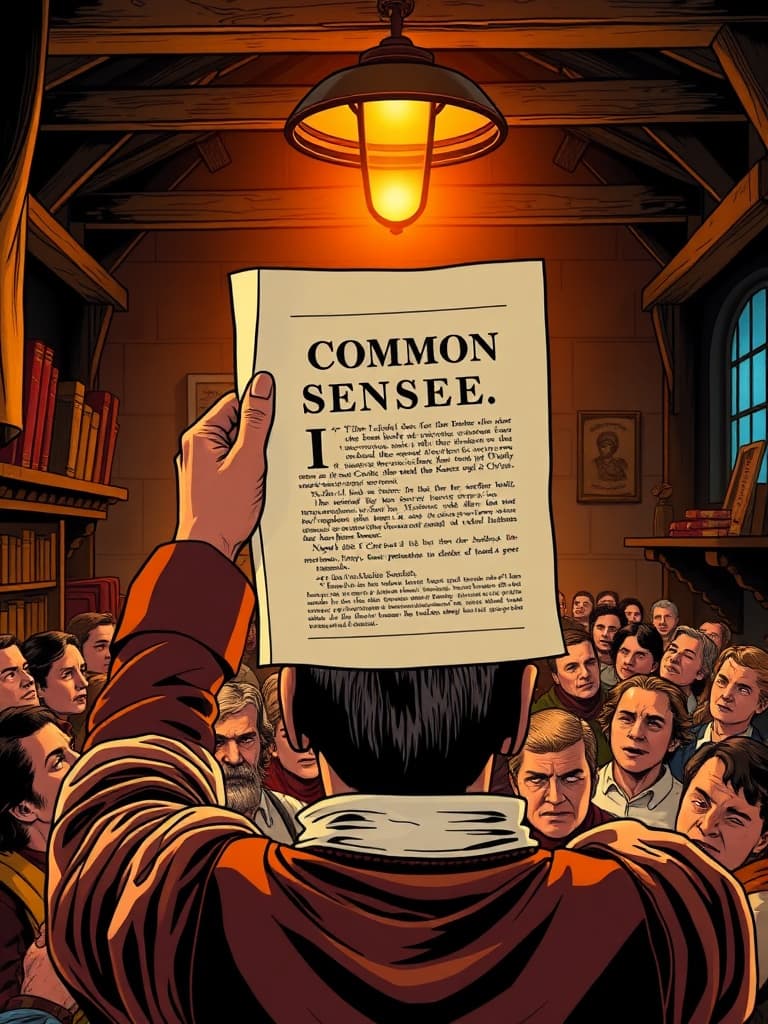
47 Pages That Made a Nation — Thomas Paine's Common Sense (January 1776)
In January 1776, a British immigrant who had been in America for barely 14 months published a 47-page pamphlet that turned 'independence' from a radical whisper into a universal demand.
Fourteen Months in America
Thomas Paine was a failure. Born the son of a corset maker in England, he had tried his hand at being a tax collector, a teacher, and a shopkeeper. He failed at all of them. Two marriages fell apart. He went bankrupt. At 37, clutching a letter of introduction from Benjamin Franklin, he boarded a ship to America.
He arrived in Philadelphia in November 1774. Nobody could have predicted that this broke, twice-divorced Englishman would reshape the political landscape of an entire continent in just fourteen months.
A 47-Page Bomb
On January 10, 1776, Paine published a pamphlet titled Common Sense. It was 47 pages long and cost two shillings. The arguments inside were simple, but they hit like a hammer.
Monarchy itself is absurd. Why should one person have the right to rule millions simply because of birth? The first king, Paine wrote, was "nothing better than the principal ruffian of some restless gang."
A small island ruling a continent defies nature. Just as the moon cannot be larger than the sun, Britain cannot govern America forever. Geography alone makes it ridiculous.
Reconciliation is now impossible. Blood had been spilled at Lexington. The king refused to even read the colonists' peace petition. He was sending foreign mercenaries. Calling for reconciliation at this point, Paine argued, was like telling a woman to go back to the husband who beat her yesterday.
Independence is the only answer.
150,000 Copies in Three Months
The pamphlet sold 150,000 copies within three months. The total population of the colonies was about 2.5 million. Adjusted for today's United States population, that would be the equivalent of roughly 20 million copies. And that number only counts purchases — copies were passed from hand to hand, read aloud in taverns, debated in town squares. The actual readership was many times the sales figure.
The key was Paine's language. He did not write like a scholar. He did not quote Latin or cite obscure philosophers. He wrote in the plain English of taverns and workshops. A farmer could understand him. A blacksmith could understand him. A barmaid could understand him. He took complex political philosophy and translated it into common sense — which, of course, became the title.
"Independence" Becomes Everyone's Word
Before Common Sense, the word "independence" was dangerous. It was whispered by radicals and dismissed by moderates. Most colonists still believed an appeal to the king could fix everything.
After Common Sense, independence became everyone's word. George Washington himself remarked: "Common Sense is working a powerful change in the minds of many men."
Perhaps the most remarkable thing about the whole episode is this: the man who changed everything was an immigrant. He had been in America for barely over a year. He had no property, no social standing, no political connections. He simply saw what people who had lived there all their lives could not see — or would not say. Sometimes it takes an outsider to state what should have been obvious all along.
Get new posts by email ✉️
We'll notify you when new posts are published