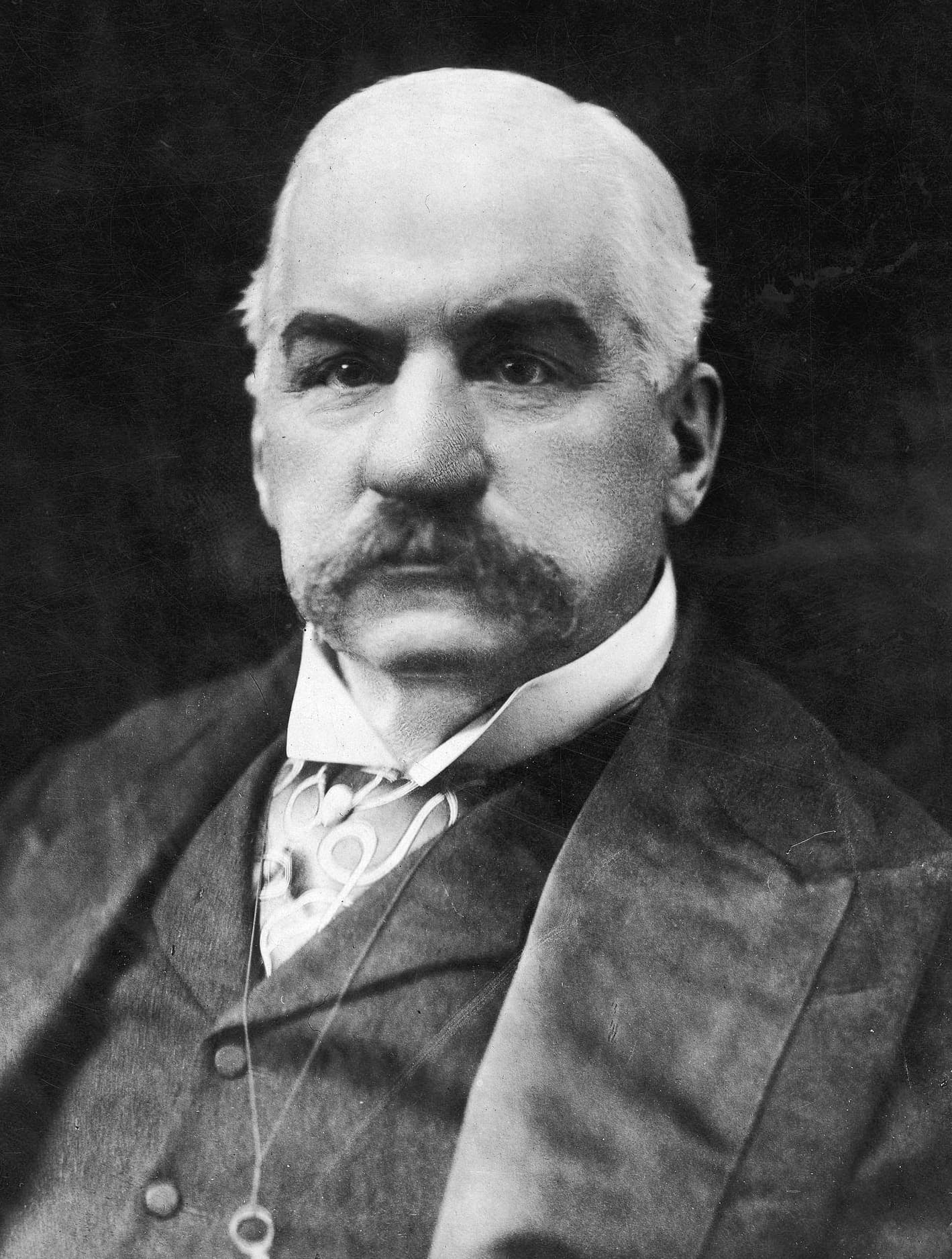
The Emperor of Wall Street — J.P. Morgan and the Birth of American Finance (1871)
The banker who saved the U.S. government twice. In 1907, one man stopped a national panic from his private library. In an age before the Federal Reserve, J.P. Morgan was the Federal Reserve.
A Banker's Son
- Connecticut.
J.P. Morgan was born into a wealthy banking family. His father Junius sold American bonds in London.
J.P. learned English, German, and French, and attended school in Switzerland. At 24, he stepped onto Wall Street.
His talent wasn't making money — it was moving money.
The Railroad Age, the Railroad King
- Morgan founded his own firm.
The defining asset of the Gilded Age was the railroad. Morgan bought failing railroads, restructured them, and rebuilt them. He called it "Morganization."
The method was simple:
- Acquire a struggling railroad
- Replace management
- Consolidate lines
- Form rate cartels
By 1900, half of America's railroad mileage was under Morgan's control.
U.S. Steel — The First Billion-Dollar Company
- Morgan handed Carnegie $480 million.
He absorbed Carnegie Steel whole, then merged it with other steelmakers. The result: U.S. Steel.
Capitalization: $1.4 billion. The first billion-dollar corporation in human history. Equal to 7% of the entire U.S. GDP at the time.
He also backed Thomas Edison. That partnership became General Electric.
1907 — One Man Stops a Panic
Autumn 1907. The U.S. financial system began to collapse.
Banks failed in chains. The stock market crashed. There was no central bank.
Morgan, age 70, summoned the nation's bankers to his private library. The meetings lasted through the night. He committed his own capital and forced other banks to do the same.
In days, the panic stopped. One private citizen rescued a nation's economy.
It shocked Washington. "No single man should have this much power."
In 1913, the Federal Reserve System was created — to do what Morgan had done.
The Last Titan
March 1913. He died in Rome. Age 75.
Wall Street halted trading for two hours during his funeral.
People were stunned by his estate: $80 million. Modest next to Rockefeller or Carnegie. Rockefeller reportedly said, "And to think, he wasn't even a rich man."
But Morgan was a different kind of rich. He didn't own money. He moved it.
Active: 1871–1913 | Railroads under control: 50% of U.S. mileage | U.S. Steel capitalization: $1.4 billion (1901) | 1907 Panic resolved: from his personal library
Get new posts by email ✉️
We'll notify you when new posts are published