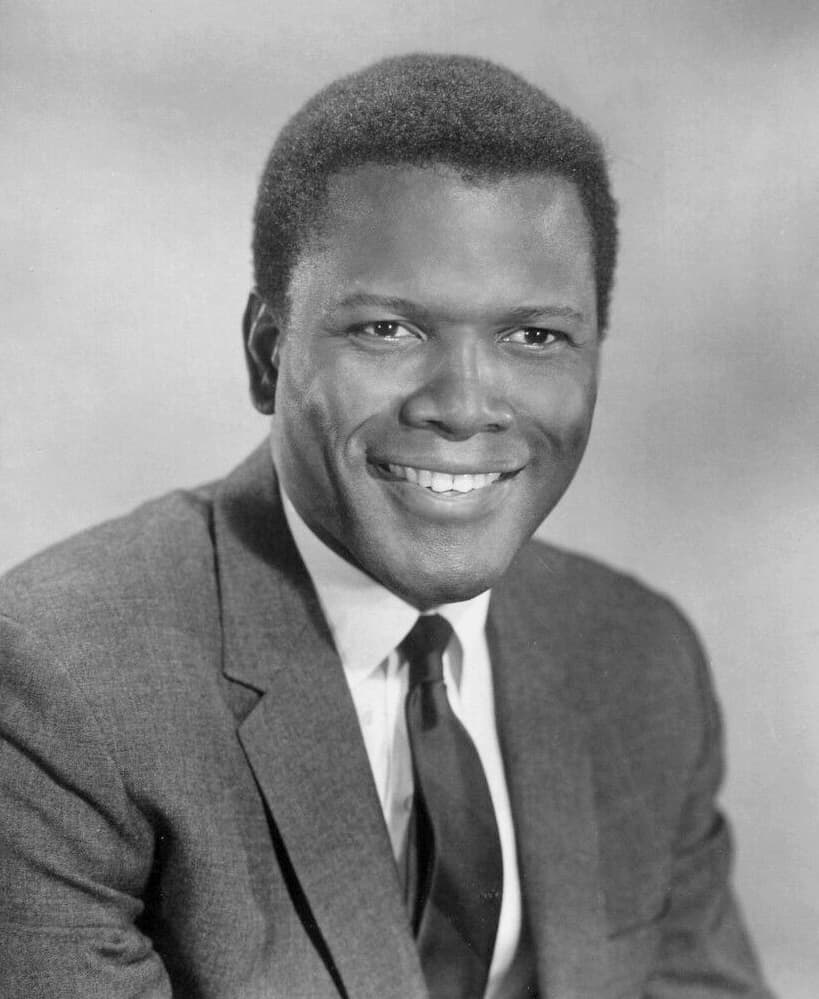
April 13, 1964 — Sidney Poitier Becomes the First Black Man to Win the Oscar for Best Actor
On April 13, 1964, Sidney Poitier became the first Black man to win the Academy Award for Best Actor. The Civil Rights Act hadn't even passed yet. This is the story of the day one actor changed Hollywood forever.
When the Envelope Opened
April 13, 1964. The 36th Academy Awards. Actress Anne Bancroft tore open the envelope for Best Actor.
"Sidney Poitier."
The audience erupted. Poitier walked to the stage. In that moment — for the first time in Hollywood's 36-year Oscar history — a Black man held the Best Actor trophy in his hands.
The Civil Rights Act had not yet been passed.
A Boy from the Bahamas
Sidney Poitier was born in Miami, Florida, in February 1927, but he grew up in the Bahamas. He was the son of a poor tomato farmer, and his formal education was minimal at best.
At sixteen, he crossed over to America alone. In New York, he washed dishes and cleaned floors. When he auditioned for the American Negro Theatre with dreams of becoming an actor, he was turned away — his accent was too thick, they said.
Poitier didn't quit. He slept with a radio playing beside him to train his ear. He read newspapers aloud to practice. Months later he auditioned again, and this time he was accepted.
The World He Walked Into
When Poitier broke into Hollywood in the late 1940s and 50s, Black actors were largely confined to roles as servants, comic relief, or criminals. A film where a Black character stood as an equal to white characters was nearly unheard of.
He refused those limits.
His 1958 film The Defiant Ones earned him his first Academy Award nomination for Best Actor — the first Black actor ever nominated in that category. He didn't win, but his name on that ballot was itself history.
Then came 1963's Lilies of the Field. A drifting Black handyman named Homer Smith helps a group of German-speaking nuns build a chapel in the Arizona desert. A quiet, simple film — and in it, Poitier played a complete human being: strong, warm, funny, dignified.
April 13, 1964
Accepting his award, Poitier was composed. His words were brief and measured.
Backstage, he reportedly said:
"I am not receiving this for myself alone. I am receiving it on behalf of all the people who came before me and walked this road."
Three months later, on July 2, 1964, the Civil Rights Act was signed into law. It was no coincidence — the currents of history were running in the same direction.
1967 — Three Films at Once
Poitier's greatest year came in 1967, when three of his films played in theaters simultaneously.
- In the Heat of the Night — A Black detective and a white sheriff reluctantly partner to solve a murder in Mississippi. It won the Academy Award for Best Picture.
- Guess Who's Coming to Dinner — A white woman brings her Black fiancé home to meet her liberal parents. Interracial marriage was still illegal in 17 U.S. states at the time of filming.
- To Sir, with Love — A Black engineer-turned-teacher breaks through to a class of tough London teenagers.
All three were box-office hits. All three confronted race directly. In 1967, the most popular movie star in America was a Black man — and Hollywood had changed.
The Door He Opened
After Poitier, the door opened, slowly at first, then wider.
In 2002, when Denzel Washington won Best Actor at the same ceremony that Halle Berry won Best Actress — the first Black woman to do so — Washington looked out at the audience and said:
"Forty years I've been chasing Sidney Poitier. They gave it to me. What did you do?"
Sidney Poitier died on January 6, 2022, at the age of 94.
History Changed Before the Envelope Opened
The Oscar was a result, not the cause. Sidney Poitier had been changing history long before April 13, 1964 — in every role he chose, in every scene he refused to make degrading, in every screen moment where a Black man stood not as a caricature but as a full human being.
The trophy that night was the accumulated weight of all those choices.
Date: April 13, 1964 | Location: Santa Monica Civic Auditorium, 36th Academy Awards | Film: Lilies of the Field (1963)
Get new posts by email ✉️
We'll notify you when new posts are published