10,000 GitHub Stars Overnight — How GPT Engineer Became Lovable
In the summer of 2023, an open-source project by a Swedish developer captivated developers worldwide overnight. A world where you describe an app in words and it gets built. From GPT Engineer to Lovable — the story of its creation.
What Happened Overnight
One night in June 2023, an unfamiliar name appeared on the GitHub trending page.
GPT Engineer.
Within hours, it had thousands of stars. By the next morning, it had tens of thousands. Short videos circulated on Twitter (X) showing people describing what they wanted in plain English and getting a working app. Developers were in disbelief; non-developers were thrilled.
The person who uploaded the project was Anton Osika, a Swedish developer.
Who Is Anton Osika

Anton Osika is a Stockholm-based developer and entrepreneur.
He studied engineering at KTH Royal Institute of Technology, one of Sweden's most prestigious technical universities, and later built his career in machine learning and software. He also worked at Sana Labs, an AI education startup.
His reason for creating GPT Engineer was simple.
"People who are not developers should also be able to turn their ideas into software."
No complex code needed — just describe what you want in natural language and get a working app. That dream, implemented in code, was GPT Engineer.
"This Project Will Make Developers Obsolete"
GPT Engineer was straightforward.
Run it in the terminal and describe what you want in English. The AI designs the file structure, writes the code, and completes the entire project.
"Build me a to-do list app. I need features for adding items, checking them off, and deleting them."
A few minutes later, a working web app was ready.
Reactions at the time were polarized.
Some warned that "the era when developers are no longer needed is coming." Others dismissed it, saying "it still has a long way to go — it cannot build anything complex." But one thing was clear: the barrier to entry for software development had begun to shake.
Within just days of being posted on GitHub, GPT Engineer received over 50,000 stars. It was one of the fastest-growing projects on GitHub in the first half of 2023.
From Open Source to Product
After the open-source frenzy passed, Anton faced a crossroads.
Leave this technology as a hobby project, or turn it into a real product.
He chose the latter.
From late 2023 to early 2024, Anton and co-founders established a company and began full-scale product development. Building on the open-source GPT Engineer, they decided to create a web-based service that anyone could easily use.
And they changed the brand name.
GPT Engineer to Lovable.
The Name "Lovable"

The name Lovable carries two meanings.
First, "you can build lovable products" — a declaration that the tool will help users create apps people genuinely love.
Second, "a tool anyone can love" — an aspiration to enable not just developers but designers, planners, entrepreneurs, and even people with zero coding knowledge to turn their ideas into apps.
Unlike the technical name "GPT Engineer," "Lovable" reaches toward a much broader audience.
What Lovable Changed
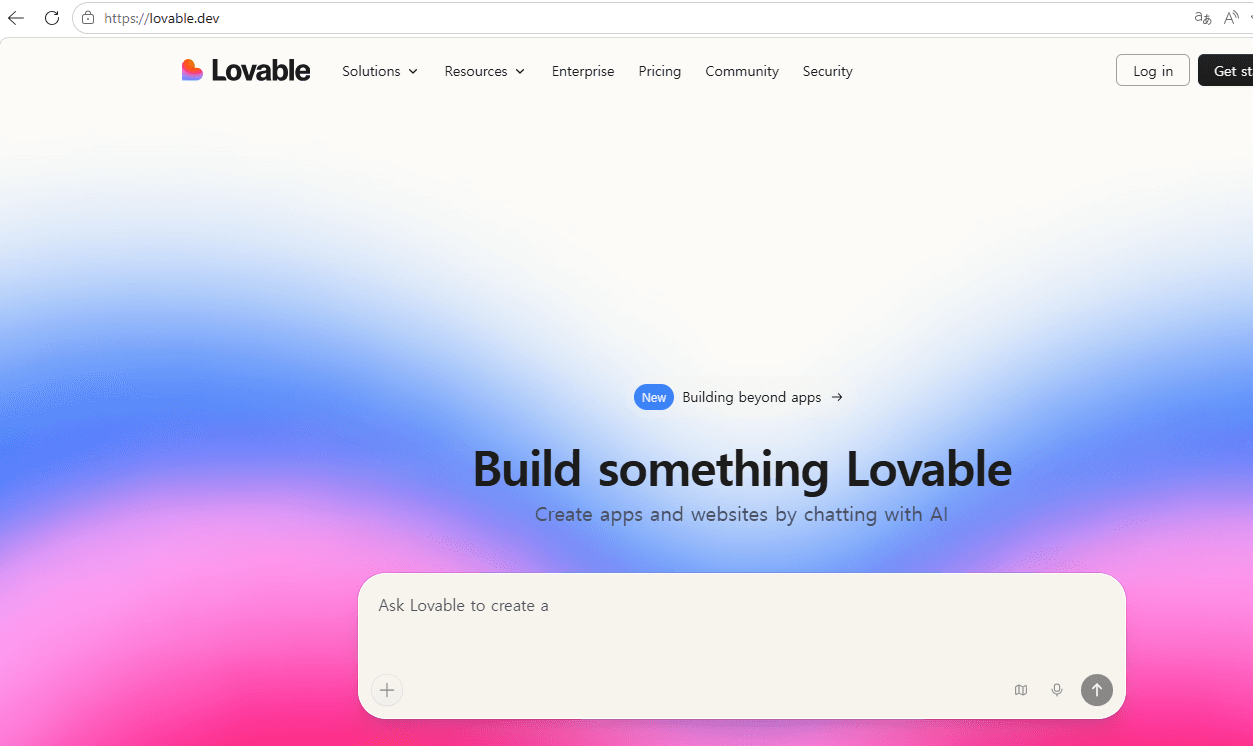
Lovable's core value proposition is building full-stack apps through conversation alone.
When a user describes the app they want in text, Lovable automatically generates React-based frontend code and backend logic. The finished app is immediately ready for deployment.
What makes it different from existing no-code tools?
Traditional no-code tools worked by assembling pre-built blocks. What you could do was predetermined, and stepping outside those boundaries meant you could do nothing at all.
Lovable is different. Code is generated directly. The limitation is not the types of blocks available but the AI's comprehension. Modifications can also be made through conversation. "Change the button color to blue," "Add a login feature" — each of these requests translates into actual code changes.
The Startup's Growth
In 2024, Lovable began attracting venture capital attention.
Standing out in Sweden's startup ecosystem, Lovable completed an initial seed round and went on to secure additional funding, expanding its team. Based in Stockholm, the company develops alongside a global remote team.
The growth rate is particularly noteworthy.
Since launch, hundreds of thousands of users have built apps through Lovable. Use cases began emerging from diverse fields — not just developers, but marketers, teachers, small business owners, and more. Testimonials like "I built an app without knowing code" spread across social media, creating organic word-of-mouth growth.
"The Age of the Non-Technical Builder"
Lovable poses a single question.
"Should the ability to create software remain exclusive to programmers?"
Doctors, teachers, novelists, chefs. They all have problems they want to solve in their respective fields. They know what tools they need. But they could not build them because they did not know how to code.
Lovable aims to tear down that wall.
Of course, there are still limitations. Very complex systems or specialized requirements still need professional developers. AI-generated code is not always perfect. But the direction is clear. As AI improves, the range of what Lovable can build will continue to expand.
One Open-Source Upload Created a Company
 Lovable's home base: Stockholm, Sweden
When Anton Osika uploaded a few lines of code to GitHub, he may not have been thinking of starting a company. It might have just been sharing an interesting experiment.
But the world responded.
50,000 GitHub stars were not just a number. They were a signal saying, "We needed something like this." It was the collective voice of hundreds of thousands of developers and non-developers crying out at the same time.
Lovable is the answer to that voice.
One open-source upload, one viral moment, and a world where millions can build apps.
This is the story of Lovable.
Get new posts by email ✉️
We'll notify you when new posts are published