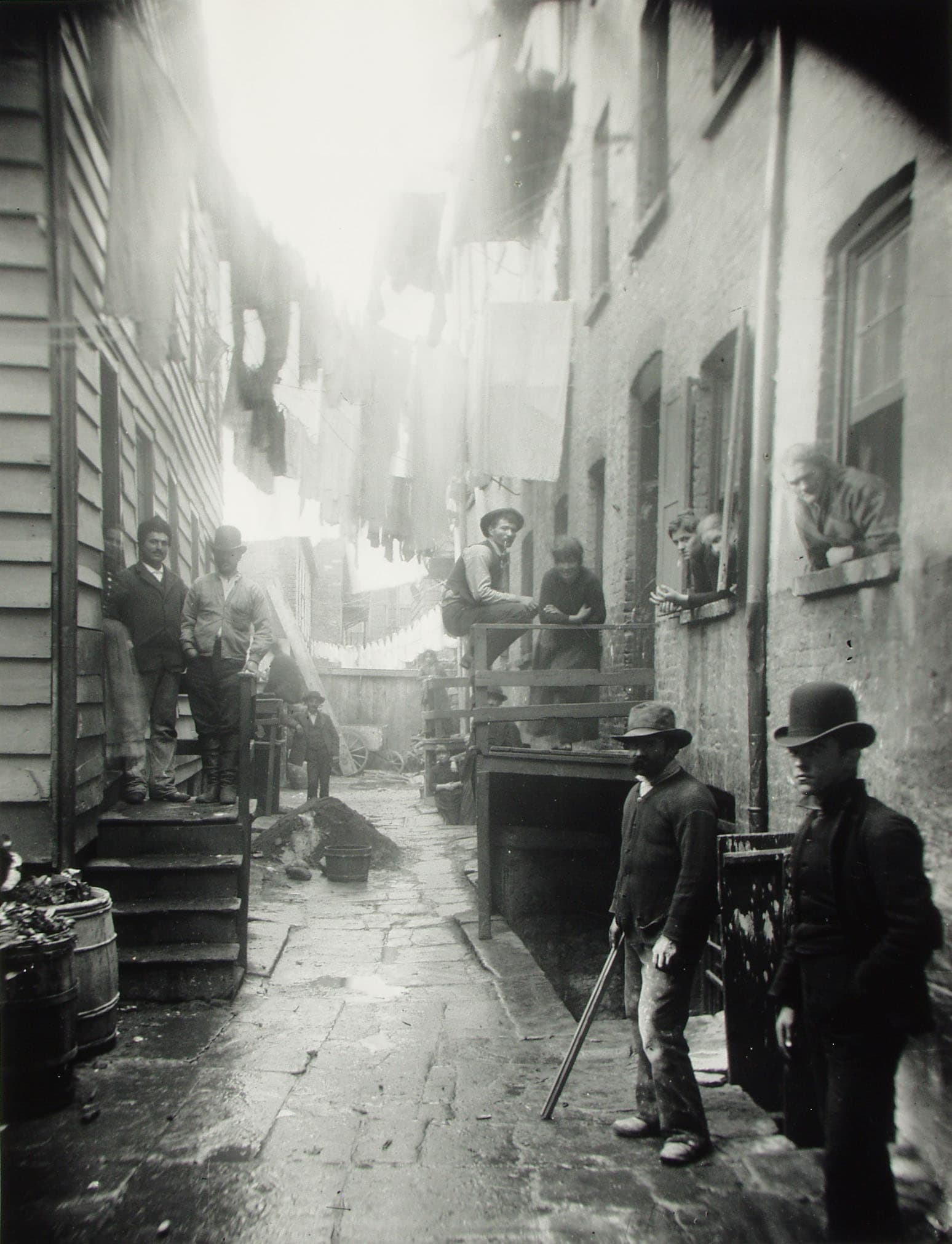
One Photograph That Changed America #1 — Mulberry Alley, 1888
Spring 1888, a narrow alley off Mulberry Street, New York. Jacob Riis took 'Bandit's Roost.' Thirteen years later, that single photograph produced America's first tenement law.
About this series — Each episode covers a single photograph that directly changed a law, a policy, or America's conscience. Ten episodes. This is the first.
Spring 1888, That Alley
59½ Mulberry Street, Manhattan, New York.
A narrow, dark alley. Six men leaning against the walls on either side. Sticks in their hands. Eyes locked dead-on the camera.
The instant the flash fires — their faces are pinned to history forever.
The photograph's name: "Bandit's Roost."
The photographer: Jacob A. Riis, age 38, police reporter for the New York Tribune.
Why This One Image
In 1888 Riis took hundreds of slum photographs. Tenement interiors. Homeless shelters. Opium dens. Child laborers.
But "Bandit's Roost" was different.
- The subjects stare back. In the others, people slept or turned away.
- The alley's tightness is visible. About five feet wide. No sunlight reaches it.
- A sense of menace. The viewer cannot enter that street. That you cannot enter was the problem.
Riis didn't plan it. A single accidental frame. But that frame became the cover of his book.
November 1890: The Book
Riis bound about forty photographs, including this one, into a volume:
"How the Other Half Lives: Studies among the Tenements of New York."
The book that finally let wealthy New Yorkers see the slum interior. Instant bestseller. Five printings.
Photographic halftone printing was not yet stable for newspaper reproduction in 1890, so the book combined photographs with line drawings. But what shook readers was the photographs.
One Person Read That Book
The New York Police Commissioner — Theodore Roosevelt.
He read the book and left his calling card at Riis's office. The note on the card: "Tell me what I can do to help."
The two of them later walked the slums together at midnight. Riis insisted on it: "You don't know it until you see it."
Roosevelt was shaken. For the rest of his life he called Riis "the most useful citizen I ever knew."
That meeting became one of the starting points of America's Progressive Era.
The Photograph Moved Congress
After Riis's book, the laws that passed:
- 1895: New York City — windows mandatory in every tenement (ventilation, light)
- 1901: New York State Tenement House Act
- Mandatory toilets in every new tenement
- Mandatory fire escapes
- Compulsory sanitation inspections
- 1916: New York City Zoning Resolution — America's first urban planning regulation
Tenement population in New York City when the 1901 law passed: about 2.3 million people.
A change that began with one photograph reshaped 2.3 million lives.
Where the Photograph Is
The original glass-plate negative is held at the Museum of the City of New York.
Riis's collection was donated to the museum by his son in 1947. Restored in the 1980s, it is now in the museum's digital archive.
Before Riis, the photograph was a record. After Riis, the photograph became a weapon.
Next episode (4/30) — #2 Lewis Hine. A ten-year-old girl stood beside a spinning machine. That single photograph banned child labor in America thirty-eight years later.
Photographed: Spring 1888 | Book published: November 1890 | NY Tenement Act passed: April 1901 | People affected: ~2.3 million | Held at: Museum of the City of New York
Get new posts by email ✉️
We'll notify you when new posts are published