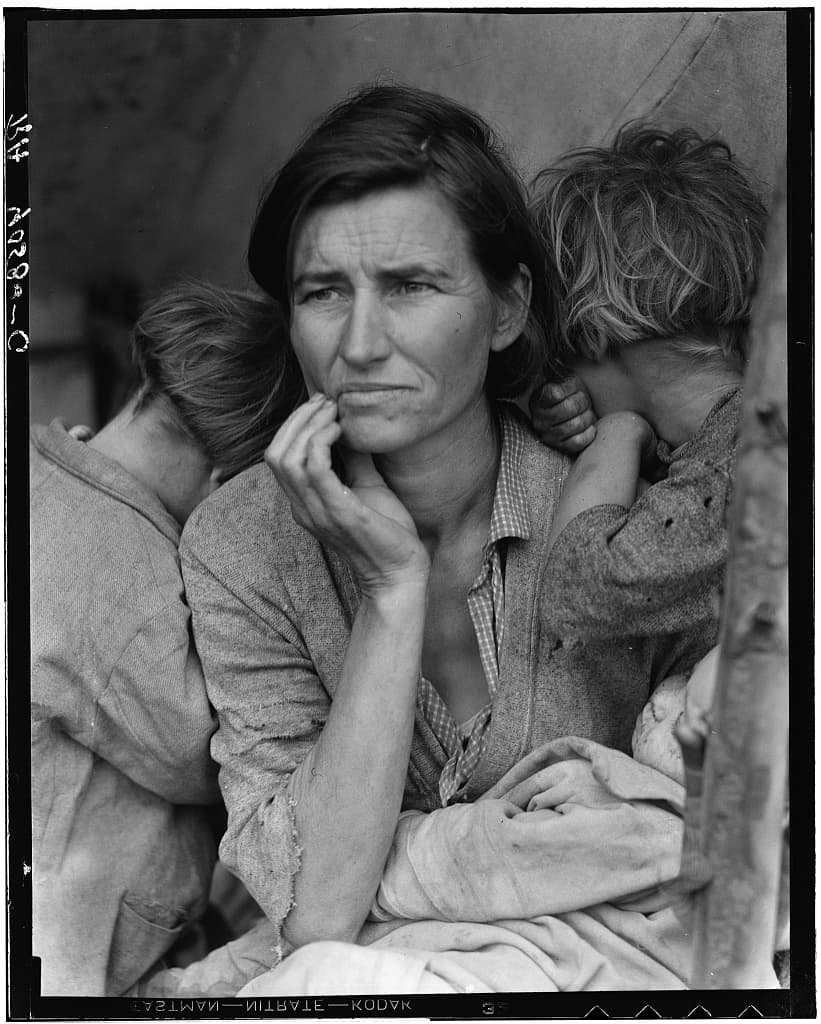
The Eyes of a Thirty-Two-Year-Old Mother — How Dorothea Lange's Photo Moved the New Deal
A pea-picker's camp in California, 1936. One photograph by Dorothea Lange triggered the fastest government emergency relief in American history.
One Photo That Changed America #003
The Eyes of a Thirty-Two-Year-Old Mother
March 1936. A pea-picker's camp near Nipomo, California.
Dorothea Lange was driving home. She had already passed the camp when something pulled her back. She turned the car around. Through the window she saw a muddy tent. And inside it, a woman sitting still.
Lange walked in with her camera. They barely spoke. She never asked the woman's name. She took five photographs. On the last one, the lens met the woman's eyes.
She pressed the shutter.
The woman was Florence Owens Thompson. Thirty-two years old. Two children buried their faces in her shoulders. A baby slept in her arms. Her car had broken down. Her family of seven sat stranded in front of a frozen pea field with nothing to eat.
What the Depression Made
After the Wall Street Crash of 1929, American unemployment reached 25 percent. Farmers in Oklahoma, Texas, and Arkansas — their land turned to dust by drought and sandstorms — loaded their trucks and headed west on Route 66. California was the promised land.
What awaited them was seasonal labor. Peas, cotton, fruit. Day wages. In 1936, California's pea crop froze. The harvest failed. The work vanished.
Florence had sold the car's tires to buy food. Now there was none left.
Why Lange Pressed the Shutter
Dorothea Lange was working for the Farm Security Administration (FSA), documenting migrant workers across the country. She was already on her way home when she stopped.
She later wrote:
"I was drawn to her as if by a magnet. The way a hungry bird is drawn to another hungry bird. I did not ask her name. I did not ask her story. I knew what she was going to tell me."
Lange drove back to San Francisco with the film. When she saw the developed photographs, she called the editor of a newspaper.
What Happened Next
Within 72 hours of publication, the federal government acted.
The San Francisco News ran the photograph on its front page with the headline:
"Look at this woman. 20,000 migrant workers are starving in California."
Reader calls flooded in. Congressional offices contacted the Department of Agriculture. The government moved.
Within 72 hours of publication, the federal government airlifted nine tons (20,000 pounds) of food to the Nipomo camp. It was the fastest government emergency response ever triggered by a single photograph in American history.
Florence and her family had already moved on. They never received any of the food.
What the Photo Built
The immediate relief was only the beginning. Lange's photograph became the central justification for FSA programs in Congress.
- FSA migrant worker camp budgets were dramatically increased
- California established formal housing support programs for migrant workers
- The image became the defining symbol of New Deal relief policy
Migrant Mother became the single photograph of the Great Depression era — on postage stamps, in textbooks, in museums around the world.
What Became of Florence
Florence Owens Thompson did not reveal herself as the woman in the photograph for decades. Not out of shame — but because the photograph had earned her nothing.
In 1978, she finally spoke publicly for the first time.
"I hope it helped people in need. It was my story. But I never got anything out of it."
She died in 1983 at eighty years old. Her family could not afford the funeral. People who had seen the photograph raised $35,000 for her burial.
Where the Photo Lives Now
Dorothea Lange's original negatives for Migrant Mother — all six frames from that afternoon — are held at the Library of Congress, FSA/OWI Collection. Freely viewable online.
Next — #004: Birmingham, Alabama, 1963. A police dog lunges at a sixteen-year-old boy. Charles Moore's camera catches the moment. President Kennedy picks up the phone.
Get new posts by email ✉️
We'll notify you when new posts are published