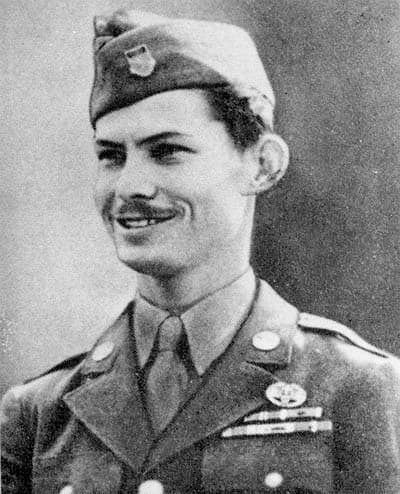
"Lord, Let Me Get One More" — Desmond Doss, the Soldier Who Saved 75 Lives Without Firing a Single Shot
At the Battle of Okinawa in 1945, a combat medic who refused to carry a weapon single-handedly lowered 75 wounded soldiers down a 35-meter cliff under relentless enemy fire. Desmond Doss became the first conscientious objector in American history to receive the Medal of Honor.
The Soldier Who Refused to Kill — and Saved More Lives Than Anyone
A Boy in Lynchburg
Desmond Thomas Doss was born on February 7, 1919, in Lynchburg, Virginia. His father William, a World War I veteran haunted by what he'd witnessed in the trenches, struggled with alcoholism and episodes of violence. One night, young Desmond watched his father pull a pistol during an argument with an uncle. His mother Bertha wrestled the gun away and handed it to Desmond to hide.
That moment, paired with a framed illustration of the Ten Commandments hanging in the family living room — showing Cain standing over the body of Abel beside the words "Thou shalt not kill" — forged an unshakable conviction in the boy's heart.
"I knew then," Doss later recalled, "that I could never take another man's life."
Raised as a devout Seventh-day Adventist, Desmond held fast to two principles: observe the Sabbath, and never bear arms against another human being. These were not abstract beliefs. They were the bedrock of his identity.
Enlisting — Without a Weapon
When Pearl Harbor was bombed on December 7, 1941, Desmond felt the same surge of patriotic duty as millions of other young American men. He wanted to serve his country. But he would not carry a rifle. In April 1942, he voluntarily enlisted in the U.S. Army, registering as a "conscientious cooperator" — not an objector, a distinction he insisted upon — and requested assignment as a combat medic.
The Army did not know what to make of him.
At Fort Jackson, South Carolina, his fellow soldiers in the 77th Infantry Division viewed him with suspicion, then contempt. They called him a coward. They threw boots at him while he slept. They threatened that he would "accidentally" be shot in combat. Officers tried to have him discharged on psychiatric grounds. When that failed, they attempted to court-martial him for refusing a direct order to carry a rifle.
Doss stood firm. He wasn't refusing to serve. He was refusing to kill. There is a difference, he told them, and the military justice system ultimately agreed. He was assigned to Company B, 1st Battalion, 307th Infantry Regiment, 77th Infantry Division — armed with nothing but a medical kit, a canteen, and a Bible.
Hell on a Cliff: Hacksaw Ridge
By the spring of 1945, the war in the Pacific had reached its final, bloodiest chapter: the Battle of Okinawa. Among the most terrifying objectives on the island was the Maeda Escarpment — a sheer limestone cliff approximately 400 feet high that American troops nicknamed Hacksaw Ridge. The Japanese had fortified the plateau above with an intricate network of caves, tunnels, pillboxes, and hidden machine-gun nests.
Multiple companies had attempted to take the ridge and been thrown back with devastating casualties. On May 5, 1945 — a Saturday, Desmond's Sabbath — Company B scaled cargo nets up the cliff face and charged onto the plateau.
They were met with a storm of fire.
Japanese soldiers emerged from hidden positions on all sides. Within minutes, the American assault collapsed. Scores of men lay wounded on the blood-soaked ground. The order came to retreat. Survivors scrambled back down the cliff.
One man stayed.
Desmond Doss, unarmed, crawled across the bullet-swept plateau toward the cries of the wounded. One by one, he dragged injured soldiers to the edge of the cliff. Using a technique he had learned in a rope-and-knot class — a double bowline loop he rigged around a tree stump — he lowered each man approximately 35 meters down the cliff face to safety.
Japanese snipers hunted him. Grenades landed nearby. Mortar rounds shook the earth. He did not stop.
For twelve straight hours, through the afternoon and into the night, Desmond repeated the same cycle: find a wounded man, drag him to the edge, lower him down, pray, and go back.
Each time, he whispered the same prayer:
"Lord, please let me get one more."
The Army's official estimate was 50 men saved. His fellow soldiers insisted the number was closer to 100. The military compromised at 75 — an astonishing number for any soldier in a single engagement, let alone one who never fired a shot.
Beyond That Day
Doss's heroism at Hacksaw Ridge was not a one-time event. Over the following weeks of brutal combat on Okinawa, he repeatedly exposed himself to enemy fire to rescue the wounded. On May 21, he was finally hit — shrapnel from a grenade tore into his legs and arms. While being carried on a stretcher to an aid station, he spotted another soldier more seriously wounded, rolled off the stretcher, and insisted the other man take his place.
Crawling toward safety on his own, he was struck again — a sniper's bullet shattered his left arm. Doss fashioned a splint from a rifle stock, bound it himself, and crawled 300 yards to the American perimeter.
He would carry 17 pieces of shrapnel in his body for the rest of his life.
From "Coward" to Medal of Honor
On October 12, 1945, President Harry S. Truman fastened the Medal of Honor around Desmond Doss's neck on the White House lawn. It was the first time in American history that the nation's highest military decoration had been awarded to a conscientious objector.
Truman reportedly told him: "I'm proud of you. You really deserve this. I consider this a greater honor than being president."
The same men who had once tormented Doss in the barracks gave sworn testimony supporting his medal citation. One of them later said:
"When we knew Doss was still up on that ridge, we found the courage to go back up. He was the bravest man we ever saw."
The Quiet Years
The war left deep scars. Doss contracted tuberculosis, likely from exposure during the campaign, and lost one lung entirely. His hearing deteriorated severely from the concussive blasts he endured. The Army classified him at 90% disabled.
He returned to a small farm in Rising Fawn, Georgia, where he lived with his wife Frances. He never sought fame, rarely spoke publicly about his wartime service, and spent his later years volunteering at his church and in his community. He was, by every account, the same gentle, humble man who had walked into Fort Jackson decades earlier.
Desmond Doss died on March 23, 2006, at the age of 87. He was buried with full military honors at the Chattanooga National Cemetery in Tennessee.
A Legacy Rediscovered
In 2016, director Mel Gibson released the film Hacksaw Ridge, starring Andrew Garfield as Doss. The movie brought worldwide attention to a story that many Americans themselves had never heard. Audiences around the globe asked the same question: "Is this really true?"
It was. In fact, the real story was even more extraordinary than what the filmmakers dared to put on screen. Several true events were omitted from the script because test audiences found them "too unbelievable."
What One Prayer Can Do
Desmond Doss proved something that the world desperately needs to remember: true courage is not the absence of fear, nor is it the willingness to kill. It is the resolve to save life in the face of overwhelming violence. With a rope, a medical kit, and a whispered prayer, one unarmed man accomplished what an entire company with rifles could not.
"One more, Lord. Just one more."
That prayer was answered 75 times on a single day in May 1945. And each of those 75 lives rippled outward into thousands of descendants, families, and communities that exist today because one quiet man from Virginia refused to let go of what he believed — and refused to let go of the rope.
Get new posts by email ✉️
We'll notify you when new posts are published