"There Are Still People Alive In There" — The Rescuers of the Oklahoma City Bombing and the Last Survivor
After the devastating 1995 Oklahoma City bombing, rescue workers risked their lives crawling into unstable rubble to save survivors. The story of Daina Bradley — the last person pulled alive from the wreckage — and the heroes who refused to give up is a testament to human courage in the face of unimaginable destruction.
"There Are Still People Alive In There" — The Rescuers of the Oklahoma City Bombing and the Last Survivor
A Normal Morning Shattered
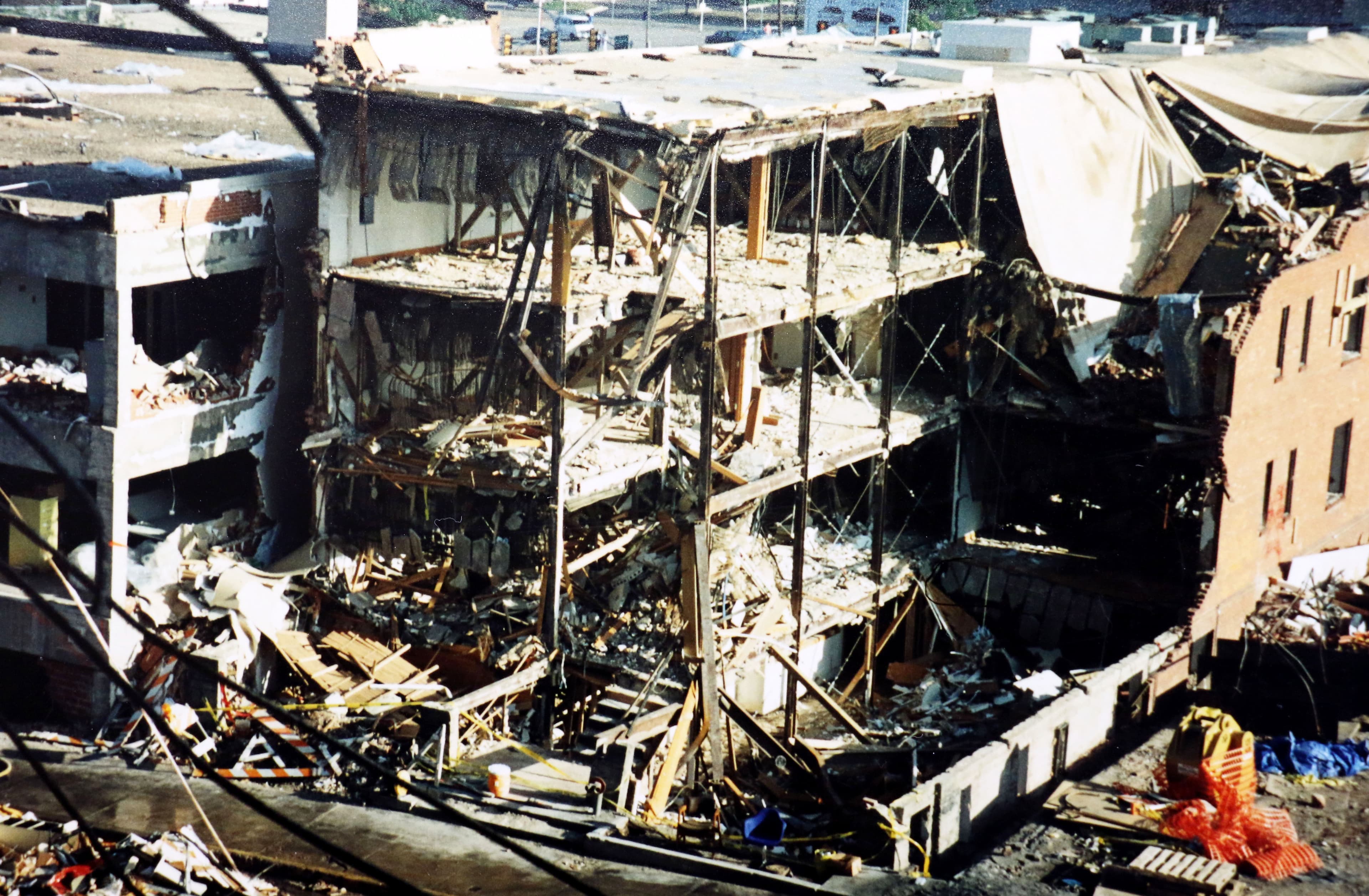
At 9:02 a.m. on April 19, 1995, a massive explosion ripped through the Alfred P. Murrah Federal Building in downtown Oklahoma City. Domestic terrorist Timothy McVeigh had detonated a truck bomb containing roughly 4,800 pounds of ammonium nitrate fertilizer and fuel oil parked just outside the building's north face.
The blast was catastrophic. The entire front half of the nine-story building collapsed in seconds. One hundred sixty-eight people were killed, including 19 children in the building's second-floor daycare center. More than 680 others were injured, and over 300 surrounding buildings were damaged or destroyed. Until September 11, 2001, it remained the deadliest act of domestic terrorism in American history.
Within moments, downtown Oklahoma City was a war zone — thick dust, shattered glass, car alarms screaming, and the desperate cries of the wounded filling the air. But instead of running away, people ran toward the destruction.
Into the Rubble
Within minutes of the explosion, firefighters, police officers, emergency medical technicians, and ordinary citizens converged on the scene. The building was dangerously unstable. Massive concrete slabs dangled from twisted rebar. Secondary collapse was a constant threat. There were even warnings of a possible second bomb. None of it mattered. People went in anyway.
Oklahoma City firefighters squeezed through impossibly narrow gaps in the rubble, calling out for survivors. Off-duty officers rushed to the scene still in civilian clothes. Nurses from nearby hospitals ran over carrying whatever supplies they could grab. Search and rescue teams from across the state and eventually the nation poured in.
Sergeant Terry Yeakey of the Oklahoma City Police Department was among the very first on scene. Bleeding from his own injuries, he pulled multiple survivors from the wreckage with his bare hands in those chaotic first minutes, refusing medical attention for himself.
One of the most iconic and heartbreaking images from that day was captured by amateur photographer Charles Porter IV: firefighter Chris Fields cradling the limp body of one-year-old Baylee Almon, who had been pulled from the daycare rubble. The photograph ran on front pages worldwide and won the Pulitzer Prize. Baylee did not survive, but the image of a rescuer gently holding a tiny child became the indelible symbol of both the horror and the humanity of that day.
Daina Bradley — The Last Survivor
As hours passed, the frequency of finding survivors diminished. Hope began to fade. But the rescuers kept digging, kept calling into the darkness.
Daina Bradley had been in the Social Security Administration office on the first floor with her mother, Cheryl Hammon, and her two children — three-year-old Peachlyn and four-month-old Gabreon. When the bomb went off, the building came down on top of them. Daina regained consciousness buried under massive slabs of concrete, her right leg crushed and pinned beneath a column. She couldn't move. She could hear rescuers somewhere above but couldn't tell how far away they were.
When rescue workers finally located Daina, they faced a devastating realization: the concrete pinning her leg could not be safely moved. Any attempt to shift the debris risked triggering a chain-reaction collapse that could kill Daina and the rescuers alike. The only option — agonizing and unthinkable — was a field amputation.
The Impossible Choice
Dr. Gary Massad, a trauma surgeon, volunteered to perform the procedure. He crawled through a claustrophobic passage in the rubble to reach Daina's side. Working in near-darkness, surrounded by tons of unstable debris, with only the most basic surgical tools, he amputated her right leg below the knee.
Daina was given sedation and pain medication through an IV started by paramedics who had also threaded their way into the wreckage. The conditions were nothing short of nightmarish — dust, darkness, the ever-present groaning of shifting concrete. Yet Dr. Massad worked with steady hands, and the rescue team gently extracted Daina from her concrete tomb.
Approximately six hours after the explosion, Daina Bradley emerged as the last survivor pulled from the Murrah Building. She was rushed to a hospital, where she would eventually recover physically, though the emotional wounds would never fully heal.
Her mother and both of her children perished in the bombing. Daina lost her right leg but kept her life — a fact that was simultaneously a miracle and a source of lifelong grief.
The Oklahoma Standard
What happened in Oklahoma City in the days and weeks after the bombing became something the nation had never quite seen before. Over 12,000 volunteers showed up to help. Blood donations overwhelmed local facilities. Restaurants and churches provided thousands of free meals to rescue workers around the clock. Strangers opened their homes to displaced families.
A phrase was born from this collective response: the "Oklahoma Standard." It came to represent the highest benchmark of community response to disaster — the selfless, immediate, and overwhelming outpouring of help from ordinary people. It wasn't a marketing slogan; it was a lived reality, documented in thousands of individual acts of courage, compassion, and sacrifice.
The concept influenced disaster response culture across the United States. When Hurricane Katrina struck in 2005 and when other tragedies followed, emergency management professionals pointed to the Oklahoma Standard as the model for civilian and community engagement.
The Weight of Memory
Today, the Oklahoma City National Memorial & Museum stands on the site where the Murrah Building once stood. At its heart are 168 empty bronze and glass chairs arranged in nine rows — one for each floor of the building. Larger chairs represent the adults; smaller chairs represent the children. At night, each chair glows softly from beneath, a quiet vigil that never ends.
A reflecting pool stretches between two bronze gates. One reads "9:01" — the last moment of peace. The other reads "9:03" — the first moment of recovery. The space in between holds the water, still and silent, representing the moment that changed everything.
Firefighter Chris Fields struggled for years with PTSD and survivor's guilt after that day. The image of him holding baby Baylee followed him everywhere. He eventually became an advocate for first responder mental health, turning his pain into purpose.
Sergeant Terry Yeakey, the officer who had saved so many lives that morning, suffered severe PTSD in the aftermath. Tragically, just over a year after the bombing, he took his own life — a devastating reminder that heroes carry invisible wounds.
Daina Bradley learned to walk again with a prosthetic leg. She rebuilt her life, carrying the memory of her mother and children with her every step. She maintained a connection with the rescuers who saved her, a bond forged in the darkest of circumstances.
What the Rubble Revealed
The Oklahoma City bombing showed the very worst of what a human being can do. A single act of hatred destroyed 168 lives, shattered thousands of families, and scarred a city forever.
But the response to that act revealed something else entirely. It revealed that when the worst happens, most people do not run. They move toward the danger. They give blood, cook food, dig through rubble with bleeding hands, and crawl into collapsing buildings to reach a stranger's voice calling for help.
The building fell. The people did not.
That is the Oklahoma Standard. And it endures.
Get new posts by email ✉️
We'll notify you when new posts are published