"Give It to the Next One" — The Man Who Passed the Lifeline Five Times in the Frozen Potomac: The Story of Arland D. Williams Jr.
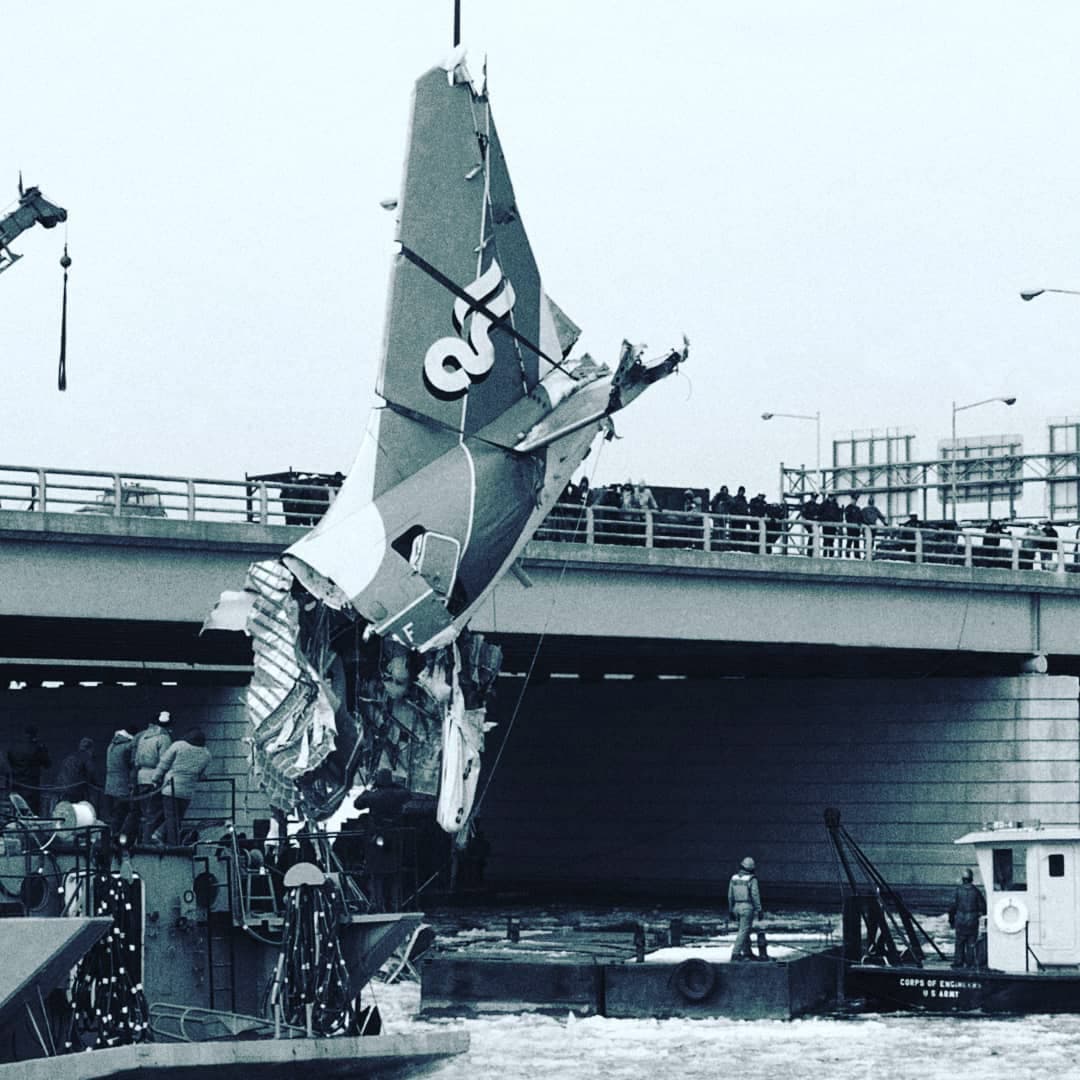
On January 13, 1982, Air Florida Flight 90 crashed into the frozen Potomac River in Washington, D.C. One man repeatedly passed the rescue line to fellow survivors, saving five lives before slipping beneath the ice forever.
A Snowstorm, a Bridge, and a River
On the afternoon of January 13, 1982, Washington, D.C. was paralyzed by one of the worst winter storms in recent memory. Roads were gridlocked, federal offices had closed early, and National Airport was barely functioning. At 3:59 p.m., Air Florida Flight 90—a Boeing 737 carrying 79 passengers and crew—finally received clearance for takeoff after nearly two hours of delays.
Thirty seconds after leaving the runway, the plane was in trouble. Ice had accumulated on the wings during the long wait, and the engines, compromised by freezing conditions, could not deliver enough thrust. The aircraft clipped the 14th Street Bridge, shearing the tops off seven vehicles and killing four motorists, before plunging into the frozen Potomac River. The fuselage broke apart on impact. Of the 79 souls on board, only six surfaced alive, clinging to wreckage and chunks of ice in water that hovered just above freezing.
The Helicopter and the Man with the Mustache
The U.S. Park Police helicopter Eagle One, piloted by Donald Usher with paramedic Gene Windsor, arrived over the crash site within minutes. There was no boat access—the river was choked with ice. The only option was to lower a lifeline and ring from the hovering helicopter and pull survivors to shore one at a time.
What the crew witnessed over the next twenty minutes would haunt them for the rest of their lives—but also restore something in them they could never quite name.
Each time the rescue ring descended toward the cluster of survivors, one man—a balding, mustachioed figure treading water with eerie calm—caught the line and handed it to someone else.
The first time, rescuers assumed he was simply closest to the line and was passing it to someone more critically injured. The helicopter ferried flight attendant Kelly Duncan to the riverbank and returned.
The second time the line came down, the same man caught it and again passed it on. Bert Hamilton, a passenger with severe injuries, was pulled to safety.
The third time. The fourth time. Each trip to shore and back took agonizing minutes, and the man in the water was visibly weakening—his movements slower, his grip on the wreckage less certain. Yet every time the line reached him, he pushed it toward another survivor. Joe Stiley, a passenger, was hoisted out with another survivor clinging to him. Priscilla Tirado, a young mother, was next—though she slipped from the line and was rescued from the water by bystander Lenny Skutnik, who dove in after her.
When the helicopter circled back one final time, the man with the mustache was gone. The Potomac had taken him.
Finding His Name
For days, the nation knew him only as "The Man in the Water." Survivors described him: calm, deliberate, never panicking, always gesturing for others to take the line first. Divers eventually recovered his body, and investigators matched his identity: Arland D. Williams Jr., age 46, a federal bank examiner from Mattoon, Illinois, based in Atlanta. He was a father of two, a former Eagle Scout, divorced, on his way to a routine audit in Florida.
Nothing in his biography hinted at the extraordinary. He had no military combat record, no first-responder training, no public history of heroism. He was, by every observable measure, an ordinary man.
"Nature, Unchecked, Usually Wins"
Essayist Roger Rosenblatt immortalized Williams in a Time magazine essay titled "The Man in the Water." It became one of the most celebrated pieces of American journalism in the 20th century. Rosenblatt wrote:
"The man in the water pitted himself against an implacable, impersonal enemy; he fought it with charity; and he held it to a standoff. He was the best we can do."
Rosenblatt argued that in a disaster defined by institutional failure—airline negligence, inadequate de-icing, delayed rescue response—it was one anonymous individual's choice that redeemed the whole terrible afternoon. In a contest between nature's indifference and one man's refusal to save himself before others, nature won the body but lost the argument.
A Bridge Renamed
Public gratitude moved swiftly. In 1983, the U.S. Congress officially renamed the 14th Street Bridge span that the plane had struck the Arland D. Williams Jr. Memorial Bridge. It remains one of the busiest crossings in the Washington metropolitan area; hundreds of thousands of commuters pass over it every week, many without knowing whose name it bears or why.
His alma mater, Southern Illinois University Edwardsville, erected a memorial in his honor. The Citadel, where Williams had briefly studied, also recognized him. In 2003, the U.S. Park Police honored him alongside the first responders of that day.
The Weight of a Simple Act
What makes Williams's story so enduring is its devastating simplicity. He did not charge into a burning building. He did not disarm an attacker. He merely held a rope—and let it go. Five times. Each decision was a fresh confrontation with his own mortality. He could see the shore. He could feel his body shutting down. He knew, with increasing certainty, that the next pass might be the last one he would survive to see. And still, he handed the line away.
Pilot Donald Usher later reflected: "He could have gone on the first trip. He could have gone on any of them. He put everyone else ahead of himself. I've never seen anything like it."
Legacy
Arland Williams saved five lives in roughly twenty minutes. He did not live to learn their names, to see their children grow, or to read the essays written in his honor. He left behind a small estate, two children, and an example that still reverberates.
Every year, quietly, someone lays flowers at the bridge plaque. And somewhere in America, five people who would not be alive without him—and their children, and their children's children—carry the weight and the grace of a stranger's impossible generosity.
Perhaps heroism is not a trait. Perhaps it is a moment—a single, frozen moment in an icy river—when a person decides that someone else's life matters more than the cold closing in around them.
Arland D. Williams Jr. made that decision five times. On the sixth, the river answered.
But the bridge still stands.
Get new posts by email ✉️
We'll notify you when new posts are published