"Dad, When We Run, I Don't Feel Disabled" — Dick Hoyt, the Father Who Carried His Son Across 1,130 Finish Lines
When doctors told Dick Hoyt to institutionalize his son Rick, born with cerebral palsy, he refused. Instead, he spent 40 years pushing Rick's wheelchair through 72 marathons, 6 Ironman triathlons, and over 1,130 races — because his son once told him, "When we run, I don't feel disabled."
"Dad, When We Run, I Don't Feel Disabled" — Dick Hoyt and the 1,130 Races That Proved Love Has No Finish Line
"Put Him Away"
In 1962, in Winchester, Massachusetts, Dick and Judy Hoyt welcomed their first son, Rick. But during delivery, the umbilical cord wrapped around Rick's neck, cutting off oxygen to his brain. The diagnosis was devastating: spastic quadriplegic cerebral palsy. Rick would never walk. He would never speak.
The doctors were blunt: "He'll be a vegetable for the rest of his life. Put him in an institution. Forget about him."
Dick and Judy watched their baby's eyes follow them around the room. They saw intelligence. They saw life. They brought Rick home.
The Boy Behind the Silence
For years, Rick had no way to communicate. His parents fought to enroll him in public school, but administrators refused — how could a child who couldn't speak or move learn anything? Dick and Judy lobbied relentlessly. They brought engineers from Tufts University to build a special computer that Rick could operate by pressing a switch mounted beside his head, selecting letters one by one.
In 1973, eleven-year-old Rick typed his first-ever words on the screen:
"Go Bruins!"
It was the night of a Boston Bruins hockey game. The boy the doctors called a vegetable was a sports fan. Everything changed.
Rick eventually graduated from Boston University with a degree in special education — a triumph that once seemed unimaginable.
"Dad, I Want to Run"
In 1977, Rick learned about a five-mile charity run for a local athlete who had been paralyzed in an accident. He tapped out a message to his father:
"Dad, I want to do that."
Dick Hoyt was no athlete. He was a forty-year-old retired Air National Guard lieutenant colonel who barely jogged. But he couldn't say no to his son. He loaded Rick into a wheelchair and pushed him through the entire five-mile course. They finished next to last. Dick's legs cramped for two weeks.
That night, Rick typed the sentence that would reshape both their lives:
"Dad, when I'm running, it feels like I'm not disabled."
Dick Hoyt read those words and made a vow: he would give his son the wind.
Team Hoyt Is Born
From that day forward, Dick trained relentlessly. Every morning before dawn. Running with a weighted wheelchair. Swimming with a rope tied to a boat. Cycling with a custom two-seat bicycle. Father and son became Team Hoyt.
They started with 5Ks and 10Ks. Then marathons. Then, incredibly, the Ironman Triathlon — a 2.4-mile swim, 112-mile bike ride, and 26.2-mile marathon, done consecutively in a single day.
For the swim, Dick pulled Rick in an inflatable dinghy while swimming with a harness. For the bike, Rick sat in a custom seat mounted on the front of a specially designed bicycle while Dick pedaled. For the run, Dick pushed Rick's wheelchair, just as he had on that first day in 1977.
One body carrying two hearts across three disciplines.
Their lifetime numbers are staggering:
- 🏃 72 marathons completed (including 32 consecutive Boston Marathons)
- 🏊 6 Ironman triathlons completed
- 🎽 Over 1,130 total endurance events
- ⏱️ Marathon personal best: 2 hours, 40 minutes, 47 seconds — faster than most able-bodied recreational runners
Boston's Beloved Sons
When Team Hoyt first applied to run the Boston Marathon in 1981, they were rejected. No category existed for a father pushing his adult son in a wheelchair. Undeterred, they ran unofficially, starting behind the last corral. They completed the course. They came back the next year, and the next.
Eventually, the Boston Athletic Association granted them official entry. Team Hoyt became synonymous with the marathon itself — as iconic as Heartbreak Hill. Spectators lined the course not to see the elite Kenyans at the front, but to cheer for the gray-haired father and his beaming son somewhere in the middle of the pack.
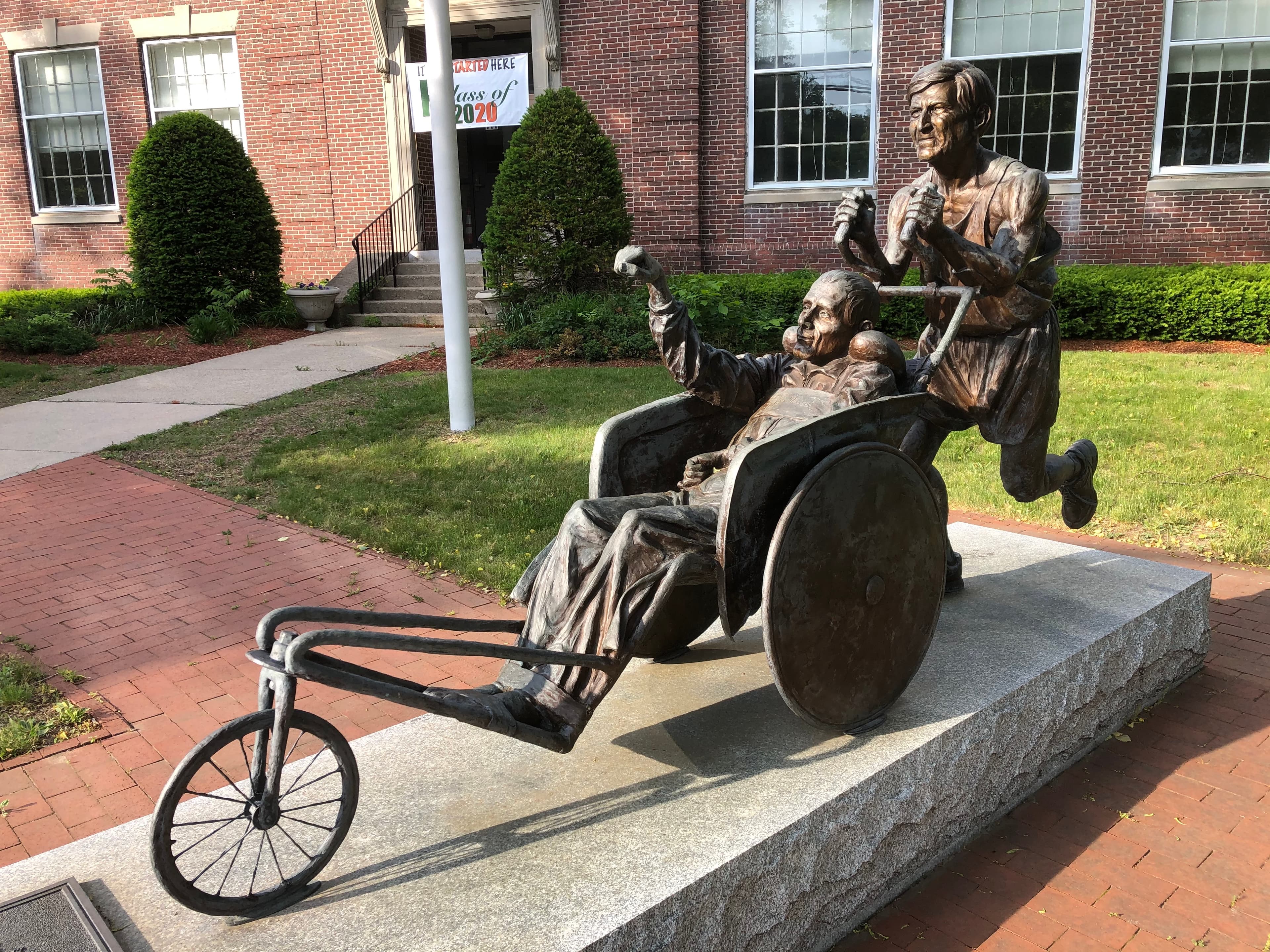
In 2013, a life-sized bronze statue of Dick pushing Rick was unveiled near the starting line in Hopkinton, Massachusetts. The inscription reads:
"Yes You Can."
The Long Goodbye
In 2014, at age 74, Dick Hoyt ran his final Boston Marathon — his 32nd. Tens of thousands stood and applauded as the father-and-son team crossed the finish line one last time.
On March 17, 2023, Dick Hoyt passed away at the age of 82. The Boston Marathon issued a statement calling him "the embodiment of the Boston Marathon spirit." Tributes poured in from around the world.
Just three months later, on June 22, 2023, Rick Hoyt died at the age of 61. Father and son, inseparable in life, were barely separated in death.
What Love Looks Like at Mile 26
Dick Hoyt was once asked what he dreamed about. He said: "I dream that Rick and I are running side by side."
He never got that dream in life. His son's legs never carried him. But for 40 years, Dick Hoyt gave Rick something no medical breakthrough could: the feeling of flying. The feeling of wind. The feeling of freedom.
Over 1,130 races, Dick's knees absorbed the punishment, his lungs burned, his muscles screamed — but in the wheelchair ahead of him, his son smiled into the wind, and that was enough. That was everything.
Team Hoyt's story asks us a simple question:
What does it mean to love someone? Maybe it means carrying them as far as your legs will go — and then a little farther.
People often called Dick the hero. He always corrected them. "Rick is the one who inspires me," he said. "He's the athlete. I'm just his arms and legs."
In the end, the man who couldn't walk taught the world what it means to run. And the man who could taught us what it means to never, ever stop.
"Dad, when I'm running, it feels like I'm not disabled." — Rick Hoyt (1962–2023)
"That one sentence changed my life." — Dick Hoyt (1940–2023)
Get new posts by email ✉️
We'll notify you when new posts are published