A War They Didn't Know Was a War — Spring 1775
In the spring of 1775, thousands of colonists picked up their muskets and marched toward Boston. They were fighting, but most of them had no desire for independence. They just wanted their rights back.
After the shots at Lexington and Concord in April 1775, something remarkable happened. Without any central command, without orders from any government, roughly 15,000 armed colonists converged on Boston. They came from Massachusetts, Connecticut, New Hampshire, and Rhode Island. They camped in fields and farmyards, forming a loose ring around the city where the British garrison was trapped.
They were at war. But almost none of them would have said so.
Fighting Without a Cause — Yet
The strange reality of spring 1775 was that most colonists still considered themselves loyal British subjects. They were angry, yes. They believed their rights were being violated. They objected to taxation without representation, to the quartering of soldiers, to the closing of Boston Harbor. But independence? That was a radical idea held by a minority.
These men had not marched to Boston to create a new country. They marched to protest. They marched because their neighbors had been killed. They marched because they were furious. But if King George had offered to restore their traditional rights, most of them would have gone home satisfied.
The problem was that nobody was in charge. There was no unified command, no supply system, and no strategy. Each militia company answered to its own officers, who answered to their own colonial governments, who were not coordinating with each other. Fifteen thousand armed men milled around Boston with no clear plan.
Bunker Hill Changes the Math
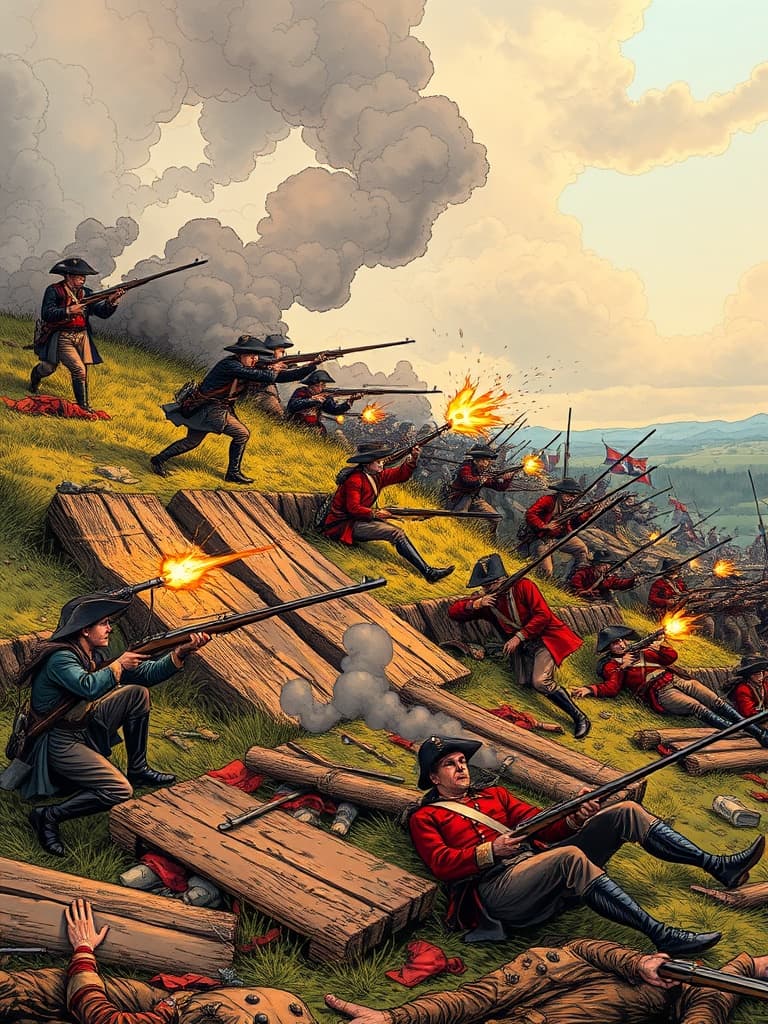
On June 17, 1775, the situation exploded at the Battle of Bunker Hill — which actually took place mostly on Breed's Hill, a smaller rise closer to Boston. Colonial forces had fortified the position overnight, and the British decided to take it by direct assault.
What followed was one of the bloodiest battles of the entire war. The British attacked uphill, in formation, against entrenched defenders. The first assault was thrown back. So was the second. On the third attempt, the colonists ran out of ammunition and the British finally took the hill.
The British won the ground. They lost something far more important. Of the roughly 2,200 British soldiers engaged, 1,054 became casualties — 226 killed and 828 wounded. That was a casualty rate of nearly 50 percent. Among the dead were a disproportionate number of officers. The American side suffered about 450 casualties.
The British never attempted another frontal assault against fortified colonial positions for the rest of the war. Bunker Hill taught them that these farmers could kill with terrifying efficiency.
Washington Arrives to Chaos
On July 3, 1775, George Washington arrived in Cambridge, Massachusetts, to take command of the newly designated Continental Army. What he found appalled him.
The camps were filthy. Discipline was almost nonexistent. Officers fraternized with enlisted men. Supplies were desperately short. Men came and went as they pleased, their enlistments measured in weeks rather than years. Some units had elected their officers through popularity contests.
Washington later wrote that he found "an exceedingly dirty and nasty people." He was not being diplomatic. The army he inherited was barely an army at all — it was a collection of armed neighborhoods.
The task ahead was staggering. Washington had to transform this mob into a fighting force capable of standing against the British Army, one of the most professional military organizations on earth. He had almost no money, no navy, limited gunpowder, and soldiers who believed that their enlistments were suggestions rather than commitments.
Spring 1775 had produced a war. Now someone had to figure out how to fight it.
Get new posts by email ✉️
We'll notify you when new posts are published