"Houston, We Have a Problem" — Apollo 13 and the 87-Hour Miracle Return
On April 13, 1970, an oxygen tank exploded aboard Apollo 13, turning a routine moon mission into a desperate fight for survival. Three astronauts used the lunar module as a lifeboat for 87 hours, and NASA pulled off history's greatest 'successful failure.'
"Houston, we've had a problem here."
On April 11, 1970, at 2:13 p.m., Apollo 13 launched from Kennedy Space Center. Destination: the Moon. It was NASA's third lunar landing mission.
Commander Jim Lovell, Command Module Pilot Jack Swigert, and Lunar Module Pilot Fred Haise lifted off into a world that had already grown bored with moon missions. After Apollo 11 and 12, TV networks didn't even bother with live coverage.
That indifference shattered in two days.
April 13 — The Oxygen Tank Explodes
Fifty-five hours and 54 minutes into the mission, roughly 200,000 miles from Earth. Swigert performed a routine oxygen tank stir — a standard procedure.
Oxygen tank No. 2 exploded.
The spacecraft shuddered. Warning lights flooded the instrument panels. Swigert radioed Mission Control:
"Houston, we've had a problem here."
Lovell looked out the window. Something was venting from the spacecraft's hull. Oxygen was streaming into space. Tank 2 was destroyed; Tank 1 was damaged and draining fast.
Oxygen wasn't just for breathing — it powered the fuel cells that generated electricity. No oxygen meant no power. No power meant the command module was a dead shell.
The moon landing was canceled instantly. But the real question was far more urgent: could these three men make it home alive?
The Lunar Module — A Lifeboat in Space
Flight Director Gene Kranz gathered his team at Mission Control.
"Failure is not an option."
The plan: shut down the command module Odyssey completely to save its remaining battery for reentry. Cram all three astronauts into the lunar module Aquarius — a spacecraft designed for two people and 45 hours of use — and survive for 87 hours while swinging around the Moon's gravity back toward Earth.
The problems were staggering.
Power. Aquarius had batteries for 45 hours. They needed 87. NASA engineers systematically shut down every non-essential system, cutting power consumption to one-fifth of normal.
Water. Only 6 liters remained for cooling systems and drinking combined. Each man survived on 200 milliliters per day — less than a cup.
Temperature. With heating off, cabin temperature dropped to 38°F (3°C). The astronauts wore every spare garment they could find but couldn't sleep through the cold.
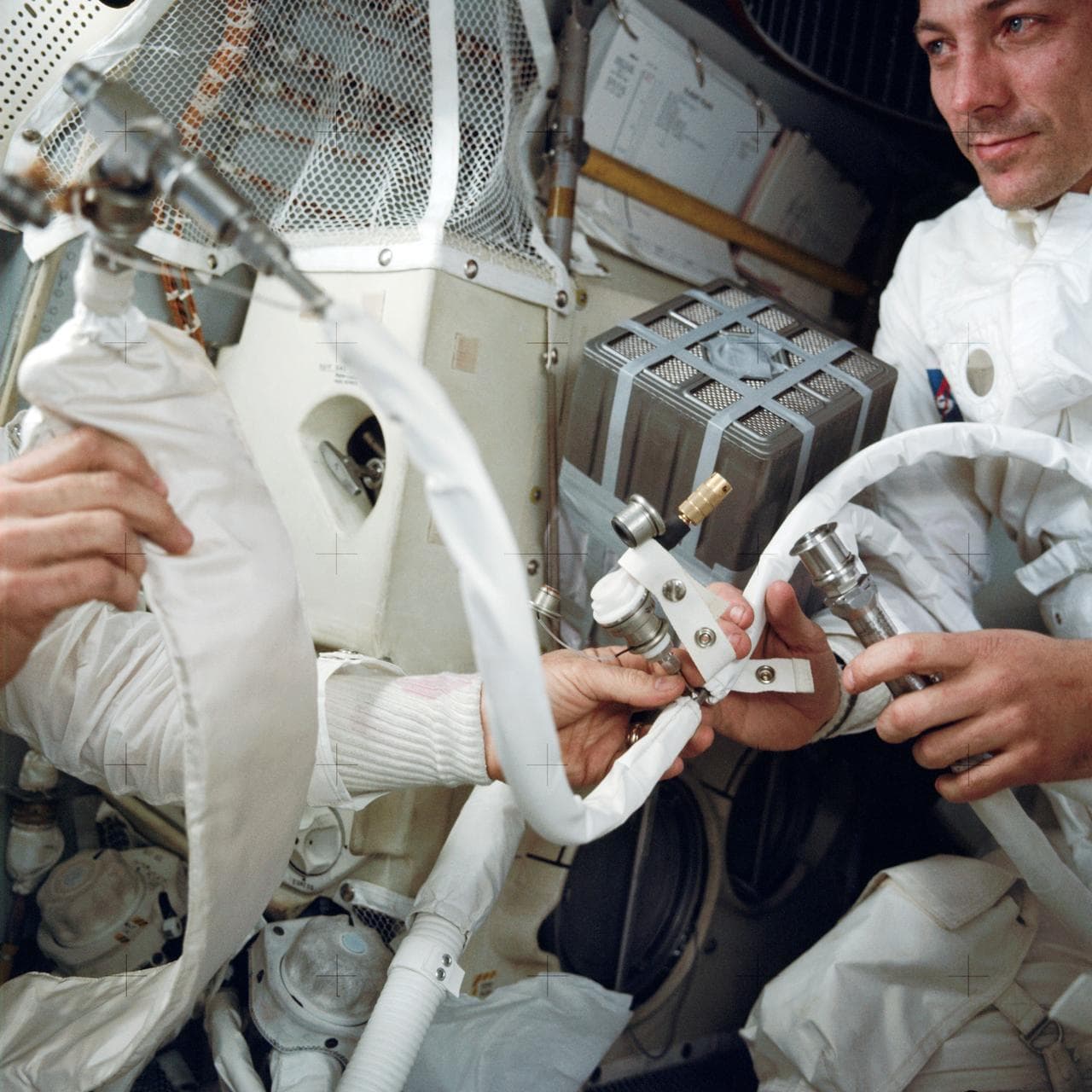
Carbon dioxide. Three men breathing in a tiny module pushed CO₂ to lethal levels. The command module's CO₂ filters were square. The lunar module's filter sockets were round. They didn't fit.
Square Peg, Round Hole — Duct Tape and Socks
Houston engineers had to design a solution using only materials available inside the spacecraft: flight manual covers, duct tape, plastic bags, cardboard, and socks.
They built a makeshift adapter, then talked the astronauts through assembly step by step over the radio. The improvised device worked. CO₂ levels began dropping.
It remains one of the most celebrated acts of improvisation in engineering history.
87 Hours — The Longest Way Home
After swinging around the far side of the Moon, the crew needed a course correction. Lovell manually aligned the spacecraft using Earth in the window as a reference and fired the lunar module's engine for exactly 14 seconds — no computer assistance, just eyes and hands.
The 87-hour return was agony. Extreme cold, dehydration, sleep deprivation. Haise developed a urinary tract infection. All three lost significant weight.
April 17 — Splashdown
At 1:07 p.m. on April 17, the command module Odyssey splashed down in the South Pacific. The last thing the crew did before reentry was jettison the lunar module Aquarius — the lifeboat that had saved their lives — and watched it burn up in the atmosphere.
The recovery ship USS Iwo Jima pulled Odyssey from the water. When the hatch opened and three men emerged, the world cheered.
All three astronauts survived.
"A Successful Failure"
Apollo 13 never reached the Moon. The mission's original objective failed.
But NASA calls it a "Successful Failure." In the face of impossible odds, engineers on Earth and astronauts in space collaborated to save three lives.
Jim Lovell later reflected:
"We failed to land on the Moon, but we succeeded in bringing our crew home. That was the harder thing to do."
Gene Kranz's "Failure is not an option" became NASA's defining motto, and Ron Howard's 1995 film Apollo 13, starring Tom Hanks, brought the story to the world.
What 87 Hours Left Behind
After Apollo 13, NASA overhauled spacecraft design, emergency procedures, and life-support redundancy. Those lessons shaped every subsequent crewed mission and influenced the safety standards of the International Space Station.
The moment engineers used duct tape and socks to fit a square filter into a round hole proved that survival depends not on technology alone, but on human creativity and the refusal to give up.
For 87 hours, three men were in the loneliest place in the universe — but the whole world was waiting for them to come home.
Date: April 11–17, 1970 | Location: Earth-Moon trajectory | Crew: Jim Lovell, Jack Swigert, Fred Haise
Get new posts by email ✉️
We'll notify you when new posts are published