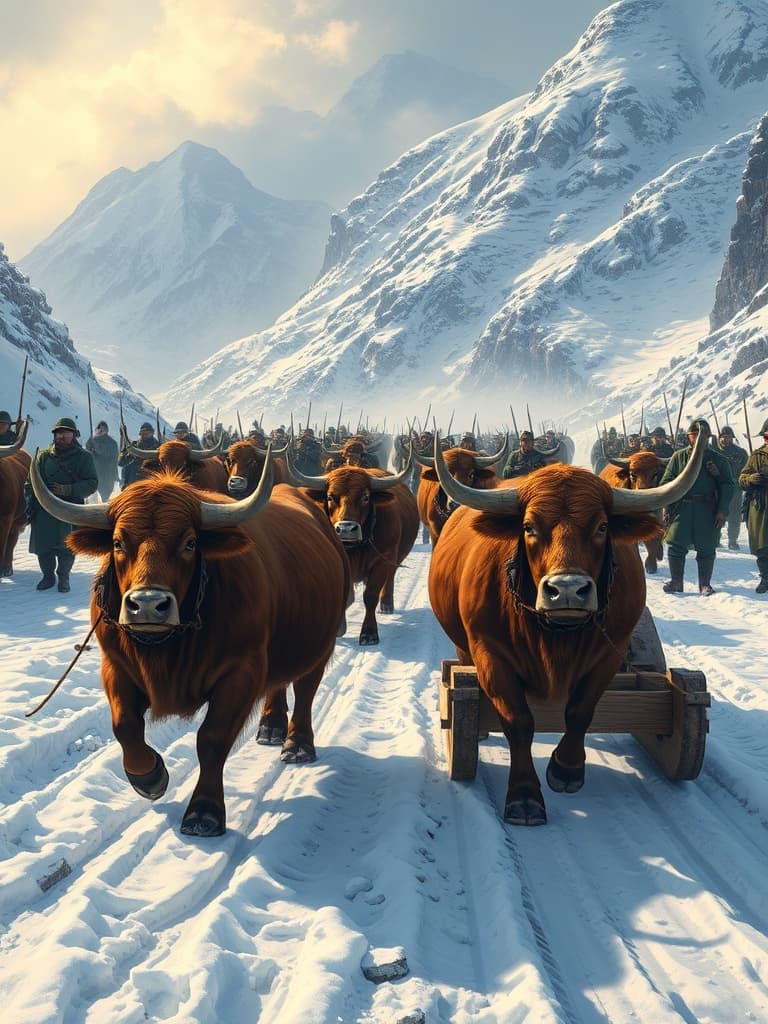
The Bookshop Owner's Cannons — The Liberation of Boston (March 17, 1776)
Henry Knox was a 25-year-old bookseller with zero military experience. He dragged 60 cannons 480 kilometers through winter mountains to free Boston. This is how a bookshop owner ended an 11-month siege.
A Bookseller's Proposal
Henry Knox ran a bookshop in Boston. He was 25 years old and had exactly zero military experience. What he did have was an unusual reading habit. While other people read novels and poetry, Knox devoured military manuals. Artillery theory, fortress construction, tactical doctrine — he had read hundreds of volumes on the science of war without ever stepping onto a battlefield.
In the fall of 1775, Knox approached Washington with a bold idea. At Fort Ticonderoga in upstate New York, there were roughly 60 cannons captured from the British earlier that year. If those cannons could be brought to Boston, they could be positioned to overlook the harbor and force the British out.
The problem was the distance. Ticonderoga to Boston was approximately 480 kilometers. It was the middle of winter. The route crossed frozen lakes, dense forests, and mountain ranges. Individual cannons weighed up to 2.5 tons. By any reasonable assessment, the plan was impossible.
Washington approved it anyway. He had no other options.
The Impossible Journey
In November 1775, Knox set out with a team of men and 80 oxen pulling heavy sleds loaded with artillery. Sixty cannons. Roughly 60 tons of metal.
The journey was brutal. Snowstorms buried the roads. Sleds sank into mud. Crossing frozen Lake George, the ice cracked and a cannon plunged into the water. Knox and his men hauled it back out, reloaded it, and kept moving. Every day brought a new crisis.
The mountain crossings were the worst. Dragging a 2.5-ton cannon uphill required every man and animal pulling together. On the downhill side, the challenge reversed — they had to keep the cannons from sliding out of control. Ropes snapped. Oxen collapsed from exhaustion. Men pushed past the limits of endurance.
It took two months. By late January 1776, Knox had delivered all 60 cannons to the outskirts of Boston.
One Night's Work
Washington's plan was simple and audacious. Dorchester Heights was a ridge of hills overlooking Boston Harbor from the south. Whoever controlled those heights controlled the harbor. On the night of March 4, 1776, Washington would install the cannons there — all in a single night.
Thousands of soldiers worked through the darkness, hauling the heavy guns up the slopes. They concealed the operation with hay bales and diversionary bombardment elsewhere. By dawn on March 5, the heights bristled with artillery. Every ship in Boston Harbor, every street in the city, was within range.
British General William Howe looked up at the heights that morning. The position that had been empty the night before was now a fortress. He reportedly said: "The rebels have done more in one night than my whole army could have done in a month."
The City Is Free
Howe's options had evaporated. Attacking uphill against entrenched artillery would repeat the catastrophe of Bunker Hill, where the British had suffered nearly 50 percent casualties. Staying put meant watching his fleet get destroyed.
On March 17, 1776, the British evacuated Boston. Roughly 11,000 soldiers and 1,000 Loyalist civilians boarded ships and sailed for Halifax, Nova Scotia. The 11-month siege was over. Not a single shot was fired on that final day.
A bookseller who had never seen combat proposed an impossible plan. He dragged 60 cannons across 480 kilometers of frozen wilderness. Those cannons, installed overnight on heights above the harbor, ended a siege without a battle. The war was far from over — years of desperate fighting still lay ahead. But on that day in March, it was a bookshop owner's knowledge, stubbornness, and sheer physical effort that freed a city.
Sometimes the most important qualification is not experience. It is having read the right books and being willing to do what everyone else considers impossible.
Get new posts by email ✉️
We'll notify you when new posts are published