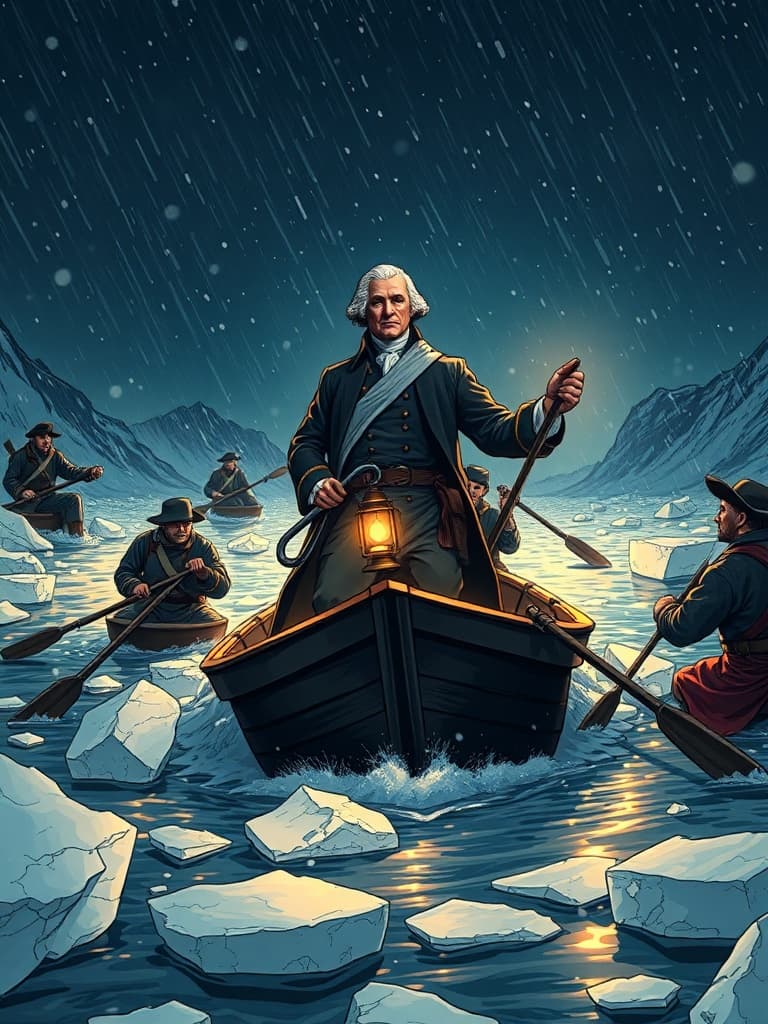
A Christmas Night Gamble — Washington's Crossing of the Delaware
By December 1776, the American Revolution was on the verge of collapse. George Washington staked everything on a desperate Christmas night crossing of the icy Delaware River — and changed the war.
By late December 1776, the American Revolution was dying. Not on paper — the Declaration of Independence was barely six months old — but in practice. Washington's army had been beaten badly in New York, chased across New Jersey, and pushed to the western bank of the Delaware River. Enlistments were expiring at the end of the year, and most soldiers had already made up their minds to go home.
Thomas Paine wrote "These are the times that try men's souls" during those very weeks. He was not exaggerating.
The Plan Nobody Expected
Washington decided to attack. Not retreat further, not negotiate, not wait for spring. Attack. On Christmas night. Across an icy river. Against professional Hessian soldiers garrisoned at Trenton, New Jersey.
The plan was audacious to the point of recklessness. Three separate columns were supposed to cross the Delaware at different points and converge on Trenton simultaneously. In the end, only Washington's column made it across. The other two turned back because of the ice.
Christmas Night on the River
On the evening of December 25, 1776, roughly 2,400 soldiers began loading into Durham boats on the Pennsylvania side of the Delaware. The river was choked with ice floes. A nor'easter blew sleet and snow sideways. The temperature hovered around freezing.
The crossing was supposed to be completed by midnight so the army could reach Trenton before dawn. It took until 3 a.m. just to get everyone across. The nine-mile march to Trenton still lay ahead, and every delay meant more risk of discovery.
Soldiers marched through the dark in freezing rain. Some had no shoes and left bloody footprints in the snow. Two men froze to death during the march.
Forty-Five Minutes at Trenton
The army arrived at Trenton around 8 a.m. on December 26. The Hessian garrison, commanded by Colonel Johann Rall, was caught completely off guard. Contrary to popular myth, the Hessians were not sleeping off a Christmas celebration — but they were not prepared for an attack either. Their patrols had been pulled in because of the terrible weather. No one expected an army to cross a frozen river in a blizzard.
The battle lasted about 45 minutes. Washington's forces attacked from two directions, cutting off escape routes. The Hessians attempted to form up and counterattack twice but were driven back both times. Colonel Rall was mortally wounded leading a charge.
When it was over, roughly 900 Hessians had been captured. About 22 were killed and 83 wounded. On the American side, there were no combat deaths. A handful of soldiers were wounded, including future president James Monroe, who took a musket ball in the shoulder.
Why It Mattered
The victory at Trenton was small in military terms. A garrison of roughly 1,500 men was not going to change the strategic balance of the war by itself. But the psychological impact was enormous.
Congress, which had fled Philadelphia in panic, began to recover its nerve. Soldiers who had been ready to walk away decided to stay. New recruits appeared. The British, who had considered the rebellion essentially finished, suddenly realized it was not.
Washington followed Trenton with another victory at Princeton a week later. Together, these two small battles kept the Revolution alive through its darkest winter. Sometimes wars are decided not by the biggest battle, but by the most desperate one.
Get new posts by email ✉️
We'll notify you when new posts are published