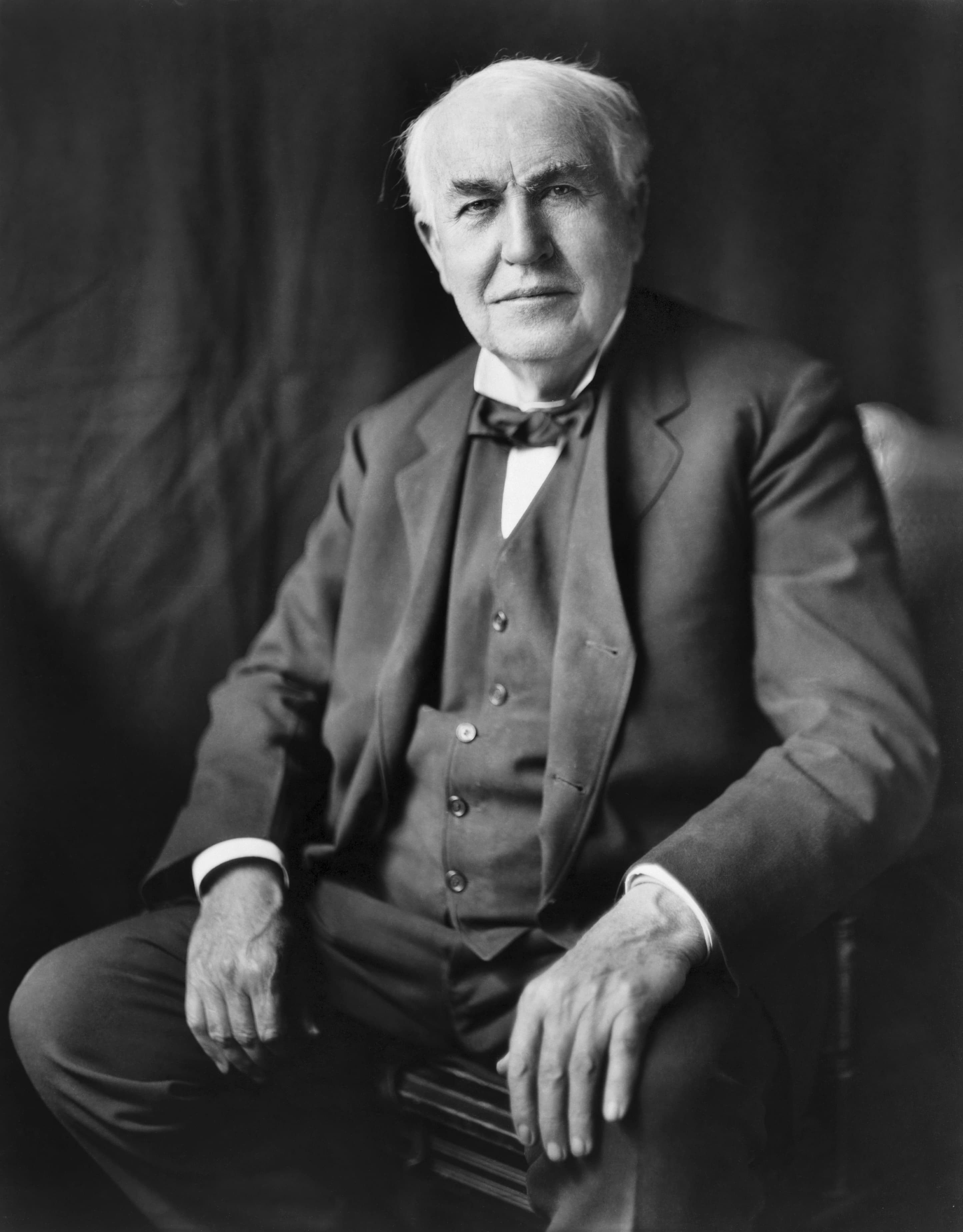
The Wizard of Menlo Park — Edison and the Light Bulb (1879)
He tested 6,000 materials. In 13 months, he built a bulb that burned 40 hours. But Edison's greatest invention was not the light bulb — it was the system for industrializing invention itself.
A Boy Who Couldn't Stay in School
- Born in Ohio.
He could barely hear. His teachers called him "slow." His mother taught him at home. Total formal education: three months.
At 12, he sold newspapers and candy on trains. At 16, he was a telegraph operator. In his early twenties, he made his first invention — an electric vote recorder. Nobody bought it.
What he learned: an invention the market doesn't want is meaningless.
1876, Menlo Park
A small town in rural New Jersey. Edison built something there.
The world's first industrial R&D lab.
Before then, invention was the work of solitary geniuses. Edison ran invention like a factory.
- Chemists, mechanics, glassblowers, mathematicians under one roof
- A library, test rooms, precision instruments
- 24-hour operation, late-night meals
- Edison declared his target: "a minor invention every day, a major one every six months"
This is the prototype of modern R&D. Bell Labs, IBM Research, Google X — all are children of Menlo Park.
1879, the Light Bulb
Light bulbs already existed. Joseph Swan in Britain had one. Everyone faced the same problem — they burned out almost immediately.
Edison tested over 6,000 different materials in a year.
October 21, 1879. A carbonized cotton thread filament burned for 40 hours. The previous record had been minutes.
In 1880, with a bamboo filament, he reached 1,200 hours. Commercially viable.
But he didn't just invent the bulb. He invented the entire system:
- Bulb
- Generator
- Distribution wires
- Safety fuses
- Household meter
- Switches
1882. The Pearl Street Station in New York City powered up. Parts of Manhattan got home electricity for the first time in human history.
The Current War
Edison's system was direct current (DC).
Out West came Nikola Tesla, championing alternating current (AC). Industrialist George Westinghouse backed Tesla.
Edison fought back hard. To show AC was dangerous, he publicly electrocuted animals — dogs, cats, eventually an elephant named Topsy.
He went further. He lobbied New York State to adopt the electric chair as a method of execution. And to use AC to power it. "See — AC is a machine for killing people."
He lost. The 1893 Chicago World's Fair was lit by AC. Niagara Falls power station, 1896 — also AC. AC became the standard.
Late in life, Edison admitted his stunt against AC was his greatest regret.
1,093 Patents
Edison held 1,093 U.S. patents — an overwhelming record for one man.
But what he truly invented — his greatest legacy — was something else.
"Invention is not the inspiration of a genius. It is the result of organized labor."
With that single idea, he turned the 19th century's invention into the 20th century's industry.
Every R&D department in every company today. Every startup lab. Every engineering classroom. Their roots trace back to Menlo Park, 1876.
Born: 1847 | Menlo Park lab founded: 1876 | First successful bulb: October 21, 1879 | Pearl Street Station: 1882 | Patents: 1,093 | Died: 1931 (age 84)
Get new posts by email ✉️
We'll notify you when new posts are published