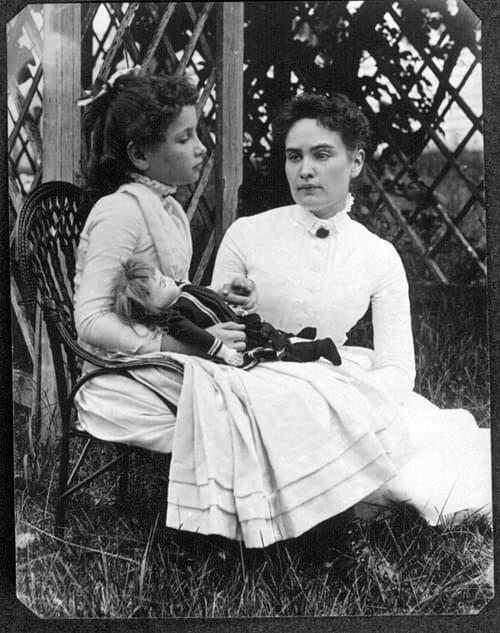
Two Women in the Dark — Helen Keller and Anne Sullivan, 49 Years Together
On April 5, 1887, a 7-year-old girl stood at a water pump in Alabama. Cold water ran over one hand while a 21-year-old half-blind teacher spelled five letters into the other: W-A-T-E-R. In that instant, Helen Keller awoke. So began 49 years with Anne Sullivan.
One Word at the Pump
April 5, 1887. A small farmhouse in Tuscumbia, Alabama. A 7-year-old girl stood beside the water pump. Cold water poured over one of her hands while a 21-year-old teacher spelled letters into the other.
W. A. T. E. R.
Helen's face froze. Slowly, she pointed at the pump. Then she traced the same five letters back into her teacher's palm. Perfectly.
That afternoon, Helen learned 30 words. For the first time since she was 19 months old, the world became a place that had names.
A Wild Six-Year-Old
Helen Adams Keller was born on June 27, 1880, into a wealthy Alabama farming family. She was a normal child. At 19 months, she spoke her first word — water.
It would be the word she lost for the next 19 years.
In February 1882, Helen contracted a severe fever — likely meningitis or scarlet fever. She survived but lost both sight and hearing. Without sight or sound, she also lost the ability to learn speech.
For the next five years, Helen lived in absolute darkness and silence. Unable to communicate, she expressed her frustration through violence. She grabbed food off others' plates with her hands. She broke things she didn't like. Her family treated her like a wild animal, and one doctor recommended she be committed to an asylum.
Her parents refused to give up. In 1886, Helen's mother, Kate Keller, read in Charles Dickens that a deafblind girl named Laura Bridgman had been educated. The Kellers traveled to see Alexander Graham Bell (whose mother and wife were both deaf). Bell directed them to the Perkins Institution for the Blind in Boston.
A 21-Year-Old Teacher with a Secret of Her Own
On March 3, 1887, 21-year-old Anne Sullivan arrived at the Keller farm in Alabama.
Anne was no ordinary woman.
Born in 1866 to poor Irish immigrants in Massachusetts, Anne lost most of her vision at age 5 to trachoma — a contagious eye infection. Her mother died of tuberculosis when Anne was 8; her father was an alcoholic who eventually abandoned his children. At 10, Anne and her brother Jimmy were sent to the Tewksbury Almshouse — a notorious Massachusetts state poorhouse where children, the mentally ill, and the elderly were warehoused together.
It was a horrifying place. Three months after arrival, Jimmy died there. He was 5 years old. Anne never forgot it.
After four years in the almshouse, Anne shouted at a visiting inspector that she wanted to go to school. Those few words got her admitted to the Perkins Institution. She was 14.
After several surgeries restored partial vision, Anne graduated as valedictorian of Perkins in 1886. Just after graduation, the school director, Michael Anagnos, offered her a job. "There's a family in Alabama. Their seven-year-old daughter is deaf and blind. Will you go and teach her?"
That was the road Anne traveled to reach Helen.
First Meeting — The Battle of the Dining Table
On her first day at the Keller farm, Helen rifled through Anne's luggage and snatched food off Anne's plate at dinner. Anne was shocked to see the family allow it.
Next morning at breakfast, Anne stopped Helen from taking food from her plate. Helen exploded. The family wanted to give in. Anne sent everyone out of the dining room and locked the door.
They fought all morning. Helen threw chairs, hit Anne, rolled on the floor. Anne refused to yield. Eventually Helen sat, ate her meal, and put away her own plate.
Anne told Kate Keller: "If I am to teach this child, I must control her world."
Two Weeks Alone — The Little House
Believing the family's pity was sabotaging Helen's progress, Anne proposed an experiment: two weeks alone with Helen in a small cottage 200 yards from the main house.
The Kellers reluctantly agreed.
For two weeks, Anne spelled words into Helen's palm constantly using finger spelling. Helen mimicked the shapes. But she had no idea what they meant. To Helen, the finger movements were just patterns.
Anne did not give up. D-O-L-L. C-U-P. C-A-K-E. Hundreds of repetitions every day.
April 5, 1887 — Awakening
About a month after they had moved into the little house, Anne brought Helen out to the water pump. She placed one of Helen's hands under the spout and pumped. With the other hand, she spelled W-A-T-E-R.
In the rush of cold water, Helen stopped.
A look of recognition swept across her face. Slowly, Helen traced W-A-T-E-R back into her own palm. Then she pointed at the pump and demanded its name. P-U-M-P. The ground beneath her feet — G-R-O-U-N-D. The trellis above — T-R-E-L-L-I-S.
Helen had understood that words name things.
That day, Helen learned 30 words. That night, for the first time in her life, Helen kissed someone goodnight — Anne Sullivan.
Anne wrote to Kate Keller: "My soul has been set free today. And so has Helen's, at last out of its prison of darkness."
Radcliffe — and Beyond
After awakening, Helen's progress was extraordinary.
- April 1887: 30 words → 600+ by summer
- 1888: Began learning Braille
- 1890: Began learning to speak (age 10)
- 1894: Wright-Humason School for the Deaf, New York
- 1900: Admitted to Radcliffe College (Harvard's sister school)
- 1904: Graduated cum laude — the first deafblind person in history to earn a Bachelor's degree
Throughout Radcliffe, Anne sat beside Helen in every lecture, finger-spelling every professor's words into Helen's hand. Every day. Every class. For four years.
Author, Speaker, Activist
Helen's autobiography The Story of My Life was published in 1903 when she was 22. It has been translated into more than 50 languages.
Over her lifetime she wrote 12 books and gave more than 475 lectures. When Helen spoke publicly, Anne (or her successor Polly Thomson) translated her speech for the audience.
What Helen did:
- Founding member of the American Civil Liberties Union (ACLU) in 1920
- Member of the Socialist Party of America (1909)
- Suffragist
- Labor rights advocate
- Anti-nuclear activist
- The face of the American Foundation for the Blind for nearly 50 years
She met 12 U.S. presidents from Grover Cleveland through Lyndon B. Johnson. In 1964, President Johnson awarded her the Presidential Medal of Freedom, the highest civilian honor in the United States.
Forty-Nine Years
Anne Sullivan came into Helen's life when Helen was 7. She stayed for 49 years, until her own death.
On October 20, 1936, Anne died at age 70. Helen was holding her hand. Anne's last words:
"Helen, I'm sorry I have to leave you."
Helen was 56. She would live another 32 years, but in interviews she often said: "After Anne left, I missed her every day. She was my other self."
A Light in the Dark
Helen Keller died on June 1, 1968, at age 87, in her sleep at her Connecticut home.
Her remains were placed in the National Cathedral in Washington, D.C. The space beside her was not empty — Anne Sullivan had been buried there 32 years earlier.
A line Helen often quoted:
"The best and most beautiful things in the world cannot be seen or even touched. They must be felt with the heart."
On April 5, 1887, at a water pump in Alabama, a girl who could neither see nor hear touched the world for the first time through cold running water. And because there was a woman holding her hand, that single moment became a light that has guided millions of lives ever since.
Two women in the dark. What they made together was brighter than any light the world has ever seen.
First meeting: March 3, 1887 | Awakening: April 5, 1887 | Helen Keller: 1880–1968 | Anne Sullivan Macy: 1866–1936 | 49 years together
Get new posts by email ✉️
We'll notify you when new posts are published