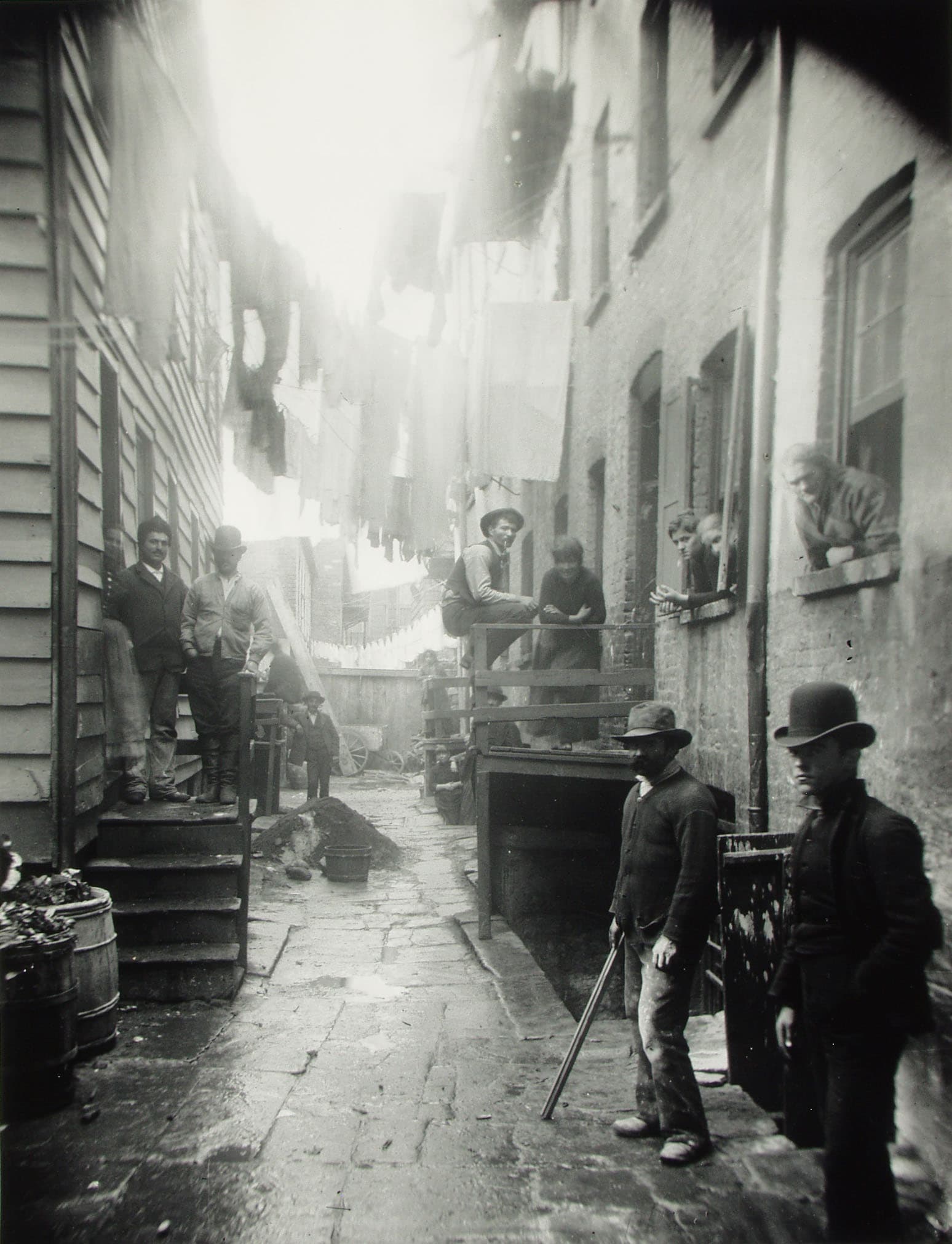
How the Other Half Lives — Jacob Riis and the Power of the Photograph (1890)
In 1890, a newspaper reporter walked into the New York slums with a camera. The photographs shook America's conscience. The birth of photojournalism.
He Was an Immigrant Himself
-
Born in Denmark.
-
He emigrated to America at 21. Empty hands. Awkward English.
In New York, he lived inside the very landscape he would later photograph. Dock work. Factory work. Farm labor. And homelessness.
For years he slept in police-station shelters. Shivering in the streets in dead winter.
That experience defined his life.
Police Reporter
- He became a police reporter for the New York Tribune. Later moved to the Evening Sun.
Where he walked daily: the slums of the Lower East Side at the southern tip of Manhattan.
New York was exploding. Half a million immigrants arrived every year. Most of them landed here.
Riis saw it every day:
- Twelve people sleeping in one tenement room
- Families living in unventilated basements
- Seven-year-old children working 70-hour weeks in glass factories
- Tuberculosis and cholera sweeping the streets
He started writing it. But wealthy New Yorkers didn't believe him.
The Invention That Changed Everything
- A pivotal technology arrived: magnesium flash powder.
Before this, indoor and night photography was nearly impossible. Now Riis could document the interior of a slum.
He stormed tenements, homeless shelters, and opium dens at midnight, carrying camera and flash powder.
The instant of the shot — flash! — and the sleeping inhabitants jolted awake.
Critics later called the methods unethical. At the time, Riis believed his mission was urgent.
1890: The Book
"How the Other Half Lives: Studies among the Tenements of New York"
Filled with dozens of photographs, statistics, and reportage.
- Five printings, an instant bestseller
- For the first time, wealthy America could see the slums
Its most powerful image: "Bandit's Roost," 59½ Mulberry Street, Manhattan. Vagrants leaning against alley walls, their eyes fixed dead-on the camera. It became the cover.
The Political Shockwave
At the time, the New York Police Commissioner was Theodore Roosevelt.
He read Riis's book and sought him out. The two walked the slums at midnight together — Riis insisted you had to see it.
Roosevelt was shaken. For the rest of his life, he called Riis "the most useful citizen I ever knew."
That meeting was one of the starting points of the American Progressive Era.
Photographs That Became Law
After Riis's book, New York City and State passed:
- 1895: Mandatory windows in every tenement (ventilation, light)
- 1901: Strict fire safety and sanitation codes for new tenements
- 1916: New York Zoning Law — America's first urban planning regulation
- New parks: Public parks and playgrounds built into slum districts
A single photograph he took moved Congress.
The Birth of Photojournalism
Before Riis, photography was a record. After Riis, photography became a weapon.
Twentieth-century documentary photographers — Dorothea Lange, Walker Evans, Lewis Hine — were all his descendants.
"The photograph stops the lie because it shows the truth." — one of his lines.
He died in Massachusetts in 1914 at 65.
If the dazzling Gilded Age was the light, Riis's slum photographs were its shadow. Both pictures together make the whole portrait of that era.
Immigrated: 1870 (Denmark → US, age 21) | Book published: November 1890 | Defining photo: "Bandit's Roost" (1888) | NYC tenement law passed: 1901 | Died: 1914
Get new posts by email ✉️
We'll notify you when new posts are published