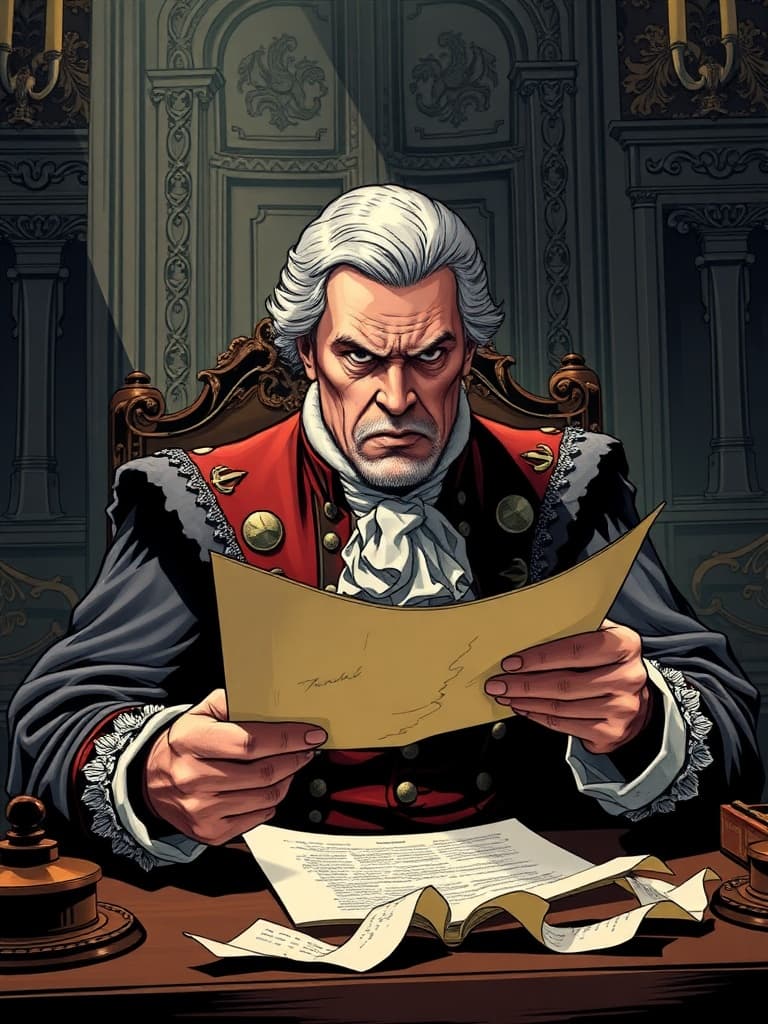
London in Shock — When George III Heard About Lexington (May 1775)
It took six weeks for the news of Lexington to cross the Atlantic. George III was furious. Parliament was divided. And on both sides of the ocean, the point of no return was approaching.
Six Weeks of Silence
In 1775 there was no internet, no telegraph, no cable. The fastest way to cross the Atlantic was by sailing ship, and even with favorable winds it took six weeks. The shots fired at Lexington on April 19 did not reach London until late May or early June.
During those six weeks, London carried on as usual. Parliament assumed the colonial unrest would blow over. George III believed that a firm hand and a reduced tea tax had already solved the problem. Meanwhile, Fort Ticonderoga fell, Crown Point was captured, and fifteen thousand militia surrounded Boston — but London knew none of it. The empire was governing by guesswork, always six weeks behind reality.
The King's Fury
When the news finally arrived, George III's reaction was immediate and unambiguous: rage. He branded the colonists rebels and traitors, and he was certain that military force was the only appropriate response. Prime Minister Lord North agreed. In their view, concession was weakness, and allowing one colony to defy the Crown would invite the entire empire to unravel.
But outside the palace, the reaction was far from unanimous.
The Voices That Warned
Within Parliament, significant opposition to war existed. Edmund Burke argued passionately for reconciliation. His reasoning was practical rather than sentimental: fighting a war three thousand miles across the ocean would be ruinously expensive, and even victory would leave Britain ruling over ashes.
William Pitt, the celebrated war hero, issued a similar warning. The colonists were not demanding independence, he insisted — they were demanding the rights of Englishmen. Negotiate now and the empire could be preserved. Send troops and it would be lost forever. These warnings fell on deaf ears. The majority in Parliament backed the King.
Gage's Letter and the Numbers
General Gage's dispatch arrived from Boston requesting 20,000 reinforcements. He had only 6,500 men, and the militia encircling the city outnumbered him more than two to one. London was shaken. If a veteran commander like Gage was asking for 20,000 troops, the colonial "disturbance" was no minor riot.
But raising, training, and shipping 20,000 soldiers across the Atlantic would take months. While London debated logistics, Crown Point fell to the Americans on May 12. Every week of delay strengthened the colonial position and weakened the British one.
The Point of No Return
In Philadelphia, the Continental Congress began asserting formal control over the militia forces. A commander-in-chief had not yet been named, but everyone understood that George Washington of Virginia was the most likely choice. Appointing a southerner would send a crucial signal: this was not a New England rebellion. It was a continental one.
Both sides were now crossing the point of no return. London decided to send an army. Philadelphia decided to build one. The window for diplomacy was closing fast, and the Atlantic — still six weeks wide — ensured that neither side fully understood what the other was doing until it was too late to stop.
Two governments on opposite sides of an ocean, each convinced the other had left them no choice. That is how wars become inevitable.
Get new posts by email ✉️
We'll notify you when new posts are published