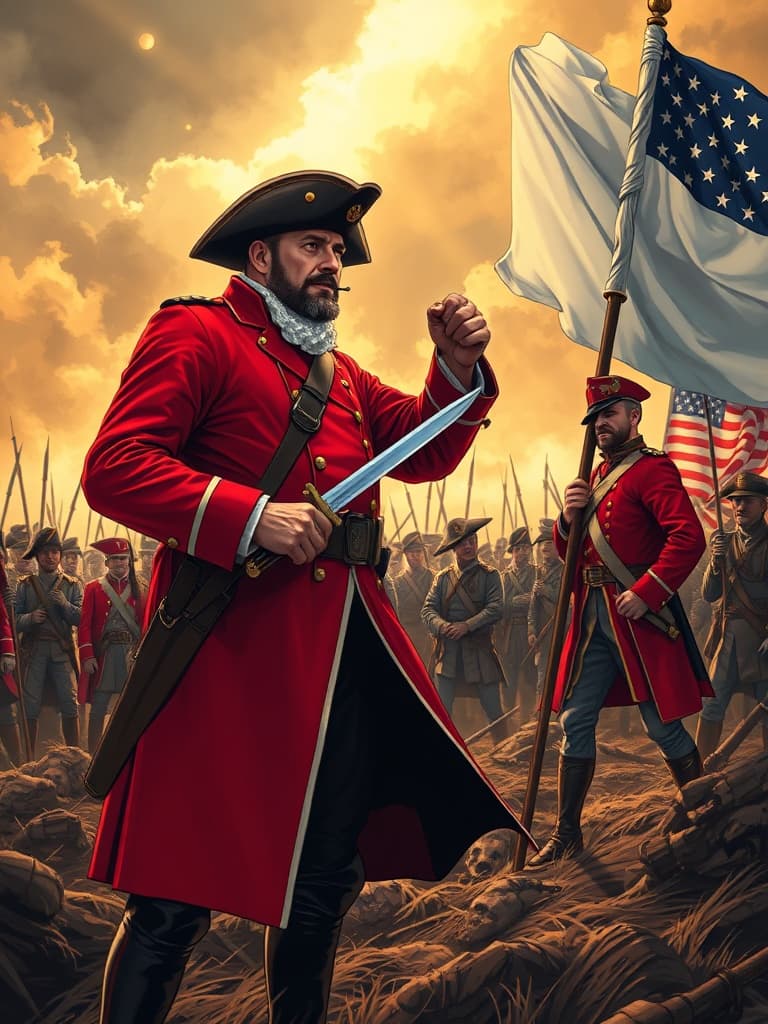
The Perfect Plan, Except for One Thing — The Battle of Saratoga
In 1777, the British devised an ambitious plan to split the American colonies in half. It was a brilliant strategy on paper — but on the ground, everything fell apart at Saratoga.
The British plan for 1777 looked excellent on a map in London. Three armies would converge on Albany, New York, cutting New England off from the rest of the colonies. General John Burgoyne would march south from Canada through the Hudson Valley. A second force under Colonel Barry St. Leger would push east from Lake Ontario. And General William Howe would send troops north from New York City.
Split the colonies, isolate the rebellious New Englanders, and crush them. Simple, decisive, and perfectly logical.
There was just one problem: nobody told Howe.
Burgoyne Marches Alone
General Howe had his own plans. Instead of sending troops north to meet Burgoyne, he loaded his army onto ships and sailed south to capture Philadelphia, the American capital. He figured taking the enemy capital would end the war. It did not.
That left Burgoyne marching south through the wilderness of upstate New York with roughly 8,000 troops, expecting reinforcements that were never coming. St. Leger's smaller force was turned back after a failed siege at Fort Stanwix, so Burgoyne was truly on his own.
The terrain was brutal. Dense forests, swamps, and rivers slowed the advance to a crawl. Burgoyne's army traveled with enormous baggage trains — he reportedly brought 30 carts of personal luggage, including champagne and a silver dining set. Meanwhile, American forces felled trees across every road, destroyed bridges, and diverted streams to flood the route.
The Battles
By September 1777, Burgoyne's army had been whittled down to about 6,000 effective troops. He was running low on supplies, and American forces under General Horatio Gates had taken up a strong defensive position near Saratoga, New York.
Two major engagements followed. At Freeman's Farm on September 19, Burgoyne attacked and technically held the field, but lost 600 men he could not replace. The Americans lost about 300.
For three weeks, Burgoyne waited for help that never arrived. His supplies dwindled. Desertion increased. On October 7, he tried again at Bemis Heights. This time the Americans counterattacked fiercely, led on the field by Benedict Arnold — who had been relieved of command by Gates but charged into battle anyway. Arnold was wounded in the leg but helped shatter the British line.
Burgoyne pulled back. Then pulled back again. Within days, he was surrounded by an American force that had swelled to over 15,000 men.
The Surrender
On October 17, 1777, Burgoyne surrendered his entire army — approximately 5,700 soldiers. It was the largest surrender of British troops in the war to that point and one of the most humiliating defeats in British military history.
The captured army marched out and laid down their weapons while, according to tradition, a British band played "The World Turned Upside Down."
France Changes Everything
Saratoga's greatest impact happened not in New York but in Paris. The French had been quietly supplying the Americans with money, weapons, and gunpowder, but they had refused to openly enter the war. They needed proof that the Americans could actually win.
Saratoga was that proof. Within months of learning about Burgoyne's surrender, France signed a formal alliance with the United States in February 1778. They committed their army, their navy, and their treasury to the American cause.
It was the French navy that would eventually trap the British at Yorktown. It was French money that kept Washington's army fed and clothed. The road from Saratoga to American independence ran straight through Versailles.
Get new posts by email ✉️
We'll notify you when new posts are published