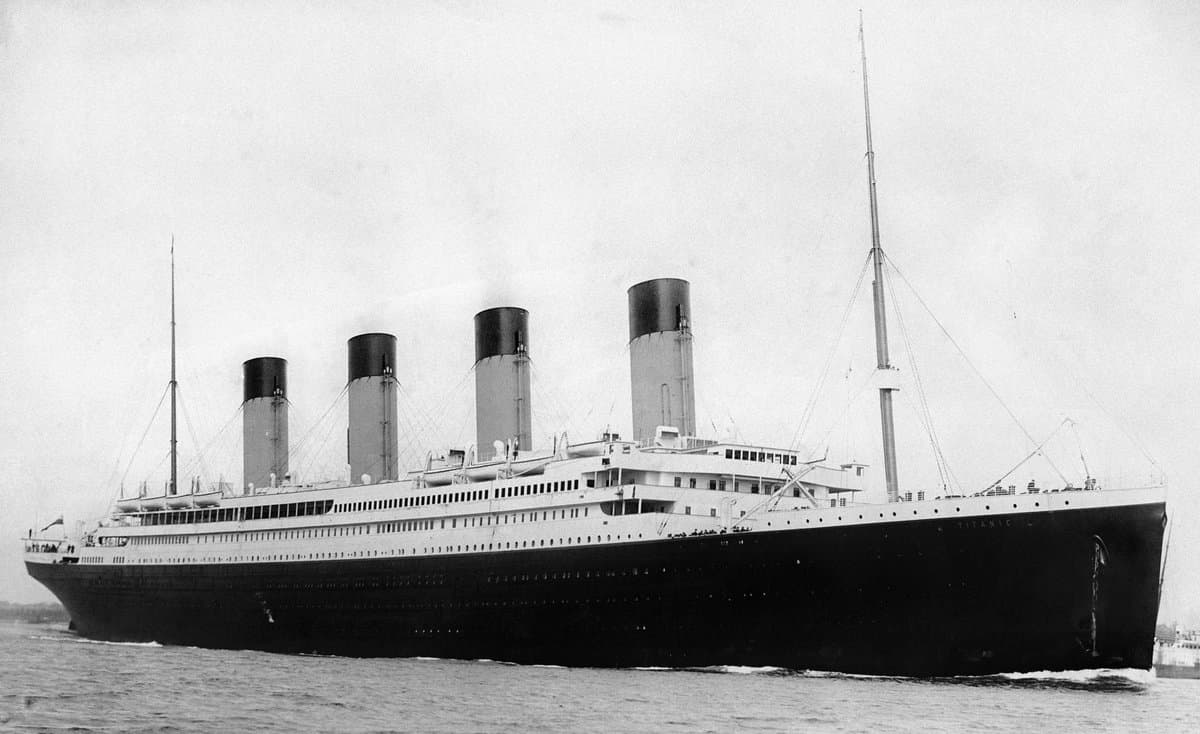
The Unsinkable Ship — April 15, 1912: The Night the Titanic Went Down
On April 15, 1912, the RMS Titanic sank in the North Atlantic after striking an iceberg on her maiden voyage. Of the roughly 2,200 people aboard, about 1,500 died — a disaster born of hubris, insufficient lifeboats, and the invisible walls of class.
"Not Even God Could Sink This Ship"
On April 10, 1912, the largest man-made object in the world left Southampton, England, on its maiden voyage. RMS Titanic — 882 feet long, 175 feet tall, and marketed by the White Star Line as "practically unsinkable."
In first class sat John Jacob Astor IV, America's richest man, and Isidor and Ida Straus, co-owners of Macy's department store. In third class, over 700 immigrants from Ireland, Sweden, and Italy dreamed of new lives in America.
Total souls aboard: approximately 2,200. Lifeboat capacity: 1,178.
April 14, 11:40 PM — Iceberg
Two days from New York. The Atlantic was glass-calm and moonless. Lookout Frederick Fleet scanned the darkness from the crow's nest — without binoculars, which had not been issued that voyage.
At 11:40 p.m., Fleet rang the warning bell three times:
"Iceberg, right ahead!"
Thirty-seven seconds later, the Titanic's starboard hull brushed against the iceberg. The impact was undramatic — most passengers didn't even wake up. A slight shudder, then silence as the engines stopped.
But below the waterline, the hull had been breached along roughly 300 feet. Five of sixteen watertight compartments began flooding. The ship was designed to survive four breached compartments — not five.
Naval architect Thomas Andrews finished his calculations and told the captain quietly:
"She will founder. It is a mathematical certainty. You have an hour, perhaps two."
The Lifeboats — Where Class Decided Who Lived
After midnight, lifeboats began lowering. The problems cascaded.
There were only half enough lifeboats. Twenty boats for 2,200 people — capacity 1,178. The original design called for 48, but they were reduced because they "cluttered the deck."
Early boats launched half-empty. Passengers refused to board, convinced the ship could not possibly sink. Lifeboat No. 1, designed for 65, left with just 12 people.
And then there was class.
| Class | Aboard | Survived | Rate |
|---|---|---|---|
| 1st Class | 329 | 199 | 60% |
| 2nd Class | 285 | 119 | 42% |
| 3rd Class | 710 | 174 | 25% |
| Crew | 899 | 214 | 24% |
Third-class passengers died at a rate of 75%. Reaching the boat deck from steerage required navigating a labyrinth of corridors — some of which were locked.
The People of That Night
Isidor and Ida Straus. When offered a seat on a lifeboat, Ida refused. "I have lived with my husband for all these years. I am not leaving him now." They sat together on deck chairs and waited for the end.
The band. Wallace Hartley's eight-piece orchestra played on the tilting deck until the very end, trying to keep the passengers calm. All eight musicians died.
Thomas Andrews. The ship's designer. He spent his final hours handing out life jackets and helping passengers into lifeboats — knowing the ship he had built was killing the people he was trying to save. He went down with the Titanic.
2:20 AM — The Titanic Sinks
Around 2:00 a.m., the bow plunged completely underwater and the stern rose into the sky. With a deafening roar, the ship broke in two. At 2:20 a.m., the Titanic vanished beneath the Atlantic.
Water temperature: 28°F (−2°C). Those without lifeboats died of hypothermia within 15 to 30 minutes.
The rescue ship Carpathia arrived at 4:10 a.m. — one hour and fifty minutes after the sinking. Almost no one pulled from the water was still alive.
Final death toll: approximately 1,500. Survivors: 710.
What the Titanic Changed
The disaster reshaped maritime law worldwide:
- SOLAS (International Convention for the Safety of Life at Sea) — mandated lifeboat capacity for every person aboard
- International Ice Patrol — 24-hour Atlantic iceberg tracking, still operating today
- 24-hour radio watch — the nearest ship, SS Californian, never received Titanic's distress calls because its radio operator had gone to sleep
- Mandatory lifeboat drills
The Titanic proved, at the cost of 1,500 lives, how dangerous human certainty can be.
Date: April 15, 1912 | Location: North Atlantic, 600 km south of Newfoundland | Deaths: ~1,500 | Survivors: ~710
Get new posts by email ✉️
We'll notify you when new posts are published