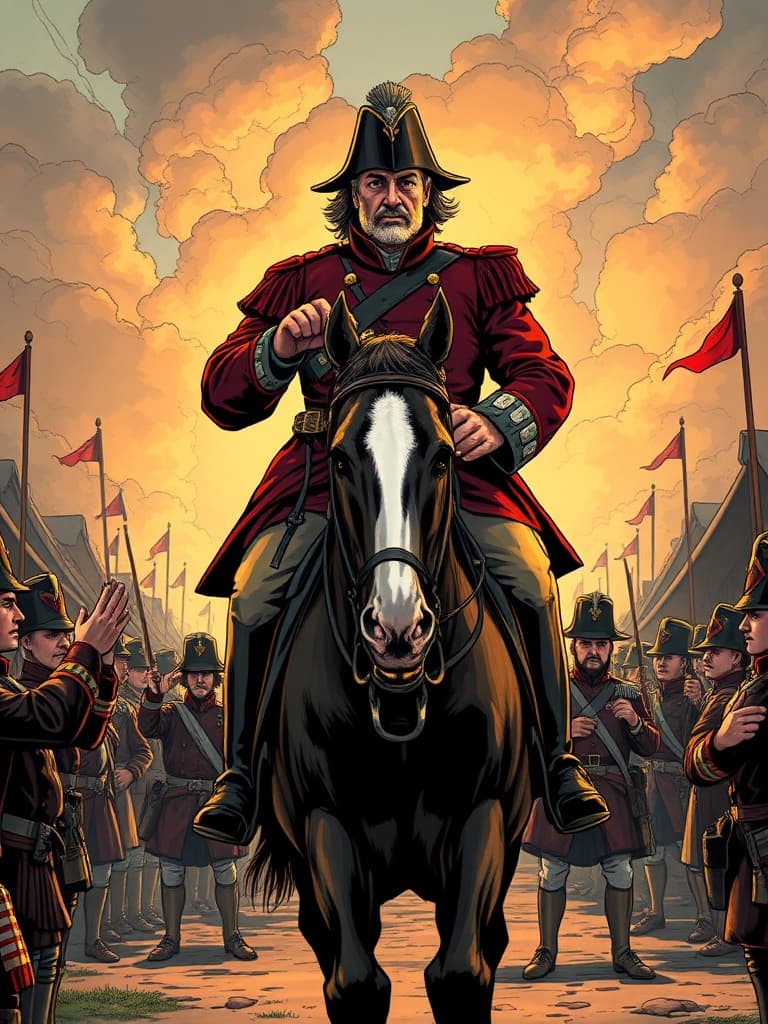
Is There Even an Army Here? — Washington Arrives at Boston (July 1775)
On July 3, 1775, George Washington arrived in Cambridge to take command of the Continental Army. What he found was not an army — it was chaos.
The Commander Arrives
On July 3, 1775, George Washington rode into Cambridge, Massachusetts. The Continental Congress had appointed him commander-in-chief of the Continental Army about two weeks earlier. He had traveled from Philadelphia on horseback, receiving cheers and celebrations along the way. He was expecting to find an army waiting for him.
What he found was something else entirely.
There were no uniforms. Officers were playing cards with enlisted men. Sentries were asleep at their posts. Some soldiers did not even have muskets. The entire camp had only enough gunpowder for about nine rounds per man. The trenches were in disrepair, and there were no latrines anywhere — the stench was overwhelming.
Washington wrote in a letter shortly after arriving: "I hardly know if there is anything here that can be called an army."
Imposing Order on Chaos
Washington did not waste time complaining. From his first week, he began transforming what he had found into something that could at least resemble a fighting force.
He established clear hierarchy between officers and enlisted men. Card games between ranks were banned. Sentries who fell asleep faced punishment. He ordered the trenches repaired and defensive lines restructured. He conducted a thorough count of every man in every unit and created training schedules.
But the biggest problem was one he could not fix with discipline alone. Most of the soldiers' enlistments were set to expire at the end of the year. Come December, this fragile collection of militiamen would legally dissolve. Washington faced the very real possibility of losing his entire army before he had even fought a major battle with it.
King George Slams the Door
Across the Atlantic, events were moving in a direction that would change everything.
The Continental Congress had sent the Olive Branch Petition to London — a carefully worded appeal to King George III. "We are still your loyal subjects," it essentially said. "Let us resolve this peacefully." It was the last serious attempt at reconciliation.
George III refused to even read it. In August 1775, he officially declared the colonies to be in a state of rebellion. Then he went further. He hired Hessian mercenaries from German principalities to send across the ocean and crush the uprising. The king was willing to use foreign soldiers against his own subjects.
The Road Back Narrows
When news of the king's response reached America, the mood shifted. Most colonists still were not calling for independence, but the hope that an appeal to the king would fix things shattered completely. The options were narrowing.
In Cambridge, Washington was struggling to hold together a disintegrating force. In London, George III was refusing to even listen. In the summer of 1775, the war had barely started, and yet the window for peace was already closing. Time was running out for anyone who still believed this could end without a complete break.
No one knew it yet, but in just a few months, a British immigrant who had been in America barely over a year would publish a 47-page pamphlet that would change the entire conversation forever.
Get new posts by email ✉️
We'll notify you when new posts are published