The Day Britain Surrendered — The Battle of Yorktown
In October 1781, a combined American and French force trapped the British army at Yorktown, Virginia. The surrender that followed effectively ended the American Revolution.
By the summer of 1781, the American Revolution had dragged on for six years. Both sides were exhausted. Washington's army was perpetually short of everything — money, food, clothing, ammunition. The British controlled New York and had a strong force in the South under General Charles Cornwallis. Neither side seemed capable of delivering a knockout blow.
Then Cornwallis made a decision that changed everything. He moved his army to Yorktown, Virginia, a small tobacco port on the York River near the Chesapeake Bay. He was told to establish a naval base there. It seemed like a reasonable order at the time.
The Trap Closes
Washington had been planning to attack New York. But when he learned that a large French fleet under Admiral de Grasse was sailing for the Chesapeake — not New York — he changed plans immediately. In one of the most audacious marches of the war, Washington and French General Rochambeau moved their combined armies nearly 500 miles south from New York to Virginia in a matter of weeks.
The timing was extraordinary. De Grasse's fleet arrived at the Chesapeake Bay in late August and defeated a British naval force sent to relieve Cornwallis at the Battle of the Capes on September 5. The French fleet now controlled the bay, cutting off Cornwallis from any escape or resupply by sea.
On land, Washington and Rochambeau's forces — about 17,000 American and French troops combined — surrounded Yorktown. Cornwallis had roughly 7,000 men. He was trapped.
The Siege
The siege of Yorktown followed classical European siege warfare, which the French engineers knew well. Trenches were dug in parallel lines, each one closer to the British defenses. Artillery was brought forward and began pounding the British positions day and night.
Two key British redoubts — small fortified positions — blocked the advance of the siege lines. On the night of October 14, American forces under Alexander Hamilton stormed Redoubt No. 10 while French troops took Redoubt No. 9. Both fell in under 30 minutes.
With the siege lines now closer, the bombardment intensified. British positions were being destroyed systematically. Cornwallis attempted a desperate escape across the York River on the night of October 16, but a sudden storm scattered his boats and forced the survivors back.
The Surrender
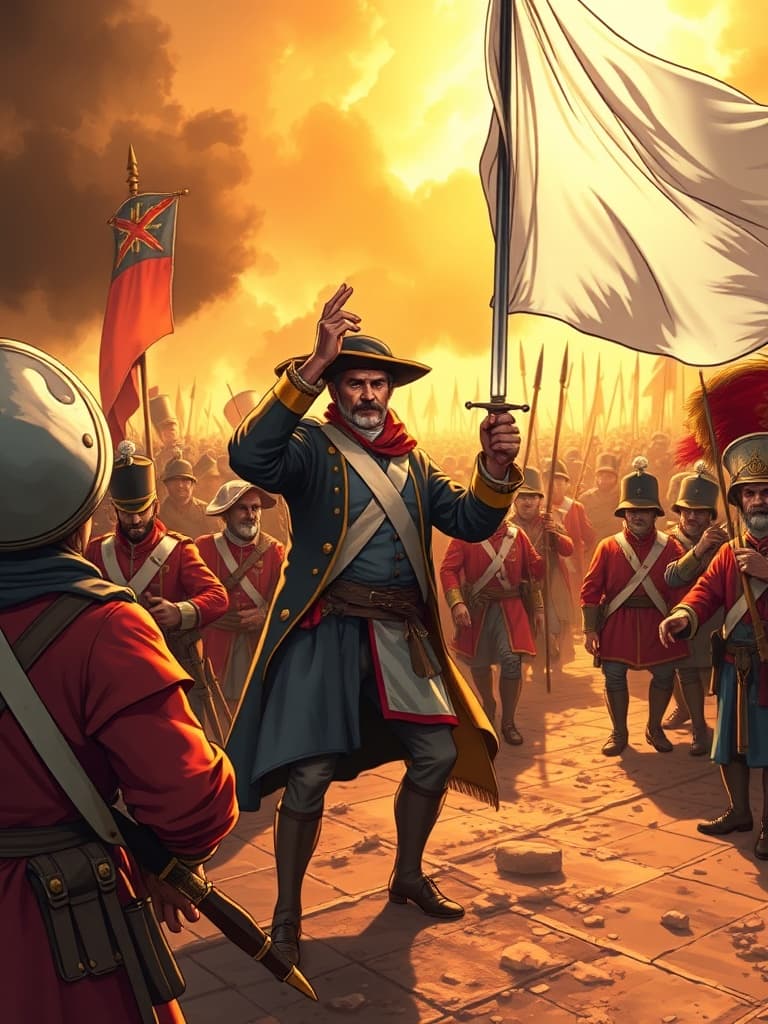
On the morning of October 17, 1781, a British drummer appeared on the parapet, followed by an officer waving a white handkerchief. Cornwallis was requesting terms.
On October 19, the formal surrender took place. Approximately 7,000 British soldiers marched out and laid down their arms between lines of American and French troops. Cornwallis himself did not attend, claiming illness, and sent his second-in-command instead. Washington, following protocol, then designated his own second-in-command, General Benjamin Lincoln, to receive the sword.
The Aftermath
When news of the surrender reached London, Prime Minister Lord North reportedly said, "Oh God, it is all over." He was right. While the war did not officially end for another two years, there was no appetite in Britain for continuing the fight.
The Treaty of Paris was signed on September 3, 1783. Britain recognized the independence of the United States and ceded all territory east of the Mississippi River. The thirteen colonies were now a sovereign nation.
And then Washington did something that stunned the world. On December 23, 1783, he appeared before Congress and resigned his commission as commander-in-chief. He gave back the power. King George III reportedly said that if Washington did that, he would be "the greatest man in the world."
In an age of military strongmen and lifetime dictators, a victorious general voluntarily returning to civilian life was almost unheard of. It set a precedent that has defined American democracy ever since.
Get new posts by email ✉️
We'll notify you when new posts are published